(This is an edited text of presentations given by Speak Out Socialists at recent meetings with other international groups)
Introduction
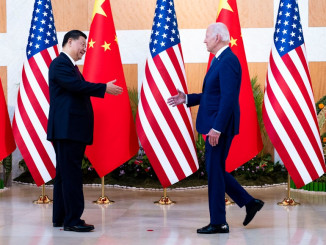
There are several different interpretations regarding the growing rivalry between the U.S. and China. Some say there is no significant rivalry because their economies are too interdependent. Others, wish to portray this rivalry as if WWIII has already begun. Still others might argue that this is not much of a rivalry because the U.S. is the only real imperial power.
These views may offer something to consider, but ultimately miss the mark. In reality, the U.S. and China are enmeshed in a full-blown economic rivalry that is escalating. Yes, they have interdependent economies, and it is in fact their mutual interdependence that acts, for now, as a major constraint on a direct military confrontation.
And with this interdependence comes mutual vulnerabilities, which the two countries are trying to get around by becoming more separate and dominant in key industries. Right now, the two are doing what is in their power to avoid a direct military conflict, even if their means of avoiding it may be actually bringing them closer to conflict at a later time.
The impact of this all out competition touches every part of the globe, as the two powers try to redivide the world according to their interests.
From Partners to Competitors
The U.S.-China rivalry matured at roughly the moment when the key technology sectors of the 21st century completed a transition from room for growth of all to zero sum growth.
The rivalry did not intensify because the countries suddenly became more hostile. Rather, the countries became more hostile because the economic logic of the markets changed underneath them, shrinking the opportunities for continued growth of both empires.
For over a decade from 1990s to 2008, the U.S. and China shared a symbiotic, mutually beneficial interdependence in which both economies grew simultaneously and the technology markets expanded fast enough that no one needed to fight over their share.
Then the economic crisis imposed some new limits on growth for both countries. And by 2014 or so, China and the U.S. emerged from the crisis as full blown competitors, and this has only intensified since.
One way to see this is in trade data: In 2000, China’s total trade was about $474 billion. In 2024 it was $6.2 trillion — a thirteenfold increase. U.S. total trade over the same period went from roughly $1.3 trillion to $5.3 trillion — a fourfold increase.
But China was not simply growing alongside the U.S. — growth of that size meant it was growing into many of the same markets the U.S. had historically dominated. And by the time new technology markets matured, and 2008 crisis faded, China was now dominant in new areas and the U.S. became the smaller challenger.
This is the basis of the rivalry: both countries are vying for supremacy.
An Interdependent Rivalry
Between the U.S. and China, there are too many economic interdependencies and rivalries to name. They range from supply chain shipping, chips, AI, energy, electric vehicles, to critical minerals, pharmaceuticals, military production, telecoms, banking, and even outer space. It is truly a mixture of hostile interdependence and symbiotic rivalry in nearly every major industry.
What’s often called a trade war is better understood as a strategic contest between two powers, each trying to limit the other’s access to the technology that will shape military and economic power for decades to come. Both sides are working to exploit chokepoints — points in the supply chain where control over one essential component gives an actor outsized leverage over the rest of the chain. The current dynamic is a race on two fronts: each side moves to use its own chokepoints for leverage before the other can build workarounds, while also working to route around its opponent’s chokepoints before they can be fully deployed. Every move invites a response. The pace is picking up, and the stakes are rising with it. At the center piece of all of this a nexus of AI-chips-Minerals-and Energy.
To concentrate on a few of these to paint a picture.
At the heart of the competition and interdependence: chips. chips — semiconductor integrated circuits — are like the nervous system of the modern economy. Nearly every part of the global economy cannot function without them. And the race for AI dominance absolutely depends on them.
Through the lens of Chip production and its uses, we can see almost in totality, the complete picture of what is an intricate and total interdependence and the various ways both countries are dead-set on trying to break out of this interdependence.
A U.S. Chokepoint
U.S. companies (Synopsys and Cadence) have a monopoly on the complex software used to make the designs for the chips.
The Dutch company, ASML — heavily controllable by the U.S. because it cannot build its machines without American laser components made by Cymer of San Diego — is the only manufacturer in the world of the extreme ultraviolet lithography machines required to fabricate the most advanced chips.
And Taiwan’s TSMC — politically and militarily aligned with the U.S. — is the only entity on Earth that can fabricate the most advanced chips at super high yields, a capacity built on thirty years of accumulated production knowledge that cannot be purchased or replicated quickly.
And, with the U.S. heavily integrated — technologically or politically — with these three (ASML, TSMC, and the U.S. software companies), together it forms a sort of cage: you cannot design around the Synopsys software without the chip being legally blocked from fabrication; you cannot fabricate without ASML’s lithography machines; you cannot achieve the yields that make advanced chips commercially viable without TSMC’s factory and experience. But at the same time, you can’t do any of that without China’s minerals.
China’s Chokepoints
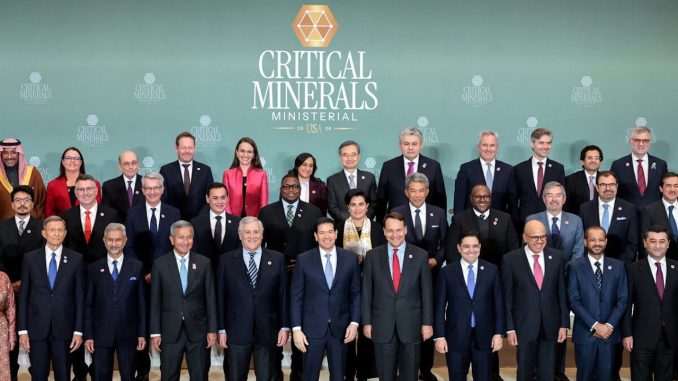
Chinese firms dominate (about 80%) of the global critical mineral extraction and processing which make up the main raw materials for advanced Chip production — and every industry that requires these minerals. It controls approximately 91% of rare earth element refining globally, 80% or more of battery-grade graphite, 73% of cobalt refining, and the majority of gallium and germanium production — all materials essential for semiconductors, defense systems, electric vehicles, and the energy transition.
To get even more technical. China’s mineral leverage is not primarily about the ability to mine the minerals. It is about controlling the petrochemical processing infrastructure required to convert raw ore into usable industrial inputs. Rare earth separation requires special chemicals made from petrochemicals, which China’s state-owned giants Sinopec and Sinochem produce at massive, subsidized scale.
The U.S. along with some Japanese and French chemical companies abandoned this processing in the 1980s and 1990s due to a combination of environmental costs and getting outproduced by Chinese companies backed by heavy state-subsidies, already in possession of Western companies’ chemical formulas from prior joint ventures.
By the time the U.S. recognized this as a vulnerability, China had built a global monopoly. In China, after the minerals are extracted nationally and globally, state oil companies produce the chemicals, state refineries process the minerals, state foundries use the outputs — all co-located, state-subsidized, and cost-controlled in ways that competitors just can’t match.
China has also increased its leverage by imposing export controls targeting not just the refined minerals but the chemical processing equipment and some handling materials that would be required to build non-Chinese mineral refineries, directly aimed at slowing down any attempts by the U.S. to build around China’s chokehold.
At the same time, while the U.S. focused its export controls on the most advanced chips — those most relevant to AI and advanced computing and advanced military equipment (like jet planes) — it left the market for older and larger chips less controlled.
And China poured capital into their domestic foundries, eventually partnering them with its domestic EV manufacturers, and by 2024 China had captured dominant global markets in the chips that power cars, medical devices, home appliances, industrial sensors, and large portions of defense supply chains.
The U.S. (and the rest of the world) now depends on China for the everyday chips that its weapons systems, vehicles, and infrastructure cannot function without — even while it successfully blocks China from the most advanced chips powering AI.
Mutual Vulnerabilities and Escalation
All of U.S. industry and military production — let alone the rest of the global economy — still depends on China for critical minerals, and these essential but less advanced chips.
And conversely, all of Chinese civilian and military industry depends on the U.S. giving permission for China to purchase advanced chips from the political triad of U.S. software, Dutch lithographic machine production, and Taiwanese high-yield fabrication.
These are mutual vulnerabilities.
And China and the U.S. as imperial competitors are working non-stop to remove these vulnerabilities — to use their chokepoints to put pressure on the other as they try to maneuver around the other’s chokepoint.
For example, beginning in 2022 and escalating since, the U.S. systematically imposed export controls to block Taiwan’s ASML from shipping any lithography machines to China. They blocked Chinese firms from accessing the chip design software, and any components (like the lasers) used in the fabrication equipment.
And then they used international trade laws that the U.S. basically created, to extend these blocks globally so that any chip designed with U.S. software or built on U.S.-originated equipment anywhere in the world is subject to U.S. export controls.
This means TSMC in Taiwan cannot legally manufacture chips for Chinese companies. The U.S. has locked China out of designing advanced chips, out of buying the machines to fabricate them, and out of having anyone else fabricate them on its behalf. They can only receive the chips via trade with the U.S., or via U.S.-approval.
Meanwhile, the U.S. is scrambling the earth to begin mineral extraction everywhere, including inside U.S. territory — yes, mineral mining is coming back to the U.S. after leaving for decades despite the severe ecological destruction it brings.
The Trump administration has pushed executive orders to achieve critical mineral independence from China for all military production by 2027 — likely a pipe dream, but it shows their aspirations.
There is even a multi-billion-dollar joint firm in the U.S., called KoBold, co founded by a mix of strange bedfellow tech billionaires, Sam Altman, Jeff Bezos, Bill Gates and Mark Zuckerberg. This firm uses AI technology to find areas with untapped minerals to extract. So far they have identified 70 exploration projects, and begun a massive copper extraction project in Zambia, which they say will somehow not rely on China for refinement.
Again we see the explicit priority to achieve mineral independence from China.
Trump’s global trade tariff chaos is actually designed as a countermove to China in this standoff. The ultimate goal is to rearrange the current global supply chain, in which countries trade freely with both the U.S. and China simultaneously — and instead force a choice: align your supply chains with the interests of U.S. imperialism or face expensive tariffs and access to the U.S. market.
The more a country refuses, the higher the tariffs. The more they comply the lower. It is through this tariff negotiation strategy that the U.S. was able to get Taiwan to invest in Chip building in the U.S. and to get Taiwan to agree to the tight controls on China’s efforts to get or build its own chips.
South Korea committed $150 billion in shipbuilding and technology investment, to counter China’s shipbuilding dominance. India lowered its tariffs through signing a mineral pact. The list goes on.
Despite Trump’s claims, these tariffs aren’t about increasing revenue for those who trade with the US. They are the mechanism for forcing countries that had been hedging between the US and China to pick a side.
Similarly, the foreign aid cuts to Africa and the Global South follow the same logic but with aid and finance rather than trade: first you cut the existing relationship, cut off funds, then create desperation, then offer restoration in exchange for mineral rights and supply chain alignment. Here we see some of the method inside Trump’s foreign aid chaos. In the first months of the Trump administration, they cancelled billions of dollars of aid to Africa. Now they have turned the prospect of getting some of that aid back into a blatant transactional negotiation with various countries.
The DRC signed a strategic minerals deal with the U.S. and then received $900 million in health aid and some security guarantees, and an agreement from the DRC to cancel their contracts with Chinese firms. Increasing access to critical rare earth minerals is now an explicit National Security issue of the U.S.
Similarly, the Trump administration’s obsession with Greenland fits into this same story, with some of the world’s largest untapped deposits of rare earth minerals. Greenland also controls Arctic shipping routes that would reduce shipping times between Asia, Europe, and North America while bypassing existing chokepoints. And the competition to dominate mining and shipping routes in the Arctic between the U.S. and China is at a breakneck speed.
In Latin America, to name just a few, the U.S. is advancing mining deals in Chile, Argentina, Bolivia, Venezuela since ousting Maduro and others.
In Brazil, the U.S. is trying to forge deals to push out or restrict China. Brazil holds the world’s second-largest rare earth reserves after China — about 23% of the global total — but produces less than 1% of global rare earth output, meaning it is almost completely underdeveloped. So Brazil too is caught between a tug of war with the U.S. and China, trying to play both sides.
A major part of the Trump regime’s prioritization of imperial dominance in the western hemisphere, is aimed at trying to reclaim dominance of the hemisphere’s mineral wealth (and energy).
China Is Pushing Back
In response, China is leveraging its monopoly on critical minerals and trying everything in its power to advance its AI technology to try to get around the U.S. stranglehold on the advanced chip market.
First, China has, too, weaponized its mineral monopoly by imposing its own export controls on several key minerals from 2023 to 2025 (gallium and germanium in 2023, antimony and tungsten in 2024, and seven heavy rare earth elements in late 2024 and early 2025). In December 2025, it barred companies affiliated with foreign militaries from receiving export licenses for rare earth materials at all — directly targeting U.S. defense supply chains.
It wasn’t a total block, because that would have been too risky. Instead, China imposes restrictions and then pulls some back in order to create uncertainty that makes planning and stockpiles difficult to maintain. This is designed at giving China negotiation leverage around the access to advanced chips.
At the same time, China is doing everything it can to accelerate its advanced chip design efforts in order to maneuver around the U.S. blockade.
Basically, China has shown that it may be able to fabricate advanced chips even without the latest and greatest technology — which depends on the U.S., Netherlands, and Taiwan — by using some of the older machines it already has but in more advanced ways. Part of their ability to do this stems from the use of AI software itself. The Chinese Academy of Sciences’ system its working to use AI computing to circumvent the U.S. software monopoly at a fraction of the cost (the design system is called QiMeng, meaning “enlightenment”). Like other efforts by the U.S. to counter move, China’s moves here are still aspirational, but it may only be a matter of time before China is able to perfect this ability and get around the U.S. chokehold.
This is part of the story of why the AI race isn’t just simply some economic bubble, but is a heavily state-integrated or subsidized national security issue, something much more akin to a nuclear arms race than just some new hot market.
Artificial Intelligence
Integral to advanced chips is the competition around artificial intelligence, which also exposes the details of this rivalry.
The competition in AI is like a new nuclear arms race, whoever achieves AI superiority brings advantages that apply to every other economic domain — from military to finance to production. Both countries are all in on the AI competition. The U.S. currently leads in AI capacity fueled by billions of dollars in what is a very risky level of economic investment, while China working tirelessly to close the gap at a fraction of U.S. costs and with less powerful (for now) chips.
It is very likely there will be big winners and big losers coming out of this. It is not that calling this an economic bubble is wrong. But that with this economic bubble, all the players are willing to bet it all because the stakes are too high.
At the same time, rapidly scaling up AI and advancing computing power requires more than just super chips. It also requires electricity in quantities that are straining power grids, and skyrocketing the global demand for energy.
Because of AI’s energy demands, now all forms of energy have a renewed importance and a growing, almost runaway, demand. This has created a renewed “race for what is left,” and pushed the U.S. to try to cut off access to China where it can — most notably from Venezuela and Iran.
Fossil fuel extraction has skyrocketed again, and this even includes revitalizing coal extraction in the U.S., and restarting closed nuclear plants.
Renewable energies are growing rapidly, but they don’t even cover the annual growing demand for electricity that has emerged from AI. And because of Chinese dominance in renewables, especially solar, the U.S. has practically abandoned any meaningful investments in renewables, and instead prioritized increasing fossil fuel and nuclear energy to power the growing demands of data centers, which advanced computing depends on.
And, according to the International Energy Agency (IEA), global electricity demand is expected to grow at least 4% per year. And power consumption by AI data centers is projected to grow by about 30% per year. This is shaping up to be a potential runaway level of energy demand, with fossil fuel sources still expected to make up over 60%.
Ecological Destruction
A consequence of all of this mining and increased electricity is an acceleration of ecological destruction.
Data centers don’t just skyrocket the power grid, they use up water for their cooling systems. More of the Earth is being torn apart for minerals, as record levels of CO2 continue to be dumped into the atmosphere. In fact, more than half of all cumulative CO2 emissions in human history have occurred since 1990, and the rate is accelerating, not declining.
In other words, the path of this growing imperialist rivalry is paved with growing levels of ecological destruction that threatens all of humanity.
The two largest economies on Earth are engaged in a total, integrated contest to control the changing structure of the global economy: computing, ship design, minerals, production, energy, finance. Dominating those industries means achieving global hegemony, with the ability to dictate the terms of global capitalism — the role
The U.S. and China are not just competing across many separate sectors, but are competing across one integrated economic system from many different angles, and both are fully aware of this competition and both are doing everything in their power to win.
Redivision of the World
Just from the question of mining and energy, we can connect this rivalry to many of the major conflicts of the day.
In the Middle East, the U.S., through its partner in Israel, is trying to reclaim its dominance in the Middle East, through any means, including genocide and all out war.
This redivision of the world includes a renewed scramble for Africa, especially for its minerals. It makes the war in Ukraine not just about Russian imperialism but about mineral extraction and energy routes.
At the same time, we are seeing a rapid change in modern warfare. Now with advanced computing, cheap drone warfare has changed the military advantages of traditional capital-intensive weaponry — as we saw with the asymmetry in the costs of U.S. weaponry versus Iranian drones.
It is clear: we haven’t seen the beginning of WWIII. But we have entered an era of an increasingly violent redivision of the world among the competing powers.
Conclusion
With all of this competition for world domination, the pathway to dominance must still cross over the backs of the working class of the world.
Access to the minerals in Bolivia by the U.S., has meant a general strike in Bolivia and a renewed militancy in the class struggle there.
In the DRC thousands of miners including children work in dangerous life-threatening conditions.
The Gen Z rebellions across Kenya, Bangladesh, Nigeria, Senegal, and dozens of other countries in 2024 and 2025 are connected to this rivalry as well. The economic uncertainty of young workers and young unemployed people is directly connected to the economic restructuring emanating from this imperialist rivalry.
Our future isn’t just one of wars, disasters, misery, and increased exploitation. It is also one of international mass resistance by the working class and youth to the misery imposed by this growing rivalry. We don’t need a crystal ball — the future is already in view: growing mass resistance by the international working class, opening the potential and necessity for revolution.