The small port town of Crockett, California, often called Sugartown, has this summer been the site of open class struggle.
This town of less than 4,000 has long been dominated by the California and Hawaii Sugar Refinery, or C&H Sugar. C&H is owned by one of the largest sugar producers in the world, American Sugar Refining (ASR), which is in turn controlled by two brothers, Alfonso and Jose Fanjul. Their net worth is an estimated $4 billion, they live near and are good friends with Trump, and they donate generously to both major U.S. political parties.
The Fanjuls and other executives at ASR and C&H, like all capitalists, get their wealth off the backs of their workers. So when they want to or need to increase their rate of profit, they do so by squeezing those workers. While some in the area may have once thought the company was a good employer because they built housing and financed social activities in the community, those practices changed in the 1980s. Since then workforce has been cut by more than half, from about 1,500 to 500 or fewer workers today. In 2009 the company refused to give health care and pension benefits to new workers. According to workers who have been there decades, working conditions have also deteriorated throughout. And this spring and summer, the company offered a new contract with 20% raises over 5 years (which wouldn’t even keep up with the cost of living), but also gets rid of health benefits for retirees, cuts sick leave from 10 days to 5, and eliminates seniority rights for overtime and other job assignments.
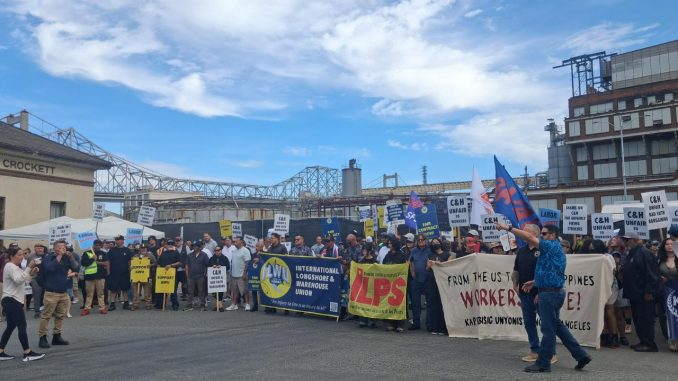
On June 15, 90 C&H workers, who are members of the International Longshore and Warehouse Union (ILWU) Local 6, went on strike after an impasse was declared because the company refused to negotiate. Soon after the strike started, ILWU Local 10, representing port workers who load and unload the sugar on and off boats, refused to work, respecting Local 6’s picket. The strike began to spread in a direct show of solidarity with their fellow workers in Local 6. But in mid-July, C&H hired scabs to unload cargo from a docked ship, and Local 10 took stronger steps. At that point Local 10 called on workers from the other ports where it has members, and they shut down the nearby ports of Oakland, Sacramento and Stockton. Some of those workers joined the picket that grew to 400. If they let scab workers unload cargo, their union and working-class power would be undermined. ILWU members and supporters picketed, blocking the entrances and exits of the facility, and that’s when C&H called on the Sheriff’s Department to stop the picketing. Tensions rose as picketers tried to stop scabs from coming and going, and two of the scabs drove their cars into the picket line, injuring several picketers and sending one to the hospital. It was then that the cops intervened, attacking and arresting not the scabs who threatened strikers or drove their cars through the picket lines, but 10 of the picketing strikers and supporters.
Last week the Crockett 10, as they’re now being called, faced a court appearance because of their arrests. When they and their supporters arrived at the courthouse, they found that they had not been formally charged but are being told that they can still be charged at any time within the next year, which is a threat to keep them from further activity. Of course the cops and the court system are doing just as C&H want them to, arresting workers and threatening them with legal action if they continue their actions.
This began as a tiny strike in a small town, tucked away in the industrial Bay Area, with a small group of workers against powerful capitalists with deep connections. To protect themselves, the workers had no choice but to fight! Meager wage increases, health care ripped away, and the choice of either work till you die or retire and hope you don’t have any medical needs!
The bosses tried to break the strike by getting other workers to scab. The workers chose to fight, and they have chosen to fight along class lines. And the class line has been drawn. If you attack this group of workers you attack us all! Not only did the C&H workers show their readiness to stand up against and strike the company, so did the workers of ILWU Local 10 who withheld their labor in support of their brothers and sisters. And now, after the attacks by the local sheriff’s department, other workers and community members are coming together to support the strikers. At the courthouse last week, more than 150 supporters showed up to stand with the strikers. These supporters included workers from other unions, the local community, and Filipino and socialist organizations and others.
Chants of “Drop the Charges” and “Defend the Crockett 10” were heard. Signs called out the role of cops as strikebreakers. Others connected the struggle of the Crockett 10 with the massacre of 19 sugar workers by the military on Negros Island in the Philippines this April, where C&H gets some of its sugar.
Although negotiations have resumed and workers are now back at work, they may be forced to go back on strike on September 30. If they do, this small and local strike could become a more heated conflict. But they won’t be alone.
One news outlet that covers business news from the perspective of the owners stated directly the potential power that workers have over the system: “The involvement of other ILWU locals, particularly Longshore Local 10’s refusal to cross picket lines, also highlights how a single plant dispute can ripple through the regional logistics network. In a supply chain already sensitive to port and terminal disruptions, the C&H strike underscored the strategic leverage warehouse and dock workers hold at critical nodes.” (our emphasis added)
They know that organized workers have the power to disrupt their production, their profits, and their entire system. We need to understand the same thing!
If the C&H workers head back to the picket line in late September, they need the support of all working people in their struggle against this company. We have all the power—if we organize ourselves to use it.
An Injury to One is an Injury to All