{This article is part of a “Special Report” published by the New Anticapitalist Party-Revolutionaries (NPA-R) in France (translated from French), published in Revolutionaries No. 66, Nov. 1, 2026}
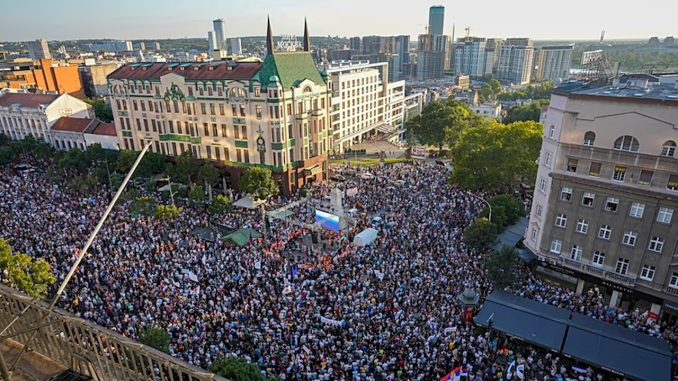
On the evening of Sunday, October 25, the streets of Belgrade were filled with scenes of jubilation, complete with car horns, singing, dancing, and smoke bombs. In Trg Slavija, the central square where the protests took place, tens of thousands of people celebrated the electoral defeat of former President Aleksandar Vučić.
Since late 2024, a massive protest movement has been rocking Serbia, sparked by the fatal collapse of the plaza in front of the Novi Sad train station. Characterized by massive demonstrations, but also by sustained forms of self-organization—particularly among students—the movement initially demanded Vučić’s resignation. On Sunday, October 25, Vučić suffered a crushing defeat: 39% and 103 seats, compared to 53% and 141 seats for the slate emerging from the student movement.
A “student list”… without students
Under pressure from the movement, Vučić had resigned this summer. It was a strategic retreat: he had himself proclaimed the head of the “United Serbia” list for the early parliamentary elections, turning the elections into a showdown between himself and the protest movement.
Opposing him, a “student slate” was formed. Its platform—an eleven-point “student plan”—includes the fight against corruption, freedom of the press, an increase in the education budget, a reduction in the maximum duration of precarious contracts, and the construction of public housing. This “student” list comprises 250 “experts” (including… no students) from various strata of the petty and middle bourgeoisie: academics, journalists, union organizers in intermediate professions, former athletes, and actors. Its lead candidate, Ilija Srdanović, is a former cardiologist and professor of medicine at the University of Novi Sad. Its “catch-all” nature has earned the list an equally diverse range of support, ranging from small social- democratic parties to the liberal democratic opposition, including community-based parties representing national minorities and… a faction of the Movement for the Restoration of the Kingdom of Serbia, which is as reactionary as its name suggests.
Before the election, with polls predicting a tight race, there were doubts about whether the election would proceed fairly. This isn’t Vučić’s first time at this, and electoral manipulation is commonplace in the country: pressure on public sector employees and civil servants, going so far as to require them to send a photo of their ballot; the presence of thugs with iron bars near polling stations; manipulation of the media, 90% of which is controlled by Vučić and his inner circle; and the common practice of “helicopter money,” bonuses of 50 euros paid to every adult citizen a few days before the election.
Elections: A Trap for Fools?
Young people are quite right to rejoice at having finally toppled the man who embodied corruption, precarious living conditions, and the erosion of democratic rights. The assemblies organizing the struggle at the university, the “plenums,” spread to certain working-class neighborhoods and sparked strikes, such as in the education sector. They reached a stage sufficiently advanced to be labeled “Bolshevik” by Vučić and to confront the repression of his thugs. The campaign unfolded amid the momentum of mobilization, with discussions in general assemblies, rallies, and massive demonstrations. But it also reflected illusions in parliamentary democracy, or the supposed “neutrality” of a technocratic government, and a lack of perspective after two years of relentless struggle.
Nevertheless, the students showed that it was possible to bring down a despised government. This should strengthen the many struggles in the region and across the entire continent, without limiting ourselves to governments, whether “left-wing” or “expert-led”!
D. R., October 26, 2026
All Articles from this Special Report
Youth and workers in struggle across Europe
Albania: After Nearly Six Months of the “Flamingo Revolution,” Gen Z Takes to the Streets Again
Elections in Serbia: Vučić Is Out—What Now?
Germany: Gen Z Against Militarism
Italy: “If you don’t let us dream, we won’t let you sleep!”
Movement for Housing, Wages, and Against Rearmament Policies in Spain
Greece — October 21 Should Mark the Beginning: Let’s Break the Election Wait Through Struggle!