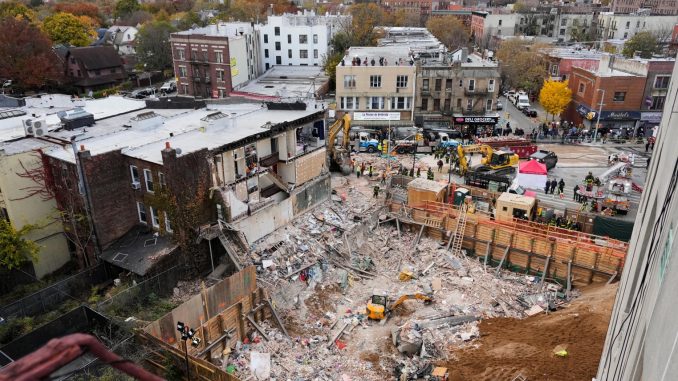
On November 11, an apartment building at 1321 Flatbush Avenue in Brooklyn, New York, completely collapsed into an adjoining excavated construction pit. Eight people were killed, including two children. 18 were injured and over a dozen households were displaced. The wall of the building next door was also torn off in the collapse, exposing apartments in the neighboring building to open air. Those tenants will now also have to relocate, as city officials say the entire building must now be demolished.
In the aftermath of this nightmare, a lot has been revealed about both neglect on the part of the landlord of the building that collapsed, and about the potentially hazardous shortcuts taken by the developers developing the lot next door.
1321 Flatbush: The Landlord
Despite tenants notifying the landlord of visible cracks in walls and the facade of the building, the landlord did nothing to address the issue. The issues with the building did not stop there: the 96-year-old apartment building had 98 open safety violations.
2625 Bedford: The Developers
Investigations of the construction project next door suggested that developers opted for a cheaper, less secure option for reinforcing the foundation of 1321 before they excavated. Instead of reinforcing the older building by pouring additional concrete under the existing building’s foundation, they used a method called “berming.” This is a system of concrete steps starting at the ground and then stepping up to support the existing building’s foundation. Review of the area by an engineer revealed that the soil around 1321 Flatbush was not ideal for this method, and that a concrete base and steel columns would be needed. No steel columns were used.
Additionally, the developers got approval from the city for a three-story building, but went forward with construction for a nine-story building. This means that there was not appropriate supervision and inspection on site for the project, which in turn could mean that any number of other shortcuts or breaches of safety might have occurred during the construction that were not caught or addressed in the appropriate way.
Flatbush, Brooklyn: The People
Flatbush is a low- to middle-income working-class neighborhood with a significant immigrant population. Much like the rest of New York City, it consists of a mix of buildings that are decades old and some more than a century old, and also newer, larger developments. Although no fault has been officially found, the collapse revealed the dangers of neglected properties and often rushed new developments. In tears, Ciahola Lawrence, a tenant in the building next door, recounted her fear when the building would shake from the construction. She also recalled how on the day of the collapse she was resting in a dark room before suddenly being woken up to find herself exposed to the light of day! She saw her neighbors be taken away on stretchers. Of the developers, she said “…They came to kill us.” As always, when profits are put before people, it’s working people who pay the price.
New regulations can and should be put in place. But the deadly dangers of a system that puts profit over people will persist until we collectively demand and fight for a new system.