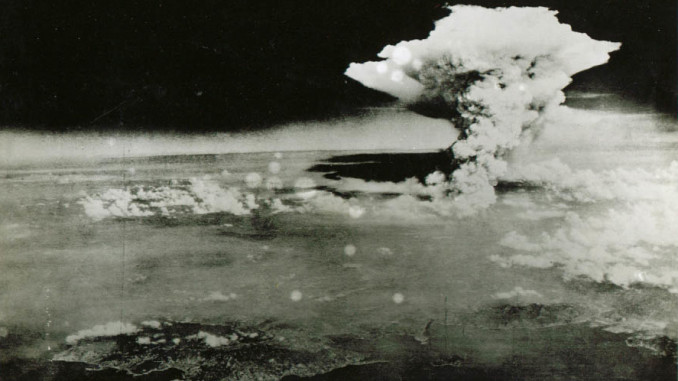
Eighty-one years ago, on August 6, 1945, the United States military dropped an atomic bomb on Hiroshima, Japan. Three days later, another bomb destroyed Nagasaki. In just a few days, over 100,000 civilians were killed. By the end of the year, several hundreds of thousands had died from the explosions, burns, and radiation. Many more suffered from illness, disability, and trauma for the rest of their lives. Those bombings are often justified by U.S. politicians as an inevitable step to end World War II. It was Democratic President Harry Truman who made the decision. But Japan was already facing military defeat and was seeking ways to end the war. In fact, this was a warning to the rest of the world of what the U.S. government is able and willing to do – sacrifice entire populations to achieve military and geopolitical objectives.
Today, there is more and more talk of a new nuclear war. Two of the nuclear powers, the U.S. and Israel, attacked Iran a few months ago based on the claim that Iran’s regime is trying to build nuclear weapons. But this is only after Trump tore up the existing agreement that was preventing that. Between Russia’s invasion of Ukraine and the wars initiated by the U.S. and Israeli governments, the world’s two largest nuclear powers have shown their commitment to use war to achieve their global interests.
Today, as we remember Hiroshima and Nagasaki, we have a responsibility not only to look back on the tragedy of the past but also to recognize the danger that continues.
The United States, Russia, China, and other nuclear powers continue to expand and modernize their arsenals. Arms control agreements have been weakened, and competition among rival powers is becoming increasingly dangerous. Around the world, governments continue to invest enormous resources in preparing for future wars, making the possibility of a nuclear catastrophe very real.
Worse still, we are often told that, in countries like the United States, government policy reflects the will of the people. But ordinary people have virtually no say in nuclear policy. Decisions about building, modernizing, and threatening to use these weapons are made by politicians and military leaders representing the ruling class, and not by the hundreds of millions of working-class people whose lives would be at risk in another nuclear war.
Ordinary working people around the world have the most to lose in another war, yet they have no say in decisions that could kill billions. As in Hiroshima and Nagasaki, everyday people will pay the price.
The anniversary of the nuclear bombing of Hiroshima is more than just a day of remembrance. It is a reminder that the future of humanity cannot be left in the hands of ruling classes willing to gamble away millions of lives in pursuit of power, profit, and imperialist advantage. Preventing more Hiroshimas and Nagasakis means building a movement capable of challenging the drive toward war itself and, ultimately, creating a world where human lives matter more than the interests of those who profit from conflict.