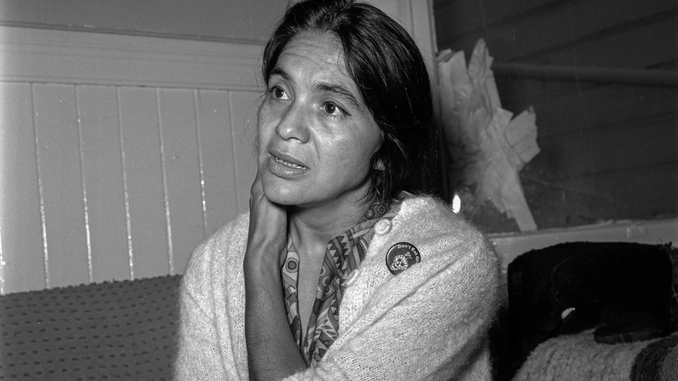
On Wednesday, October 28, Dolores Huerta died at age 96. Since her early 20s and into her final years, Huerta was an activist and organizer, giving all of herself to help working-class people build confidence in themselves and their potential power.
Born in Depression-era New Mexico to working-class Chicano parents, Huerta saw from an early age the struggles of miners and agricultural workers. After the family moved to Stockton, California, she saw more examples of agricultural workers – both Chicano and Philippine – being exploited by their bosses and controlled by racist laws and officials. Realizing things needed to change, she became an organizer in the mid-1950s, working with a community organization to organize for workers’ rights, and soon becoming a lobbyist working on labor and Chicano issues in Sacramento, California.
In the 1960s, she recognized the need to do more and threw herself into the work of organizing farmworkers directly. She understood that to make political change, workers would have to get organized and build their own power. She helped accomplish this goal in the 1960s as she collaborated with Cesar Chavez to build the National Farm Workers Association, which in 1965 would become the United Farm Workers, or UFW. Beginning in 1965, these unions and tens of thousands of Chicano and Filipino agricultural workers in the San Joaquin valley of California built their power through a five-year struggle against big grape growers. They conducted a years’ long strike and extended boycott of the companies involved. Despite racist repression which included hundreds of arrests and in some cases severe beatings, in 1970 they won the strike. Huerta was one of the lead negotiators of a first-ever contract for agricultural workers that included increased wages, rules to protect workers from pesticides, a health fund, and partial union control over the hiring process. The victory was a solid demonstration that even the most oppressed and most vulnerable workers could take on powerful companies and win if they were organized and willing to use their power. The organizing done by Huerta and many other women in the movement was a key reason for its success.
She and many other working-class women, workers, people of color, students, anti-war protesters, and environmental and health advocates were part of a much larger confluence of movements in the 1960s that helped bring about concrete changes to U.S. society and the lives of working people. Huerta was willing to work together with members of many of these movements in order build the power of the larger working class. This was another part of the reason for the successes of the United Farm Workers and the Chicano movement in this period.
In the following decades, Huerta continued her role in the UFW and continued to push for change through both direct union action and state and federal legislation to improve workers’ lives. She remained active in a variety of labor and social movements, particularly in the movements for women’s rights and environmental protection, while mentoring many young activists who followed in her footsteps.
Although she never embraced a revolutionary perspective and was constrained by the limitations of working for change within the Democratic Party (which the UFW and most other unions remain aligned with), Huerta is nonetheless an inspirational figure.
Early in her life she recognized clearly that things needed to change. She also recognized that change would only come through the hard work of organizing and building working-class power. As she talked to people and they expressed cynicism or said, “no, we can’t do this,” she responded exactly the opposite: “Si, se puede!” or “yes, we can!” She had a deep confidence in the working-class.
This recognition that working-class people can organize and make real change gave her a basic truth on which she could build. With that obvious truth in mind, she then dedicated her life to the cause of working-class people, and made endless sacrifices to help build our forces.
Today we remember Dolores Huerta, a tireless and lifelong fighter for the working class.