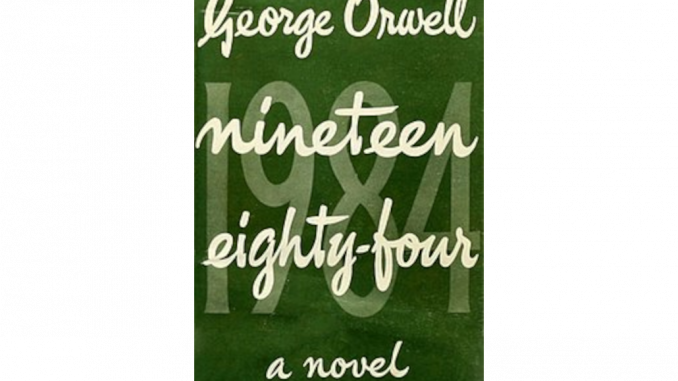
On June 8, 1949, George Orwell’s novel 1984 was published in the United Kingdom. The entertaining and at the same time horrifying work of fiction has since become a standard work on the long list of so-called dystopian novels that are read by high school students and cited by people who worry about the potential tyranny of various governments. When looked at from the perspective of our world today in 2026, it is very possible that his fictional world is closer to reality than ever.
1984 is about the tyrannical society of Oceania, which claims to be socialist, in a larger world of seemingly endless war and conflict. It is governed by Big Brother and his party, and they rule over the working mass of the population, or “the proles.” The “thought police” enforce a “newspeak” language mandated by the Ministry of Truth. The Ministry of Truth in fact says the exact opposite of the truth. Instead, it literally rewrites history, newspapers and maps, editing or deleting facts or even evidence of facts, and replacing those with what the Ministry wants people to believe. For example, the Party would say that Oceania was at war with Eastasia and in alliance with Eurasia (or vice versa), and had always been so, even though the opposite was actually the case. Throughout the novel, Big Brother and Oceania’s thought police are constantly monitoring the main character and the rest of the population, forcing them to accept this upside-down world of untruth. The slogan of the party in charge is, “Freedom is Slavery. War is Peace. Ignorance is Strength.” Acceptance of the lie that “2 + 2 = 5” becomes the primary test of whether one gets to live without torment in this dystopian world.
The book is often used as a sort of proof of what happens in a supposedly socialist or communist society and is often taken as a direct condemnation of the Soviet Union under Joseph Stalin. Many right-wing as well as liberal politicians and commentators cite it as why we should never allow socialism or communism to make a comeback. They use it to claim that whenever a state gains too much power, we can expect tyranny like that in Oceania.
There is some truth to this interpretation of the book. Orwell had seen the authoritarian and anti-human side of the Soviet Union after it degenerated into a bureaucratic authoritarian state in the early and mid-1920s. He watched as the Stalinist bureaucracy purged and murdered most of the leaders of the 1917 workers’ revolution in Russia and degenerated into a cult around Stalin. He was indeed critiquing authoritarian states like the Soviet Union of the time, and he was using the Soviet Union as a model for his novel.
Despite these obvious and intentional similarities and parallels, there are two major problems that make it difficult to honestly accept this interpretation. The first is Orwell’s actual views on the nature of capitalist society and tyrannical states. The second are the very real parallels between capitalist societies and the dystopian world he created in 1984.
Orwell himself was always, from a young age until his death, disgusted by the inequality, conflict, suffering, exploitation, warfare and other violence of capitalist society. In a 1946 essay entitled, Why I Write, he wrote that “Every line of serious work that I have written since 1936 has been written, directly or indirectly, against totalitarianism and for democratic socialism, as I understand it… My starting point is always a feeling of partisanship. A sense of injustice.” These are not the words of a capitalist or a right-wing nationalist. They are the words of a person who hates tyranny and suffering, whether brought by fascism that grows out of capitalist society or whether carried out in the name of a so-called socialism.
His clear understanding of what capitalism did and why he could not accept it came through clearly in a review he wrote in 1944. The review was of The Road to Serfdom, a book by the bourgeois economic propagandist Friedrich Hayek that is often held up by right-wing and liberal capitalist politicians as a sort of prophetic bible against the supposed tyranny of socialism. Orwell wrote that “a return to ‘free’ competition means for the great mass of people a tyranny probably worse, because more irresponsible, than that of the State. The trouble with competitions is that somebody wins them. Professor Hayek denies that free capitalism necessarily leads to monopoly, but in practice that is where it has led…” He continued on to say that, “Capitalism leads to dole queues, the scramble for markets, and war… There is no way out of this unless a planned economy can somehow be combined with the freedom of the intellect…”
And in 1949, only one year before he died, he stated clearly while in the United States, “My novel 1984 is not intended as an attack on socialism.”
Orwell, despite not being a member of a socialist party or considering himself a Marxist, had a sharp and long-lived hatred of capitalism, and had at least great sympathy for the ideas of socialism and the hope those ideas offered the world.
The second reason we shouldn’t accept this right-wing, capitalist interpretation of 1984 is that there are no socialist or communist societies anywhere on earth oppressing their people as Orwell described. We do see totalitarian tendencies but, whatever they call themselves, they are in capitalist states today.
Prior to the fall of the Soviet Union in 1991, it was at least possible to see that there was one workers’ state on Earth, even though it had not been democratic since its early days. But the Stalinist dictatorship that evolved there did have many real characteristics on which Orwell based 1984. Once the Soviet Union fell and once it became obvious that China was in reality a capitalist society and an imperialist power (albeit one with massive state direction of the economy and society), the dominant propagandists on the state level have all been completely capitalist. Sometimes that meant propaganda funded directly by capitalist states themselves, sometimes manufactured by capitalist-owned media monopolies, sometimes theorized by highly educated intellectuals who bought into and promoted the ideas of the ruling classes of their nations, or some combination of all those. But capitalist propaganda became the dominant, all-consuming ideology that bombarded the world day and night. This has been as true of so-called Communist China as it has been of the U.S.
These propagandists have included historians, teachers at all levels of schooling, both mainstream and right-wing politicians, and many journalists and intellectual commentators who have glorified and defended the status quo of capitalist society. This has been the case throughout U.S. history, particularly during and after the Cold War era. This type of propaganda became the norm in most societies throughout the world, and this is still the case to this day. In fact, the capitalist propaganda machine and its extreme right-wing variants may be bringing us closer to Orwell’s 1984 than ever before.
Today, reactionary right-wing propagandists in the United States and other nations are attempting to ban books simply because they contain LGBTQ+ themes or characters, or because they highlight racism, or because they accurately describe history. Despite video evidence directly contradicting him, after his supporters violently attacked the U.S. Capitol on January 6, 2021, Donald Trump said, “They were peaceful people… the love in the air, I’ve never seen anything like it.” Fox news propagandists like Tucker Carlson, despite the visible facts that the attackers were right-wing reactionaries, declared on Fox News that “FBI operatives were organizing the attack on the capital.” Political operatives at media companies like Sinclair write deceitful and deceptive scripts that hundreds of their so-called reporters then read aloud word for word to their audiences. And in a stunningly direct example of Orwellian propaganda, Israeli Prime Minister Benjamin Netanyahu said in a 2024 speech at the United Nations: “Here’s the truth. Israel seeks peace. Israel yearns for peace.”
Despite his brilliant creativity, Orwell was long gone and didn’t make this up. And this is all happening in a fully capitalist world, no socialist influence in any state to be found.
But Orwell did recognize the need for authoritarian states to lie in order to justify their existence and their actions. In 1946, he wrote: “The organized lying practiced by totalitarian states is not, as is sometimes claimed, a temporary expedient… Totalitarianism demands, in fact, the continuous alteration of the past, and in the long run, probably demands a disbelief in the very existence of objective truth… From a totalitarian point of view, history is something to be created, rather than learned.” The very fact that so many governments and corporations today behave so similarly to Orwell’s descriptions in 1984 shows how close he came to the truth.
And in a world being shaped more and more by giant tech companies that are operating on a global scale to suck up and monopolize all information and knowledge for their profit, it is becoming easier for the capitalist ruling class to shape and dominate us. They are developing the technologies that can monitor us, identify us, track us, and control us, just as the “thought police” used the technologies of Orwell’s day to monitor and control the “proles” of his 1984. In this period of what scholar Shoshana Zuboff calls The Age of Surveillance Capitalism, we are becoming enveloped and maybe even trapped in a world that we don’t fully want. And today’s tech capitalists, driven by pursuit of profit and childlike satisfaction of their own egos, are developing and amassing the technological capacity to truly monitor every aspect of life in ways that previous totalitarian states and rulers such as Joseph Stalin and Adolph Hitler could have only dreamed of. Under capitalism, the full horror of Orwell’s vision may be coming true.
Orwell’s 1984 is in many ways a horrifying vision of the future. Unfortunately, much of the book can make us believe that it is impossible to change things, and that we can’t defeat the powers of Big Brother, the Party, and the thought police. And much of our reality today also gives us that same feeling.
But in passages in the book, Orwell also offers remarkably clear visions of a different world shaped by a different force. Orwell’s words of hope focus on the one group in capitalist society that has the real power to make change:
“If there is hope, it lies in the proles… because only there, in those swarming, disregarded masses, 85% of the population of Oceania, could the force to destroy the party, ever be generated… [T]he proles, if only they could somehow become conscious of their own strength, would have no need to conspire. They needed only to rise up and shake themselves like a horse shaking off flies. If they chose, they could blow the Party to pieces tomorrow morning.”
This is also our perspective, and the perspective of Marxist revolutionaries worldwide. The collective power of the working class is still humanity’s best hope for avoiding the terrible world that Orwell envisioned.