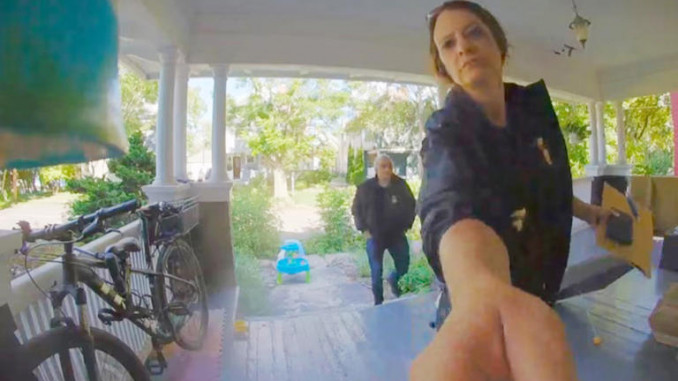
In January of this year, Immigration and Customs Enforcement (ICE) agents occupied parts of Minnesota and carried out aggressive immigration raids across the state, resulting in the murders of Renee Good and Alex Pretti. Outraged by the state-sanctioned killings, David Streever, a resident of Rochester, New York, wrote a scathing email to Todd M. Lyons, the then-acting director of ICE. While the email angrily criticized Lyons, calling him a “monstrous human being” and comparing him to an official in Nazi Germany, it was only political dissent and did not pose any real danger or threats of violence.
However, while on vacation in Finland with his seven year-old daughter, his doorbell camera showed that two law enforcement officers came to his home. Those officers were later confirmed to be Department of Homeland Security (DHS) agents. They had come not to investigate a crime, but to question and intimidate him over his critical email. The harassment did not stop there. When Streever landed at the John F. Kennedy Airport, a third federal agent, this time from the Department of Homeland Security investigations, had tracked him to his hotel and left a business card at the hotel front desk.
This story raises concerns about both constitutionally protected free speech and the expansion of the surveillance state. Streever has since filed a lawsuit against ICE and DHS agents, claiming that they violated the First Amendment, which protects freedom of speech and political dissent. Sending federal agents to someone’s home over an email that never threatened safety is calculated intimidation. On top of all of this, it also brings the use of surveillance technologies into question. The DHS has numerous surveillance tools at their disposal, such as facial-recognition camera apps, location tracking, and social media monitoring. Their arsenal of surveillance tools make it alarmingly easy to track and punish anyone who dares to speak out.
This is only just another example of the waves of repression against people who speak out against ICE terror. That same day, the two agents that came to Streever’s home also tracked down a Syracuse poll worker over unsubstantiated allegations of threats against ICE. Another man from Pennsylvania was approached by DHS agents for pleading that an Afghan asylum seeker not be deported. There are countless other examples of DHS using their power to intimidate people. They not only carry out deportations and detentions, but are also increasingly used as tools for political and ideological suppression.