“There are youngsters like cockroaches, who don’t get any employment or have any place in the profession…”
These words were spoken on May 15 by Indian Supreme Court Justice, Surya Kant, in a diatribe against the unemployed and underemployed youth. These words have since gone viral and created a political and social firestorm by striking a raw nerve in many young people and igniting a massive upsurge of protests across the country. This has created a real political crisis for the ruling BJP party and has now forced out a high-level Education Minister.
This statement was made after a scandal in which a high-stakes medical exam was leaked by corrupt officials via a privatized training program. This in turn prompted the cancellation of scores for 2.2 million people who had previously taken the test, and this put them in the position where they would have to retake the test.
The exam is so high-stakes that around 2.2 million students every year must compete for just 136,000 medical college seats. The test itself is extremely difficult, and students sometimes spend years studying for it, putting themselves under intense pressure to succeed. Students also have to pay for the test, which means working hard and saving money to pay for it. There is also an enormous amount of profiteering as many families of students are forced to take out loans to register for the test. After hearing that they would have to retake the exams, millions of students were thrown into despair and fury, and at least 12 students are reported to have taken their own lives.
Despite the highly public leaks of the exams generating a lot of controversy, they ultimately just confirmed what many Indian students have known for years – that the whole education system is infested with gangster-like profiteers who do not hesitate to prey on their desperation. Meanwhile students from wealthy backgrounds can simply buy their access into educational opportunities.
Furthermore, India, the most populous country on Earth, has over 1.4 billion people and half of that population is under 29 years old. These young people of working-class and even middle-class backgrounds struggle to find their place in society and make stable lives. A recent study found that young people in India have never been more educated in history (even when considering closing gender gaps and inequalities between castes). Yet nearly 40% of graduates aged 15-25 are unemployed, which is a higher rate of unemployment than their less educated peers. And the real unemployment rates are likely much higher than any figures that the government reports. And to make it even worse, India has 229 billionaires that live off the labor of the majority. This is some of the context that led to this recent social explosion.
In this context, Chief Justice Kant’s insulting comments calling young people “cockroaches” highlighted clearly the attitude of India’s ruling class and political elites towards the poor and struggling middle class. These words were the spark that lit the wildfire.
Soon after, on May 18, Abhijeet Dipke, an Indian student who happened to be studying in the United States at the time, asked a simple question on social media, “what if all the cockroaches came together?” For many, this was not a rhetorical question.
Dipke then created a social media post declaring the Cockroach Janta Party (CJP), or “Cockroach People’s Party.” This was a parody making fun of the ruling Bharatiya Janata Party (BJP), but instead embracing the symbol of the cockroach as a sign of defiance. What began as a joke quickly became much more as its social media exploded to tens of millions of followers virtually overnight, surpassing the social media following of all of the established political parties. Not long after, the CJP social media was blocked in India for a brief time. But the anger that many people felt was not a joke and was not going to be contained to the virtual world. The made-up party was becoming a symbol for the rage and fury of poor and working-class youth towards the system and its capitalist rulers.
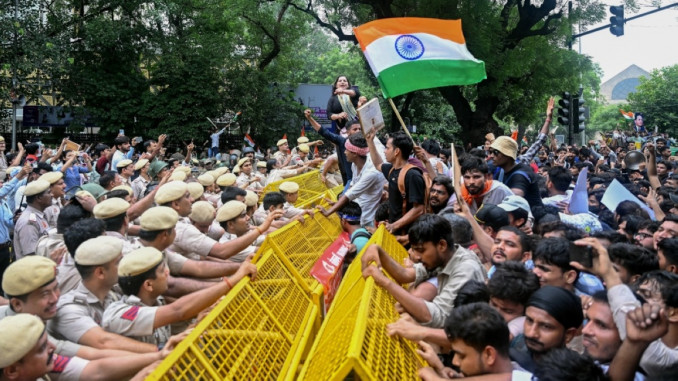
The first real test of strength was a demonstration that was called on June 6 in New Delhi. The protest attracted thousands of mostly young people, bringing with them their grievances against the system, from the corruption at every level of the government to the massive wealth inequality.
As the movement has developed, one of the overarching demands that has emerged has been for the resignation of Dharmendra Pradhan, the Education Minister, who has been seen as incapable of maintaining the integrity of the exams but is also responsible for the horrible state of public education throughout India. In a system of rank corruption, the smallest acts of accountability can feel radical. The CJP put out an ultimatum that either the Education Minister resigns by June 20 or they would begin an indefinite occupation in front of the Parliament. As promised, an occupation has been carried out, becoming a massive hub for supporters. People from all over the country and even internationally have been donating food in support.
In addition, the movement has spread far beyond New Delhi to at least 34 cities throughout the country including Mumbai, Pune and Hyderabad. One aspect that has been very critical is how the protests have cut across the various divisions of society – Hindus, Muslims, Buddhists, Sikhs, as well as across the castes. Many parents of the students, some of whom have supported Prime Minister Narendra Modi’s BJP party in the past, have come out in support of their youth. Many farmers have joined the protests by bringing their own demands against bad trade deals as well as bringing their livestock to protests.
The movement also drew in other prominent dissidents such as Sonam Vangchuk, a well-known environmental activist who used his public image to draw others into the movement. Vangchuk engaged in a hunger strike that lasted 26 days and was taken in custody where the authorities unsuccessfully tried to force feed him. Vangchuk ultimately forced the authorities to agree to not legally retaliate against any of the protesters.
The movement has also inspired solidarity demonstrations among the Indian diaspora internationally in places like London, New York and Vancouver.
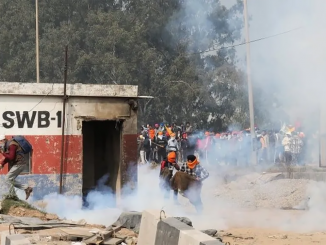
Things escalated further when the CJP called for a march to the parliament on July 20, and mass demonstrations brought out tens of thousands in New Delhi, and more throughout the country. The police responded with tear gas and beatings with wooden sticks with nails in them. An estimated 150 people have been hospitalized from these police attacks. In some cases, protesters fought back and defended themselves while throwing the tear gas back at the cops. There have also been instances of the cops inappropriately touching and harassing women. Doctors have volunteered in large numbers to treat the wounded. Rather than scaring the movement into silence, the police brutality has had an opposite effect and drawn more and more into the streets.
As militant as many of the demonstrations have been at times, the protests have also been characterized by joyful silliness. In a festival atmosphere, people have been singing, dancing, organizing talent shows and dressing up as cockroaches, Spider-Man and historic Indian freedom fighters. People use humor and silliness to not only make fun of the government but also to draw more and more people into the streets. They have made a mockery of Prime Minister Modi, who it was almost impossible to criticize openly before this uprising. The movement reminds us how mass struggles can transform social norms and people can get a small taste of a society that we would want to live in, where people feel alive and able to live collectively.
Until recently, Modi has been largely silent on the protests as well as the scandals that led to them in the first place. In limited public statements, he was very careful to acknowledge the young people’s grievances against the leak but no mention of any possibility of a resignation of the Education Minister.
However, on July 25th, there was an announcement that the Education Minister resigned. What seemed unimaginable a month ago became reality, particularly by challenging the public image of Modi as a “strongman” who is immune to public protests. No doubt, many people see this as an important victory.
At this point, it is unclear where this struggle will go.
Even with the Education Minister pushed out, the struggle still remains. Some of the main demands that the movement has generated are for the families of suicide victims to be financially compensated, for the cops who engaged in brutality to be held accountable, and for a guarantee of no retaliation against any of the protestors.
Furthermore, the anger towards lives of grinding poverty that drew many people into the streets in the first place won’t go away anytime soon. The prospect for a quality education and fundamentally the prospect of a better life doesn’t have to be relegated to the wealthy, or to those who get lucky, or to those who sacrifice everything for an exam that is seen as a golden ticket to upward social mobility. To achieve this future where everyone can have a dignified life requires standing up to 229 billionaires as well as the Modi regime that enriches them with massive government contracts and tax breaks.
The youth of India have begun to raise their expectations for their lives and this is an important step. But to fundamentally overturn the rule of the billionaires and their government, working people as a whole in particular have to use their power. The success or failure of this movement to achieve its goals is largely dependent on everyone – from formal workers to informal workers, the construction workers to the I.T. workers, the rickshaw drivers to the agricultural workers, the textile workers to the precariously unemployed – becoming conscious of this fact. Ultimately, it means connecting with workers across borders to stand up to and challenge the whole system of capitalism and the wealth that the super-rich get from it.
In a world characterized by extreme instability – war, fuel shortages, inflation, unemployment, environmental collapse and more – the struggle of the young people in India reminds us all that a single spark can create a highly combustible situation.
Perhaps more importantly, their struggle also reminds us of the potential of what can happen when all of the cockroaches come together.