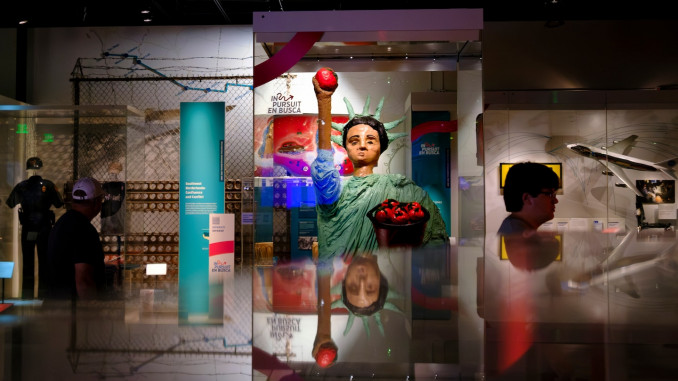
This Fourth of July, the White House released a report accusing the Smithsonian’s National Museum of History of promoting “improper ideology” that fails to make possible “the informed and honest patriotism that is essential for a successful republic.” The report was issued under the directive of Trump’s 2025 executive order, “Restoring Truth and Sanity to American History.”
This 162-page report finds fault with exhibits throughout the museum that do not fit the administration’s preferred narrative. For example, it accuses the museum of acknowledging the Founding Fathers’ participation in enslaving people, of not sufficiently “celebrating” Christopher Columbus, and of neglecting to share the “constructive” role of Christianity in shaping the nation. The report also criticizes any museum reference to the history or even the existence of transgender or gender non-conforming people.
Although the 180-year-old Smithsonian is governed by a public-private board, and not by the executive branch, the Trump administration is still able to exert significant pressure over the institution. Kim Sajet, the first woman to direct the National Portrait Gallery of the Smithsonian, voluntarily resigned last year after Trump declared he was firing her, a power he does not have.
Trump’s executive order declared that the role of the Smithsonian should be to promote “American greatness.” The current mission statement of the institution, however, states its purpose as, “Empowering people to create a more just and compassionate future by exploring, preserving, and sharing the complexity of our past.”
As a taxpayer-funded museum, the Smithsonian has the duty to serve the people, not the preferences of the president. We have the right to hear the story of the past both as it is understood by a consensus of historians, and also through the display of primary source material exhibited by museum curators. But history is complicated, and the Smithsonian takes an additional step by asking open-ended questions throughout their exhibits in order to engage visitors and to encourage reflection, critical thinking, and interaction. The White House report discourages these questions, preferring that museum visitors are taught in a one-sided manner the proper ideology.
But who is served by a narrow version of history in which only celebration and patriotism are authorized? A president leading a country into an expensive, ongoing war certainly prefers that we remain unquestioning patriots. Similarly a president with low approval ratings and unpopular initiatives would benefit from the stifling of dissent and critical thinking.
We deserve museums that inspire us with the actions of people and movements of the past, and to recognize what people are able to accomplish when we are united against injustice. But we also deserve to learn about the horrors and tragedies that are part of this country’s history, and to be able to engage with this information in a thoughtful and critical manner. By forcibly controlling the narrative of American history for political benefit, Trump is attempting to deny people an honest understanding of history. We reject this move to restrict and rewrite the past, and agree with historians that the Smithsonian should remain free from political influence.