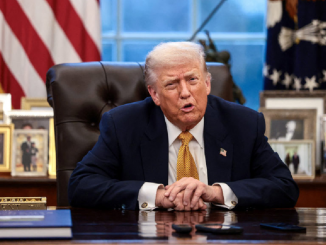
In early August, the Baltimore Banner reported that Johns Hopkins University (JHU) President Ron Daniels had helped the Trump administration develop a new framework for higher education. Daniels was one of four university presidents consulted as the administration drafted a plan calling on universities to make changes around admissions, tuition, academic standards, faculty politics and other issues.
This came after more than a year of attacks on higher education by the Trump administration. Hopkins itself has lost millions of dollars in federal funding, laid off workers and joined lawsuits challenging some of the administration’s cuts. So why was the president of Hopkins helping the same administration shape its higher-education policy?
Daniels’s answer essentially is that talking is better than not. He claims that by working with the administration, university leaders can push back against its worst ideas, protect academic freedom and institutional autonomy. He also argued that the university presidents involved had moved the conversation toward greater transparency and accountability.
But this raises a bigger question.
Who decided that he should speak for Hopkins?
Daniels, who wrote a book called What Universities Owe Democracy, decided to join these discussions without consulting Hopkins faculty, students or staff. In fact, faculty union leaders said that they only learned about his involvement through news reports.
So, while Daniels talks about defending democracy and institutional autonomy from Trump, the people who actually work, educate, and study at Hopkins had no say in how their university engaged with the administration. The decision was made from the top.
We are being told that university leaders can help defend democracy from Trump. But how can we expect them to defend democracy when their own institutions are profoundly undemocratic, with economic and political power concentrated at the top?
Just look at who governs Hopkins. Its Board of Trustees include leaders from major banks, private-equity and investment firms, and some of the country’s largest corporations. It also includes people who have occupied senior positions in the U.S. military and government. These are not elected by university workers, faculty, students or Baltimore residents. Yet this board makes the decisions for an institution that employs tens of thousands of people, controlling billions of dollars and with consequences way beyond the limits of its campuses.
This shows that elite universities are governed by the same class of people who own and manage major corporations and financial institutions.
Hopkins’s relationship with the military makes this clear. The JHU Applied Physics Laboratory was created during World War II as part of the government’s effort to mobilize scientists and engineers for the war. After the war ended, and despite decades of protest and opposition from students, faculty, and staff within the university, APL continued to deepen its ties with the military. It went on to work, among other things, the AMFAR military radar system and guidance technology for the Tomahawk cruise missile. Today, it is research center with around 8,800 employees and a budget of more than $2 billion, doing work for the Department of Defense (or War, as Trump aptly calls it) as well as the intelligence community
And what about academic freedom? Universities have a reputation for being full of liberal students and left-wing professors. The political views of the people who teach, study and work at a university can be very different from the administrators and other powerful people at the top of the institution.
Hopkins is a good example of this. The Marxist geographer David Harvey taught there for decades, including courses on Marx’s Capital. Depending on the broader political atmosphere of the moment, students and faculty may be able to criticize capitalism, organize against wars, support strikes, and challenge university leadership up to a point. In this sense, faculty can exercise some control over teaching, research and curriculum. Students can organize and sometimes force administrations to change course. Workers may be able to unionize and fight over wages and working conditions. Universities can be places where ideas deeply hostile to the existing social order are studied and developed.
But none of this gives these groups anything close to the power trustees and administrators have over the university’s strategic direction. Faculty, workers and students don’t decide who sits on the Board of Trustees, how the university invests its wealth, how much military research it performs, where it expands and invests its resources, or what relationships it develops with corporations and the government.
And the consequences of these decisions don’t stay inside the university.
Hopkins has a long history of making decisions that have harmed and alienated the Baltimore community. That history includes Henrietta Lacks, a poor, Black person whose cells were taken without her consent and became extremely profitable while her family got nothing for decades, to controversial lead-paint studies involving children from predominantly Black, low-income families, the displacement of hundreds of families through redevelopment around the East Baltimore medical campus, and the university’s recent creation of its private police in spite of strong community opposition. Again and again, Hopkins has profited from its decisions, while Baltimore residents have to live with its consequences.
When decisions are limited to negotiations between university presidents and government officials, people outside those negotiations are the ones who pay the price. Institutional autonomy sometimes means protecting researchers and students from government interference. But more often than not, it actually means preserving the power of an institution to make decisions without democratic control from the people who work in it or live around it.
This is why the problem with Daniels’s approach isn’t that he should have been tougher with Trump. Put a more progressive president in his office and the basic structure would remain. So, the alternative isn’t simply finding better people to run these institutions. Instead, we need to ensure that the people who actually make universities run can gain real power over them. Real democratic control should mean giving workers, faculty and students power over the direction of the university itself. And when university decisions reshape neighborhoods and entire cities, the communities affected by them need democratic participation, too.
But there is also a limit to how far we can democratize a university without confronting the larger system it is part of. An institution that depends on wealthy donors, corporate partnerships, military contracts and government funding cannot simply decide to separate itself from those interests. The same economic and political forces that concentrate power at the top of universities concentrate power throughout U.S. society.
These forces guarantee that we aren’t going to build a fully democratic university in an undemocratic society. In the end, changing who controls our universities is part of the much bigger struggle over who controls the wealth, institutions, and resources of society as a whole.