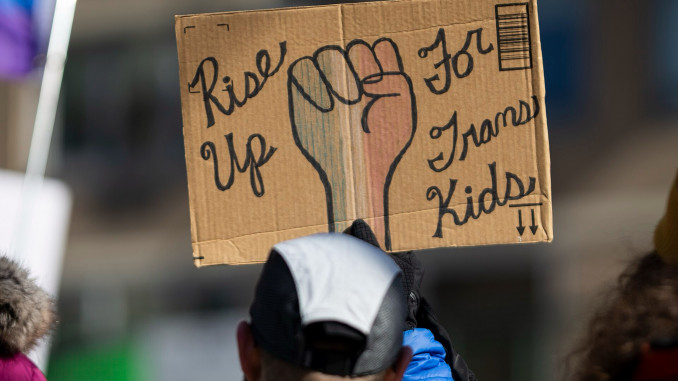
June is Pride Month, when the LGBTQ+ community celebrates its enduring resilience in the face of discrimination and violent attacks. The surge in anti-queer legislation, hate crimes, and right-wing rhetoric is part of a broader strategy by the right-wing of the ruling class to divide, distract, and suppress people. This doesn’t just affect the LGBTQ+ members of society, this divide-and-conquer strategy is meant to keep all of us divided and, as a result, weaker.
Today, LGBTQ+ people – especially trans people – are once again facing attacks and a growing wave of anti-trans hate. In 2026, 530 bills were introduced in legislative bodies across the country to reduce the rights of queer people: to remove healthcare access, censor education, ban books and trans-athletes, and strip anti-discrimination protections. This is part of the campaign to push queer and trans people from public life.
Pride gatherings are declarations that queer people will not be pushed back into the closet. Pride is just that – to declare the right to be who we are – demonstrations of defiance. Our rights have been won by refusing to be silent. Pride didn’t start with rainbow flags, or corporate sponsorships. It started as a radical movement.
As long as queer people have been pushed into the closet, they have fought, not just to come out, but to destroy the closet. LGBTQ+ people were organizing in the U.S. in the 1950s, at the height of McCarthyism, despite the risks of being fired, arrested, and publicly outed. The Mattachine Society, founded by former Communist Party members, the Daughters of Bilitis, the first U.S. lesbian organization, and other groups across the country built networks, published newsletters, and held secret meetings to survive and resist.
In the 1960s, as the Civil Rights Movement gave courage to people across the U.S., LGBTQ+ people also began stepping into the open. The fight at the Stonewall Inn in New York City marked a pivotal moment. In 1969, during yet another police raid on a gay bar, queer and trans people—many of them Black, Brown, and unhoused—fought back. For days, crowds gathered and battled police in the streets. Decades of rage against police harassment, social violence, and systemic exclusion boiled over. It wasn’t the first uprising and it wouldn’t be the last. But it lit a spark. The following year, people returned to the streets—not to mourn, but to march. That was the first Pride.
The 1970s saw a sharp backlash. These attacks were orchestrated from the top, again by right-wing politicians, religious institutions, and media outlets that were threatened by the social movements of the time. They targeted what they saw as a weak and vulnerable section of the population, people who had been marginalized and were a threat to what those in power called “normal society”.
Today’s attacks follow the same playbook. The attacks against LGBTQ+ people are the same: attacking workers’ rights, criminalizing immigrants, taking away our healthcare, and abandoning poor and disabled people. Every blow against one group of people, based on gender, race, class, or ability, opens an attack on us all. The gains queer people have won – like the right to access gender-affirming healthcare, obtain the legal benefits of marriage, and to be open about who they are in schools and workplaces – are under attack.
History teaches us that our power lies in solidarity and organization. If we ignore, or even worse, support the attacks on people who are portrayed as being different from us, by those who control society, we undermine our power and our humanity. Falling for the fears stoked by those in power against others is a way to weaken our collective strength. So, whether it is a baseless fear of trans people, strong women, Black people, immigrants, unhoused people, and others, that fear places us on the side of those in power. It is a way for them to divert our attention from their attacks on us.
Every celebration of our being, whether it is Pride, Juneteenth, International Women’s Day, Cinco de Mayo, May Day or others is a celebration of ourselves, our history. It is a collective expression of our hopes for a decent life for all of us.
And when we realize our common interests and use our collective power, we will be able to bring into being the world we all need and deserve.