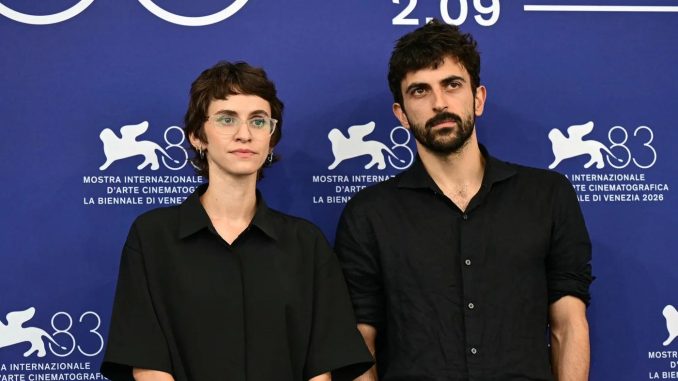
Two Israeli filmmakers, Yuval Abraham and Rachel Szor, received a 24-minute standing ovation for their new documentary “NAZA” at the Venice Film Festival on September 10, before going on to win the festival’s Special Jury Prize. NAZA is an acronym the IDF uses to describe the number of civilians it thinks it will kill in a particular strike – it’s the Israeli equivalent of the U.S. military term “collateral damage”. Through anonymized interviews with IDF members, many of them part of elite intelligence units, the film makes the argument that the genocide in Gaza has been conducted as part of a deliberate policy of mass killing. As the filmmakers put it, “There’s no NAZA in Gaza,” meaning that no one is collateral damage because everyone is treated as a legitimate target for death. They say, “The mass killing of Palestinian civilians in Gaza was not a ‘tragic byproduct’ of a war against Hamas, as it is commonly portrayed in Israel, but a premeditated, calculated, and intentional act.”
The film and its positive reception outside of Israel has triggered the usual hysterical responses from the Israeli government, much of the Israeli public, and their external allies. “NAZA”’s premiere in New York City on September 26 drew pro-Israel protesters and billboard trucks calling the film propaganda. Most concerning, however, was the call by Israeli Prime Minister Benjamin Netanyahu for a new law that would strip Abraham and Szor of their citizenship, calling their film “treasonous.”
To strip someone of citizenship is potentially to make them stateless. Hannah Arendt, a German Jewish theorist who escaped the Holocaust and experienced statelessness, called citizenship “the right to have rights”. She argued that without it, no government has a formal responsibility to give you protection. Stripping citizenship from people was a tool Nazi Germany used to make them vulnerable to expulsion, deportation, and ultimately, extermination. The international law of human rights established after WWII was intended to remove this possibility by establishing that all governments have responsibilities to protect all people regardless of their citizenship status. Hannah Arendt was skeptical about whether this regime of international human rights would be effective, and we are seeing now that she was right to worry. Every year, we see governments ignoring their human rights responsibilities towards people who flee oppressive governments or climate and economic catastrophe. Many vulnerable immigrants are cast, effectively, into statelessness. They are, for example, prevented from landing on the shores of Europe and allowed to drown in the Mediterranean, or kept languishing at the U.S.-Mexico border. The U.S. deportation machine is also constantly pushing and crossing the boundaries of existing law, for example by deporting people so quickly they have no time to pursue their due process rights, or by shipping them off to so-called third party countries where they have no rights at all.
Of course, statelessness is also effectively the situation of the Palestinian people living under Israeli occupation. Lacking the protection of a state able to guarantee their rights, people are subject to unimaginable abuse, expulsion and, ultimately, genocide. When you remove people’s right to have rights, you can do whatever you want to them.
Even if Israel does strip the citizenship of Abraham and Szor, as well-known figures they will likely be OK. The threat, though, signals a willingness of self-proclaimed democratic Western states to extend these extreme repressive measures to people who they used to keep under their protection. As well as refusing to let immigrants or the occupied in under the umbrella of state-protected rights, they are moving to openly remove this protection from people whose speech they find threatening.
In this moment, defending everyone targeted by governments for their speech is more vital than ever. We’ve already seen the federal government hand down heavy sentences in the Prairieland case in Texas. Fifteen anti-ICE organizers in Minnesota are now facing a similar aggressive prosecution for their speech and organizing. We need to push back now with all our strength to prevent another set of long sentences. We also need to show them that we will not let them push their punishments into even more extreme territory.