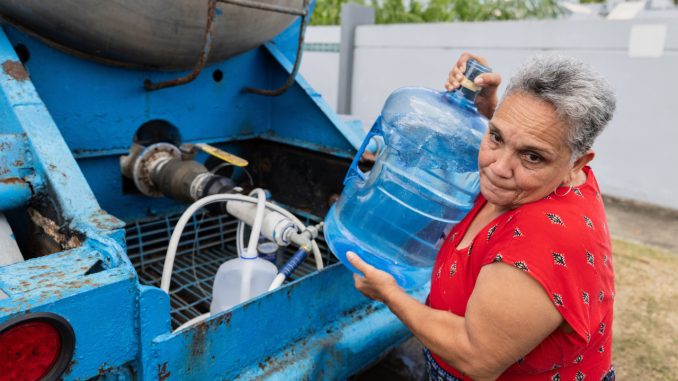
When you turn your water faucet on, whether in the bathroom or kitchen, can you count on water coming out? For more than 180,000 people across Puerto Rico today, they cannot confidently say whether they have access to water at home. They cannot take a shower whenever they want, wash their dishes whenever they want, or pour a glass of water to drink whenever they want. People are forced to wait in long lines to fill up buckets at water distribution wells. This is because since August 7, they have faced water rationing in which they have to wait 48 hours at a time until the next opportunity to access the water in rotating outages.
So what is really going on?
Puerto Rico is suffering from a drought with 63% of the island currently facing either what is characterized as “extreme drought” or “severe drought.” This past July was the driest month ever recorded in over a century for the capital city, San Juan. The agriculture industry has been totally disrupted with crops shriveling up and dropping to the ground before they are ripe.
The climate crisis is here and humanity is facing it right now, from Puerto Rico to Nepal. The United Nations, which has historically been very cautious with their prognoses, has just published a report effectively saying that damage from climate change has gotten past the point of no return and that the worst impacts will now be unavoidable. To add to the insanity, less than two weeks later, the Trump administration removed any authority of the Environmental Protection Agency to regulate carbon emissions from power plants. While the Trump administration deserves a lot of our anger, his administration is only saying the quiet part out loud that previous administrations and governments all around the world have been too cowardly to say—that they were never going to take real action to address the climate crisis.
Just as this insane system will suck every last drop of fossil fuels out of the ground if left unchecked, it will also suck out every last drop of clean drinking water as well.
While the drought is a huge problem that is contributing to the water crisis, Puerto Rico also suffers from having a massively outdated infrastructure. The Puerto Rico Aqueduct and Sewer Authority reports that around 60% of the drinking water is lost before it reaches people’s homes due to leaky pipes. In fact, even before a drought was ever announced, parts of the island like Loiza, that happen to be disproportionately Afro-Caribbean, have faced inadequate access to water.
The construction of a so-called “super aqueduct” has been stalled in a state of disrepair and a source of massive amounts of corruption, particularly among politicians within the leading political party. On top of this, the drinking water reservoirs are contaminated from dirt and debris, much of it from the legacy of Hurricane Maria 11 years ago. In addition, Puerto Rico has nothing in place to offer financial support for people to install necessary tools to collect rainwater, which is not uncommon in places that have similar climates.
Why doesn’t Puerto Rico have the resources to invest in renovating its water infrastructure? Why are there regular electrical blackouts? Why are there not enough good-paying jobs that many are forced to leave the island?
To answer these questions, we need to understand Puerto Rico’s colonial relationship to the United States. Following the Spanish-American war in 1898, Puerto Rico was annexed and the people have since then been colonial subjects of the United States. The question of sovereignty and self-governance is and has been a joke. Puerto Ricans pay taxes that go to the U.S. federal government but don’t even have a voting member in the U.S. Congress or vote for president. Since 1917 when the Jones Act was passed, Puerto Ricans have been forced into purchasing only U.S.-made goods, which not only imposed artificially high prices but also created a cycle of economic dependency on the United States. Over the years, various economic policies have been implemented to open Puerto Rico up to U.S. corporations with all sorts of tax havens and ways to get around union contracts in the U.S. mainland.
To do this, the Puerto Rican government’s crippling debt, which has never been audited or consented to by the population, has been used as a weapon of leverage to further impose U.S.-favored policies on the people. In order to supposedly get the debt under control, from 2016 until today, the U.S. has imposed a “Financial Oversight and Management Board” (initiated by the Obama administration and known as “La Junta”) that has carried out privatization and austerity on the population such as layoffs, attacks on the unions, lowering the minimum wage and closing hospitals and schools. One of the many consequences is that the Aqueduct and Sewer Authority has been extremely understaffed and under-resourced to meet the needs of the population.
While it may not appear so, there has been an enormous amount of investment from the United States into Puerto Rico.
On the one hand, wealthy investors pour in incredible resources to build all sorts of luxury hotels and amenities to create an island that is a perfect playground for the rich. At a time that ordinary working-class Puerto Ricans are living day by day with uncertainty as to whether they can have access to clean water, major hotels, resorts, restaurants and casinos are reported to be largely unaffected.
On the other hand, there are a whole range of military bases throughout the island. In fact, at the end of last year the U.S. reopened the Roosevelt Roads naval base in Ceiba that had been closed for 20 years. These are some of the critical military hubs that make it possible for the United States to attack Venezuela and kidnap their sovereign president and his wife, carry out the crippling blockade of Cuba, and engage in extrajudicial killings of hundreds of fishermen in the Caribbean.
So, when it comes to serving the needs of the empire, whether creating a tropical paradise for the global elite or using the island as a staging ground to carry out military attacks on anyone who challenges U.S. power, there is no shortage of investment. Whether the population has access to clean drinking water is another story.
While the U.S. domination of Puerto Rico is primarily responsible for the situation facing the population, everything is also enabled by the local elite in Puerto Rico that has been governing the island for the U.S., refusing to advocate for any autonomy from the United States while benefiting from the various privatization schemes. This is true whether it is the Partido Nuevo Progresista or the Partido Popular Democrático that have been trading power for decades. They offer no solutions for the population.
That is why some people have begun to speak out, whether engaging in road blockades or picketing the expensive birthday dinners of the Trump-aligned Governor. The demonstrations may be relatively small right now but there is deep anger among the population.
For working people in the United States, 55% of whom cannot cover an unexpected $500 emergency, what do we gain from the domination of the Puerto Rican people, or any other people in the world? We don’t. The same forces that are profiting from our desperation are the ones that use places like Puerto Rico as testing grounds for their policies that they may want to use against all of us. Working people in Puerto Rico have a right to independence from the United States and determine their own futures.
While Puerto Rico’s water crisis has multiple roots, all of them stem from the singular source—the inherently destructive nature of capitalism.
It is a system that, when pushed to its logical conclusion, will deprive us of clean water in places like Puerto Rico, will deprive us of fuel to run our hospitals in places like Cuba, will deprive us of our right to even make it past our childhoods in places like Sudan or Palestine. It is a system that threatens all of our lives on every corner of this planet.
But there is a force that can stand up to this insanity. It is the same force that pushed out the corrupt and bigoted governor of Puerto Rico in the “Ricky Renouncia” movement in 2019. It is the same force that pushed back ICE from Minneapolis earlier this year.
In our numbers and across all of the borders imposed on us, we are incredibly powerful when we are organized on our own terms. We need to organize ourselves on a basis that can uproot this entire predatory system.
This is a fight that we can win. This is a fight that we must fight. Our survival depends on it.