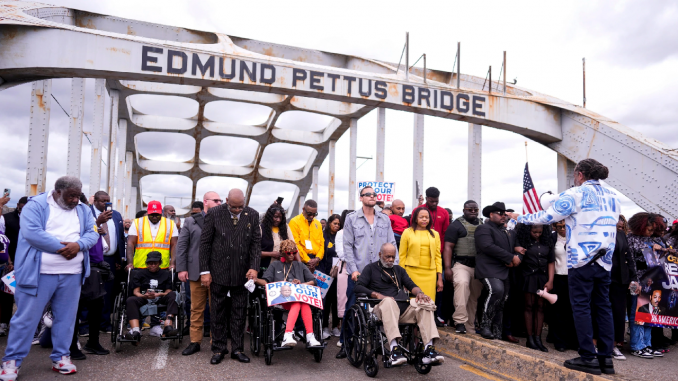
On Saturday, May 16, an estimated 5,000 people demonstrated in Selma, Alabama against the various efforts to attack people’s voting rights. People from all over the South came to take a stand against the suppression of their votes.
The protest took place at the Edmund Pettus Bridge in Selma, which was not an accident given its significance as a key site of struggle in 1965 where Black people stood up against vicious racist violence from state troopers and white supremacist vigilantes during their struggle to win basic voting rights.
Today, people’s voting rights in the United States face a whole range of open assaults. The Supreme Court just overturned Section 2 of the Voting Rights Act, which had allowed racial minorities to challenge discrimination in redistricting. The recent Louisiana vs. Calais Supreme Court decision claims that it is unconstitutional to consider race in drawing maps that previously complied with Section 2. In reality, the recent ruling is very race-conscious – it has led to a frenzied redrawing of voting district maps across the country aimed at minimizing whatever voting power communities of color previously had, often by dismantling majority Black districts. In some cases, elections that were in progress were postponed until new maps could be drawn.
With this ruling, the clock was turned back six decades. One demonstrator, Reginald Mason from Birmingham said, “…I never thought I would be standing here today fighting for what they have already fought for me.” This is on top of other court rulings that have chipped away at different aspects of the Voting Rights Act.
A partisan gerrymandering war between the Republicans and Democrats has taken off since last summer when Donald Trump called for Republicans in Texas to redraw their maps to explicitly eliminate five Democratic Party seats. In response, the Democrats have played a similar game in places like California and Virginia.
These court rulings are on top of the purging of voter rolls, talk about eliminating vote-by-mail, proof of citizenship at the voting booth and even threats of sending ICE agents to the polls.
Trump and his loyalists in the Republican Party have made it clear that, to hold onto power, they will try to steal elections outright and throw out whatever democratic norms that we might take for granted living in the United States.
While racism is certainly a big part of these efforts to attack people’s democratic rights, it is not exclusively an issue of Black and white. The Republican Party and the Democratic Party both represent the interests of the super elite. They agree on the fundamentals of how the world should work but they may disagree on the strategies to maintain the system. The Trump administration represents one section of the super wealthy. At this moment, they may have some sense of how deeply unpopular they are with policies like the war on Iran, increasing gas prices, cutting of healthcare subsidies, and all of their attacks on ordinary people. But this isn’t the first time they have resorted to undemocratic methods to maintain their control. On some level, they know that they can’t win in popular elections alone by relying on whatever enthusiasm there might have been from their traditional voting base, which is why their best bet is limit the participation and influence of those who they expect would vote against them, particularly Black people, but also others.
The people who recently stood up in Selma Alabama for the right to participate in political life were right to do so, just like all of those who came before in the Black Freedom Movement. To defend whatever democratic rights we might have had in this society, voting will not be enough. Putting our confidence in the Democratic Party, which has been in power much of the time while our rights have been eroded over and over again, will not get us to where we need to go. Symbolic sporadic demonstrations won’t cut it. It is going to take a militant mass struggle that fundamentally challenges the people in power, similar to what we recently saw in Minneapolis this past winter when communities mobilized themselves on a scale that was capable of essentially pushing ICE and Border Patrol out of town.
If we are able to pull something like that off, why should we stay at the level of defending the shell of democracy that we have today? Why couldn’t we go on the offensive to fight for a fundamentally democratic society – one where the majority of us, all working-class people from all backgrounds, actually are the ones in charge for once?