Earlier this month, the House Armed Services Committee proposed the 2027 National Defense Authorization Act (NDAA). The proposal raised concerns, as it put forth a $1.15 trillion budget for military spending for 2027. Donald Trump then requested an additional $350 billion, bringing the total to $1.5 trillion. The House is set to vote on the NDAA in July, and if passed, it would result in the largest military and defense budget in U.S. history.
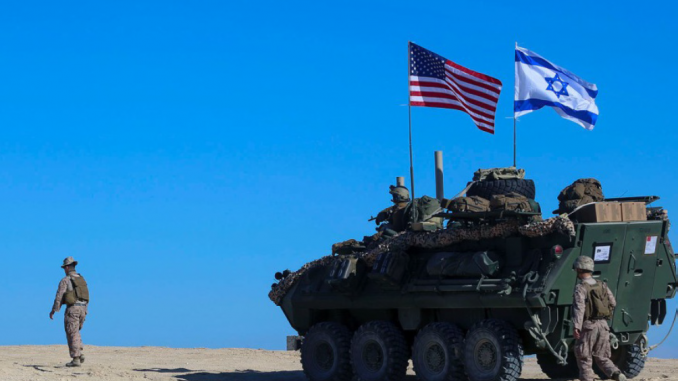
Additionally, another provision, Section 224, or the “United States-Israel Defense Technology Cooperation Initiative,” would fuse sections of the U.S. and Israeli military for technology sharing, the production of weapons systems, and research and development across AI, autonomous, and cyber warfare.
Section 224 drew particular attention and criticism because of the poor image both the U.S. and Israeli military have, after the Gaza genocide and Iran war. People fear that it would expand pro-Israel lobbies’ already large influence on U.S. politics, making the U.S. political system even more vulnerable to influence from the Israeli government that pressured the U.S. to start the war against Iran.
There is a long history of collaboration between the U.S. and Israel, dating long before the 2027 NDAA. The 2026 NDAA also expanded provisions to increase the interoperability between the two countries. Section 1231, 1234, and 1235 gave more funding to U.S.-Israeli “anti-tunnel cooperation” programs (i.e. against various resistance groups in the Middle East like Hamas and Hezbollah), AI funding and research, and joint military exercises to increase coordination between the two, respectively. Police departments and even Immigration and Customs Enforcement officers have also trained in Israel, bringing IDF methods back to the U.S. to use on the U.S. population. These are just two recent examples, but the history between the two countries spans back decades, starting as early as the 1967 Six Day War.
Both countries have had heavy losses from the past few years of war and conflict, and both countries are going through their own political turmoils. Thus, this integration of military intelligence and resources is essential for the two countries to further their strategic goals. For Israel, it’s the expansion of the Zionist state, and for the U.S., it’s to maintain its position as the world’s superpower. This alliance is nevertheless viewed as a necessity in the case of future conflicts in the Middle East.