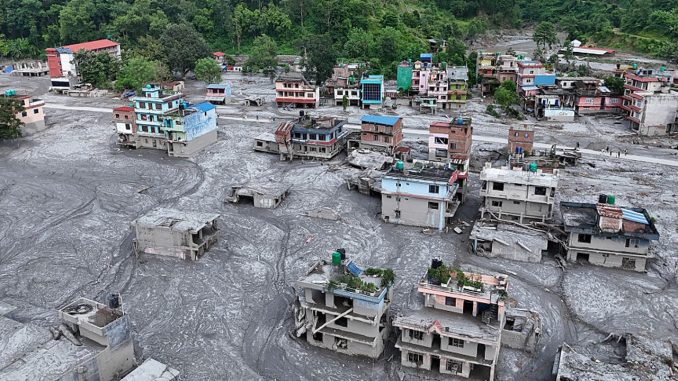
On Wednesday, August 26th, a horrific flash flood of ice, mud, rocks, water and debris swept through Nepal and the Tibetan region of China along the Trishuli River in the Himalayan Mountains. As of Sunday, August 30th, there have been 804 confirmed deaths and 3,048 missing people. Thousands of people have been trapped awaiting emergency aid with no guarantee that any help will show up. Homes and infrastructure such as roads, bridges and power plants were destroyed in the wreckage. Hospitals in the cities have been overwhelmed. The humanitarian crisis faced by the population is only beginning.
Despite the horror and solidarity felt by people all around the world, the resources and aid given by major governments have been pathetic. The United States in particular has pledged $3.6 million to aid Nepal. To put this number into perspective, U.S. Secretary of War Pete Hegseth has estimated that the war on Iran has cost $37.5 billion – ten thousand times more than what’s being given to Nepal.
While there was initially some speculation that the floods had been caused by an earthquake, this disaster was due to glacier collapse, which in itself registered as a 5.2 seismic event. According to glaciologist Andrew Mackintosh, “…when a glacier of that scale collapses, it generates a lot of water, and then there’s a cascading sequence of events … where the water and the sediment combine and bulks up and creates the flood.” To compound things, it’s reported that following the collapse of the glacier, a temporary dam was created on the Lhende River by rocks and debris from the mountain, only to eventually break down and begin a massive flood.
As shocking as it was for many of us to watch the devastation unfold, this shouldn’t have been a surprise. Glaciers in the Himalayas as well as around the world have been melting due to rising global temperatures.
According to the World Meteorological Organization, the Himalayan region is warming nearly twice as fast as the global average. In addition, the International Centre for Integrated Mountain Development has reported that the rate of ice loss is double today than what it was in 2000. This melting in the Himalayas can be especially disastrous for the South Asian subcontinent as it can lead to not only glacial collapse and severe floods like the one that just occurred, but also to disruptions of whole ecosystems that were possible only under those specific conditions that existed for centuries.
Although what’s happening there may seem worse than other places, none of us are safe on a rapidly heating planet. We could look at the devastation today in Gary, Indiana, where 300,000 people have been without power due to a powerful storm, or the wildfires in Canada that filled the Northeast with plumes of smoke, or the extreme heatwaves throughout Europe more recently. The climate crisis is in front of all of us.
Year after year, we face the highest global temperatures ever recorded, with records being shattered constantly. Ocean surface temperatures have increased as well. As a consequence of this climate disruption, extreme weather events such as the rapid melting of glaciers, more intense rainstorms, the drying up of major rivers, and the expanding area affected by tornadoes and more, not only become more intense but also more frequent.
Scientists have been raising the alarm for decades that the burning of fossil fuels traps heat and consequently warms up the entire planet. If we lived under a rational system, we would have reorganized our energy infrastructure into something that would have respected planetary boundaries while also meeting the needs of the population and providing good jobs for the workers carrying out this transition. But when we look at the world today, it’s clear that this hasn’t happened. Ultimately, warning after warning from the scientific community has been actively ignored by the people in power. Whether presidents and politicians offer lip service and fake solutions or proudly proclaim that they don’t care, the consequences are still the same.
The truth is that the reason why a transition away from fossil fuels hasn’t happened is because this type of transformation can’t happen under this system.
Under this system of capitalism, where the ultimate decider of everything in our society is whether it will generate short-term profits for the wealthy, everything else will always be an afterthought, including the survival of our species.
This massive flash flood shows us a window into a future that those in power want all of us to accept. They want us to accept a future in which all of us, especially those who are most vulnerable, are forced to endure the destruction of our lives, our lands and our futures as extreme disasters become more common and unavoidable. They want us to accept a framework that the best we can do is to maybe “adapt” to a devastated climate rather than actually address the issues and repair the damage. They want us to accept a system that forces some of the poorest people in the world, who are the least responsible for climate change, to pay the debts, in this case the climate debts, of the richest people in the world.
But these are not our only choices. We don’t need to accept a path of guaranteed destruction or the rule of a small minority over our lives.