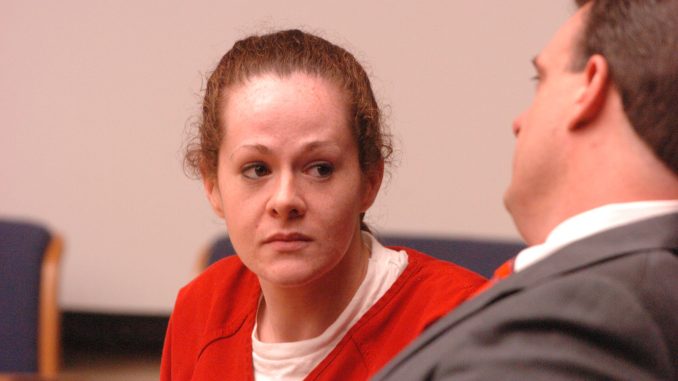
On Wednesday, September 30, the state of Tennessee injected Christa Pike two times with pentobarbital, an alkaline drug (like bleach) intended to sedate her and terminate her breathing. The two attempts failed to fully sedate or put her to death, instead causing her an hour or more of intense suffering as she underwent multiple needle insertions and her arms blistered and burned. When they finally gave up trying to kill her, the attempt put her in critical condition at a local hospital, intubated and on a mechanical ventilator. This is another of many botched attempts to execute prisoners using lethal injections and is yet another example of the sickness of our society.
Christina Pike was 18 years old when she and her 17-year-old boyfriend lured a classmate into the woods in Tennessee and beat, cut and killed her in brutal fashion. The cutting of a pentagram into the victim’s chest drew added attention to the case, leading many to speculate that the young killers were satan-worshipers. They were judged by the public and probably the jurors to be morally depraved and guilty. The next year, she and her boyfriend were found guilty of murder, and at age 18, she was sentenced to death.
As horrific as her crime was, the life that she lived prior to the murder was equally miserable.
Because her mother abused alcohol while pregnant, Christa was born with mild brain damage and had seizures from an early age. She was raped at age 11 by a neighbor. She was fondled, punched and bloodied by one of her mother’s boyfriends. At 17, she was raped on a roadside by a stranger. Even the boyfriend who she became devoted to at age 17 hit and threatened her. The first time she attempted suicide was at age 12. Her clinical therapist who began treating her shortly after her she was convicted of the murder described how Pike was in constant “fight or flight mode,” and how she disassociated from herself in order to survive the traumatic experiences. She was diagnosed with bipolar disorder and post-traumatic stress disorder. For a variety of reasons, none of this evidence was brought into her trial, and when she and her boyfriend were found guilty of the murder, she became the youngest woman ever to be sentenced to death in Tennessee. Because he was only 17 at the time of the killing, her boyfriend received life imprisonment.
Pike, already the victim of a miserable and painful childhood, has since 1996 been the victim of other forms of violence by the state of Tennessee. Rather than look at the total circumstances and the environment that helped create this horrible series of events, the state since then has sought to punish and kill someone who was already victimized. She has spent the last 30 years mostly in solitary confinement, spending the majority of every day in a room the size of a parking space.
After years of her case winding through appeals and extensions and slowly approaching a final date of execution, she faced yet another form of mental and physical torture. Doctors and her lawyers warned that the lethal injection intended to kill her might cause more suffering in her final minutes. Pike has small veins, which in the past have caused difficulties with injections and blood draws. This increased the likelihood that the pentobarbital would leak out into her body tissue, where instead of sedating and killing her, it might burn through her tissue and cause intense pain. Beyond that problem, the state of Tennessee and others have botched executions before: they’ve had trouble finding veins and they’ve had trouble with the drugs themselves, which weren’t tested well in advance or were impure and therefore had unintended side effects. Despite these warnings, the state authorities chose to make her undergo what was likely to be another torturous experience. It was. As of this writing she is in critical condition, and legal experts are unsure of what will come next.
Christa Pike’s story is a tragic example of a life cut short by the conditions she was born into. By her teenage years she had already been horribly abused, and those damaging experiences continued as she went through adolescence. And when she acted out in response to her suffering, she was sentenced to pay an awful price.
Pike is one of the many victims of a society saturated with violence, sexism and abuse that damages millions of young people before they can even become themselves. And too often, as in the recent Lindsay Clancy case, people with obvious emotional and mental health conditions who commit horrible acts are often judged in moralistic or religious terms. When this happens, the root causes of the problems are never addressed, and the blame is assigned to the individual.
But individuals aren’t born into the world evil, violent or satanic. They become those things after years of experience show them cruelty and shape them into someone who mirrors the society they inhabit. In a society sick with violence, sexism, abuse, and the pursuit of profit above all else, Christa Pike and others can commit monstrous acts that victimize others. But we can’t forget that they are victims as well, symptoms of a sick society.