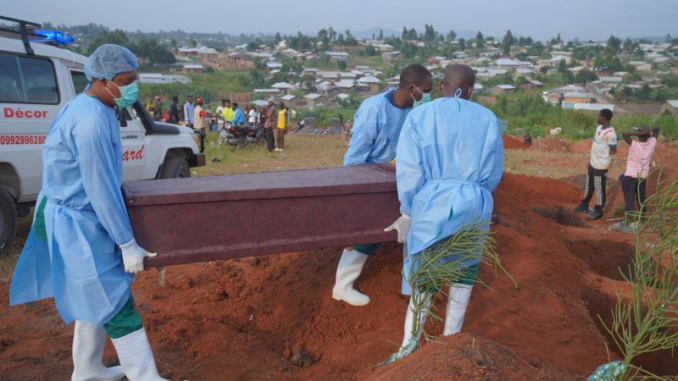
Since the beginning of April, the eastern Democratic Republic of Congo (DRC) has been experiencing its 17th Ebola outbreak. Ebola is a disease linked to a class of viruses called orthoebolaviruses, and is spread through close contact with the blood or bodily fluids of infected people and animals. It is a serious disease with a fatality rate of approximately 50%.
The previous 2018-2022 Ebola outbreak saw 323 cases in the first 100 days, with a total death toll of 2,299 people; the current outbreak saw over 5,000 cases at the 100 day mark, and has killed more than 2,500 people to date. Factors contributing to the rapid spread include the specific strain of Ebola virus involved, Bundibugyo virus, for which there is currently no vaccine. Combined with the colonial legacy that continues to shape the region, the dissolution of aid programs such as USAID under the Trump administration, and decades-long violence and instability over “conflict minerals,” these factors have contributed to making the current Ebola outbreak the deadliest in history.
The lack of healthcare infrastructure is a legacy of European colonialism. In an analysis of the 2014-2016 outbreak in West Africa, historians catalogued the systemic underdevelopment of healthcare resources across the continent since the 20th century. For example, prior to Sierra Leone’s independence from Britain in 1961, it had a decently robust healthcare system – but only for British nationals and for the purpose of economic development in the region. Sierra Leoneans were treated as second-class citizens with inferior access.
In the 1980s during the post-independence development boom, Sierra Leone attempted to build up its own universal healthcare system, but Britain incentivized healthcare workers to leave Sierra Leone to study and work in Britain for better working conditions and wages. This “brain drain” led to a crisis of a lack of healthcare workers and infrastructure, leaving the region chronically underdeveloped. During the 2014-2016 outbreak, Britain stepped in to manage the outbreak, but did not include the expertise of doctors from the DRC and other African nations with actual experience in managing the disease, reducing the effectiveness of healthcare interventions.
This legacy also affects perceptions of western healthcare responses by the local population in the most recent outbreak. Residents are distrustful of the government and public health providers. When they see white tents and treatment centers, many associate them with foreign aid groups and choose not to seek medical care, which makes the outbreak harder to control and allows it to spread more quickly. Many international healthcare agencies are associated with the collaborating regime that trades medicine and aid for minerals in the region. There is also skepticism with outsiders arriving to address a single disease, while ignoring famine, violence, and routine conditions like malaria. This gives them the perception that their body is “a problem to be managed, not a person to be cared for.“
Academics also trace the severity of this outbreak to the disinvestment in global health security, specifically the dismantling of USAID under the Trump administration in 2025, where the majority of the staff were terminated. USAID was the main operational arm in global infectious outbreaks, including preparedness and response. It had a strong presence in the DRC, including surveillance systems to catch outbreaks, laboratory testing facilities, and programs to train local healthcare workers. In the last 2018 outbreak, USAID coordinated efforts to train thousands of local healthcare workers, vaccinated 300,000 people, and expanded laboratory testing. This past infrastructure has largely been dissolved due to the USAID cuts, as well as cuts from European countries who have followed suit in reducing funding to their own global healthcare organizations. Though the Trump administration sent $23 million in emergency funding in May, the emergency response is simply not enough to contain and provide the necessary support for this outbreak.
In addition, instability in the region is also a massive contributing factor to this outbreak’s severity. The DRC has been experiencing decades of armed violence over valuable minerals as well as continued deep ethnic, cultural, and political conflicts since the 1994 Rwandan genocide. “Conflict minerals” such as gold, tungsten, tin, coltan, and others, are essential to the global electronics, aerospace, and renewable energy industries. For nearly three decades, armed militias in the eastern DRC trade rare minerals to imperial countries to finance war; the region is rampant with extortion, massacres, forced displacement, labor exploitation, and child exploitation. No matter what, the Congolese suffer, while rich imperial powers sit back and excavate both profits and the region’s resources.
Peeling back the layers of this current Ebola outbreak, we see the violent nature of capitalism at the intersection of healthcare crises, war, exploitation, and the competition for resources. This system extracts an enormous cost in human lives, and is something we cannot accept. Capitalism’s end is long overdue – and it’s up to us to end it!