The United States Supreme Court has come out with a series of decisions that are immensely consequential for millions of people throughout the country.
Birthright citizenship and immigration policy
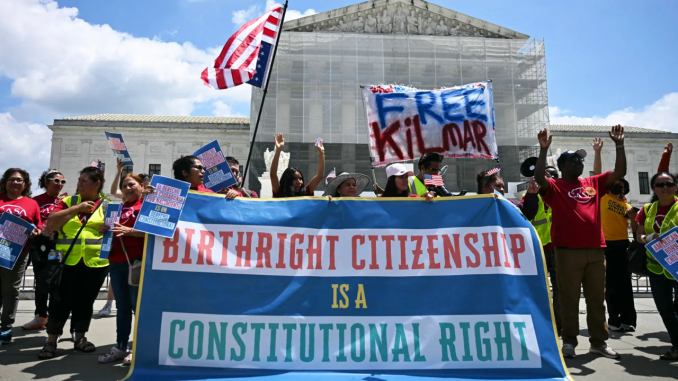
Six Supreme Court justices agreed that the constitution grants citizenship to all people born in the United States. This decision defied the wishes of the Trump administration, which wanted to revoke birthright citizenship since the beginning of its second term. However, the fact that three of the nine justices are willing to implement what was recently a far-right pipedream, the end of birthright citizenship, reminds us of the unprecedented, severe threats faced by immigrants and all people in this country.
Birthright citizenship is the legal concept that a person is an automatic citizen of a country that they are born in, regardless of whether or not their parents have citizenship status. For an enormous number of people, the consequences of birthright citizenship and access to basic legal rights are huge. It is estimated that close to one in ten births in the United States is from a mother who is either undocumented or with some form of temporary legal status. Ironically, even Folarin Balogun, the World Cup athlete at the center of Donald Trump’s latest controversy with FIFA of tipping the scales in his favor, happens to be a U.S. citizen precisely because he is a beneficiary of birthright citizenship.
The concept of birthright citizenship in the United States goes back to the period of Reconstruction following the abolition of slavery. As people who were formerly enslaved fought for their rights, the 14th amendment was passed, clearly outlining that, “All persons born or naturalized in the United States, and subject to the jurisdiction thereof, are citizens of the United States and of the State wherein they reside…,” among other legal rights.
Like the struggle to end slavery, the struggles of immigrants throughout the years pushed the legal boundaries and expanded who had access to basic rights. Yet the Trump administration and three Supreme Court justices tried to overturn birthright citizenship.
Many people can understandably breathe a sigh of relief with this Supreme Court decision. But it is nowhere near enough.
The decision on Birthright Citizenship comes on the heels of a previous decision by the Supreme Court to allow Trump to revoke Temporary Protective Status for Haitian and Syrian immigrants as well as those of a number of other nationalities. In a separate case, the court said that federal agents can physically block people at the U.S. border to prevent people from applying for asylum.
In addition, it is no secret that many in the Trump administration who are shaping immigration policies are open white nationalists. Stephen Miller, White House Deputy Chief of Staff for Policy, has openly espoused the “white replacement” conspiracy theory as well as promoting a range of white nationalist websites. Just because the white nationalists don’t get what they want all of the time, doesn’t mean that they don’t still pose a major threat to all of us.
This is not just about immigration policy.
On the last day of Pride Month, the Supreme Court allowed states to ban trans children and youth, including college students, from participating in school sports, in a decision that followed a series of attacks on the rights of trans young people. In a concurring opinion, Clarence Thomas was especially cruel, writing that any acknowledgment that trans people exist is “to lie to the public.”
Another recent major Supreme Court decision undercut the independence of agencies including the National Labor Relations Board, Federal Reserve Board, Federal Trade Commission, Federal Communications Commission, and many more. The recent Supreme Court decision effectively gives the president authority to remove leaders of these agencies that they choose—with one exception.
In Trump v. Cook, the court denied Trump’s request to fire Lisa Cook, a member of the Federal Reserve Board of Governors. The Federal Reserve is essentially the United States’ central bank, and its independence from interference by the president is very important to the financial industry that wants to keep capitalism running smoothly.
Similarly, earlier this year, the court enraged Trump by striking down his chaotic tariff plan that would have thrown a wrench into the global system of trade that rakes in profits for big businesses. The court is allowing Trump to implement his right-wing agenda in almost every instance. But this case threatens major corporations and the stock market.
We are living through a time period when all sorts of democratic norms are being challenged and undermined. The Trump administration brazenly defies the law, ignores court orders, targets its political opponents, threatens the media, seizes voting rolls, has normalized sending federal troops into major cities, goes to war and attacks places like Nigeria, Yemen, Venezuela and Iran without bothering to get congressional approval, and much more.
The Supreme Court also granted expanded presidential immunity to presidents, starting with Donald Trump, giving them almost free reign to behave lawlessly, that is, the freedom from prosecution for almost any crimes they commit in the course of their presidency.
So-called “separation of powers”
While none of this extralegal violence and mafia-like behavior is entirely new for a capitalist society like the United States, there was at least some pretense that there were rules that needed to be followed. One of those rules, that many of us were taught in school, was that there were three branches of government that would keep each other in check. We are told that this “separation of powers” provides the guardrails from authoritarianism taking hold.
But Trump, the Supreme Court, and Congress have shown that those guardrails don’t really exist. Trump and those around him in the executive branch have gotten the courts and Congress to fall in line with their policies. The Republicans in Congress have been practically in lockstep with Trump. And the Democrats would rather wring their hands and play by the rules of the game than challenge the system.
In the moments when there is some push-back, sometimes the Trump administration has been forced to comply, such as when the Supreme Court slapped down Trump’s so-called Liberation Day tariffs, and when Congress demanded that the Justice Department release the Epstein files. In the latter case, however, the release of files was far from complete.
In fact, Project 2025 – the right-wing playbook written by the Heritage Foundation as a guide to action for policies to enact under the second Trump administration – specifically outlines their perspective of the Unitary Executive Theory which would concentrate almost all power in the hands of the president while destroying what little power independent government agencies have.
At the core, we live in a system of government that is by and for the super-rich. This dynamic is true whether we live under a democratic government or a fully authoritarian dictatorship. Karl Marx infamously said, “…the modern state is but a committee for managing the common affairs of the whole bourgeoisie.” The quiet part was said out loud about this fundamental reality with the “Citizens United” Supreme Court decision of 2009 which said that corporations could donate unlimited money to political campaigns.
When the capitalist economy is relatively stable, the super-rich can rely on following democratic norms most of the time. When the capitalist economy is in trouble, democratic norms come to be seen by the ruling class as more and more of an obstacle to maintain their control and their profits. The Trump administration and the people who financially back it represent one part of the capitalist class that wants to challenge many of the traditional democratic guardrails. In demanding what they want, sometimes they lose (as with birthright citizenship) and sometimes they win but this doesn’t change the authoritarian trajectory on which our society is currently moving.
In fact, there is no so-called “balance of power” among the executive, legislative, and judicial branches of the U.S. government. The ruling class, from the slaveowners of 1776 to “tech bros” like Musk and Zuckerberg today, have always relied on the rest of us believing that we have real power through this form of government.
Instead of having illusions in institutions such as the court system, we need to have confidence in our own forces to fight back against the attacks on our needs and rights. We can only rely on our ability to mobilize ourselves to defend our interests.