October 19, 2026 editorial of the New Anticapitalist Party-Revolutionaries (NPA-R) in France, translated from French
On TV, [French President] Macron spoke more about the “violence” that marred the October 17 protests than about the causes of the anger. While he did say a few words about “legitimate demands,” it was only to announce a series of meaningless meetings, without any concrete measures. On the other hand, regarding the “rioters,” he called on high-ranking police officials and prosecutors to show them the utmost severity, while urging political parties to present a united front… all to bring everything back to the 2027 presidential election.
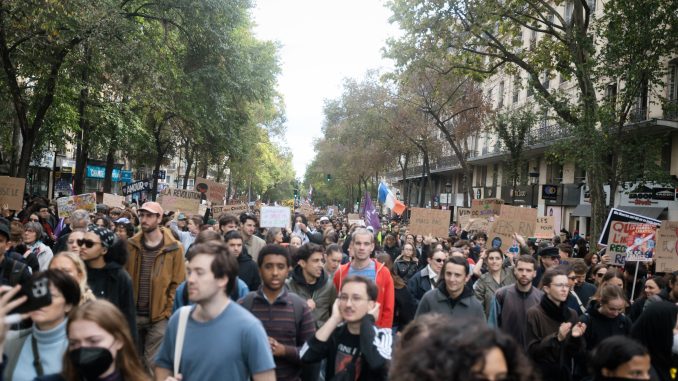
But it’s impossible to ignore the immense success of October 17. Whether Macron likes it or not, it’s going to be a hot fall! There were 550,000 demonstrators according to the police, or 800,000 as reported by the press—in any case, it was a massive mobilization for a date that came out of nowhere in early September, organized by the “Yellow Vests” (a French movement against economic inequality in 2018-2020) just to remind everyone that in 2018, the revolt had swept the country over a liter of diesel costing around… 1.50 euros per liter ($6.71 per gallon). It was the sudden emergence of high school students that gave the mobilization a major boost and put the date firmly on the calendar.
The government, terrified of seeing all the anger against its policies converge, tried to nip the high school students’ movement in the bud by using tasers, tear gas, and batons against very young teenagers. Yet nothing worked. The young people stood their ground, and their movement served as a catalyst: all the anger did indeed converge on Saturday, October 17!
Who are the real “rioters”?
Condemning the “violence” that is constantly being shown in the media, [Prime Minister] Lecornu issued a sort of ultimatum: “You have to choose a side: that of the Republic—and therefore the police—or that of the rioters.” There has indeed been violence, no doubt mirroring the violence the police inflicted on high school students, particularly in working-class neighborhoods, such as in the 93rd department (one of the poorest, youngest, and most diverse areas of France, with a high percentage of immigrants). This violence also reflects the anger toward a government that showers the wealthy with generosity while taking away everything that benefits the working class.
But those who condemn the vandalism and looting on a Saturday night seem blind to the devastation of lives caused by pro-business policies: 350,000 homeless people, nearly two million workers surviving on less than the minimum wage, and ever-longer lines at food banks and other relief organizations. A human tragedy, not just vandalized bus shelters!
And what about those who are dismantling public services? Who are letting schools fall into disrepair? Who have dismantled the public healthcare system? Those who are destroying jobs by closing factories? Macron, Lecornu, and [Minister of the Interior] Nuñez hope that the specter of “violence” will silence the anger: they will not succeed.
Protesting won’t be enough; we’ll have to bring the economy to a standstill.
Already, the national high school and college student coordinating committees are calling for new days of action starting Thursday, October 22, alongside the Yellow Vests on Saturday, October 24, as soon as classes resume on Tuesday, November 3, and, together with all workers, on November 5. The inter-union coalition had already scheduled this day for October in order to bypass—without mentioning it—the October 17 action. Not only was October 17 a huge success, but November 5 now appears to be a new, tangible milestone, particularly given the break for the All Saints’ Day school holidays, which puts the high school students’ mobilization on hold.
Just as high school and college students have done, we must begin discussing right now—in workshops and offices—how to organize ourselves to influence and build the movement. October 22, October 24, November 3, and November 5: all these dates must serve as milestones. Protesting is obviously important, but it won’t be enough. We’ll also have to paralyze the economy and move toward a general strike, because behind this government of the rich stand the rich themselves—specifically, the bosses—and we must make them spit back everything they’ve stolen from us.