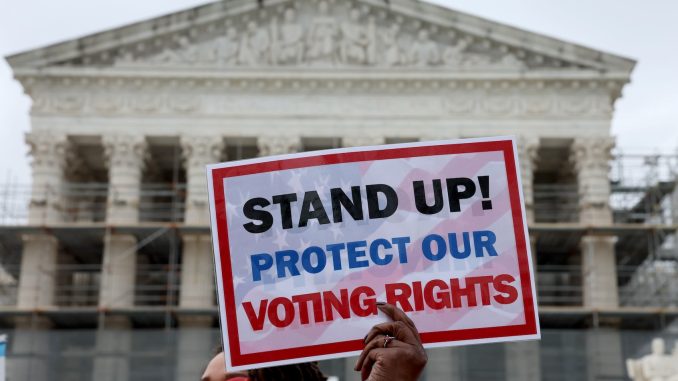
On August 24, the U.S. Supreme Court ruled against attorneys general from 23 states who had sued to prevent the Trump administration from trying to take control of upcoming midterm Congressional elections. Trump had found a backdoor way to achieve what he’s so far failed to do: control state voter rolls in order to say who can and can’t vote. On September 3, a federal judge made a new ruling, saying that Trump’s plan to use the U.S. Postal Service to block mail-in voting is unconstitutional. The following day, a federal appeals court made a separate ruling against Trump’s strategy to use a Postal Service database to block voters. Trump has appealed to the Supreme Court again.
If the court rules in Trump’s favor, he’ll essentially get veto power over voter lists and be able to claim that this or that voter is ineligible and prevent them from receiving a ballot. Even if the Supreme Court doesn’t give him this power, the timing of the ruling adds maximum chaos to upcoming elections, as some states have begun sending out their ballots.
As the Democratic Party and its officials pursue a legal strategy to beat back this federal takeover attempt, we also need to keep an eye on all the other threats to civil rights. The Supreme Court has been whittling away at voting rights for some time. First, they flooded elections (which had already been dominated by big money) with even more corporate and billionaire dollars through the Citizens United decision in 2010. As the conservative majority on the court has grown, it has become bolder, gradually destroying the Voting Rights Act that secured voting rights for non-white Americans in 1965. Racial gerrymanders are now essentially legal, meaning that the voting power of Black Americans is now diminished, especially throughout the South. Beyond legal interference in voting, there are other threats in play, including the possibility that Trump will deploy ICE as “election monitors” to intimidate voters at polling places, or to outright prevent disfavored groups from voting. And “election deniers” who tried to overturn the 2020 election are now in positions of power in some states.
In the face of these threats, the Democratic Party is doing its typical thing: sending out its lawyers and telling the rest of us to “just focus on turning out to vote.” We need to remember, though, that voting rights were not won for Black people by lawyers. Black and Latino people won those and other civil rights themselves through mass action and civil disobedience in the streets, in schools, at lunch counters, and through boycotts and strikes. All these actions caused so much disruption to the ordinary operation of U.S. capitalism that it became no longer worth it to the system to suppress their votes.
The same is true today. The one time so far that this second Trump administration has been set back on its heels was in early 2026, when ordinary people went into the streets in Minneapolis to oppose the ICE invasion of their city. Even then, the real victory only came when they withdrew their labor for a single day in a general strike on January 23. With 100,000 people in the streets that day, along with many more who simply refused to work, the city came to a standstill. On February 4, the federal government announced a “drawdown” of ICE from the city. In the days between the strike and this announcement, the CEOs of 60 large Minnesota-based corporations, like Best Buy and Target, signed a letter to Trump demanding an end to the ICE surge in the city. Generally, when corporations say jump, U.S. governments jump. The workers of Minneapolis did in one day what months of legal challenges by Democratic Party attorneys general had been unable to achieve.
We should keep Minneapolis firmly in our minds as we approach the midterm elections. Capitalist democracy is certainly better for ordinary people than the alternative of a dictatorship of Trump and his fellow billionaires, but we have to be realistic about the priorities and limitations of that so-called “democracy.”
We should see protecting these elections as a defensive project aimed at maintaining the rights of free speech and association. Waiting for election day and voting for Democrats, whose party is in bed with Wall Street, won’t solve the problem. The Democratic Party’s tactics are limited to endless legal maneuvers in a system designed to keep working and poor people in their place: working endlessly to produce capitalist profits, with no voice or impact in the big decisions that affect our lives. Working-class people need our own politics, independent of the bosses’ two-party system. If organized, we could overwhelm attempts to physically impede voting. Minneapolis showed us a glimpse of what’s possible.