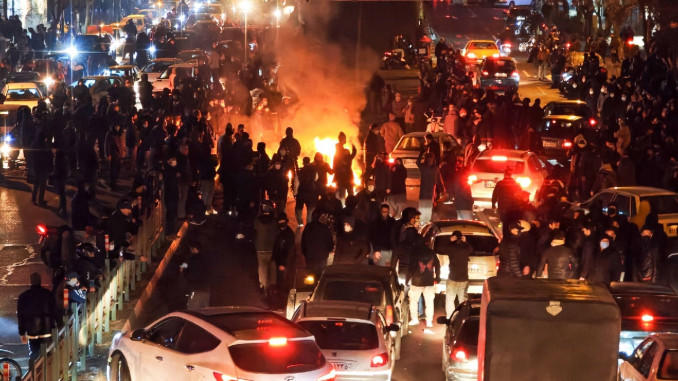
On December 28, masses of people took to the streets across Iran in protests that, in many cases, called for the downfall of the Islamic Republic. The Iranian regime responded with intense repression against the protesters with at least 4,500 reported massacred and many more missing. Not only was the regime shaken by the revolt of the Iranian people, but these events caused conflict and crisis throughout the world. Trump’s regime threatened to take military action, and Iran’s allies, China and Russia, looked to shore up the Iranian regime in case of a conflict. For a second, it seemed like revolution in Iran was on the table with unknown political consequences in the world. But now, after a few weeks of conflict, a tense calm has settled. While it may seem that the situation has stabilized, the tensions that led the people of Iran to revolt remain, and are only increasing. It is only a matter of time until Iranians take to the streets again to demand “Down with the dictator!”
The Iranian regime was established in 1979, in a revolution that overthrew the Shah, or king, of Iran. The Shah was backed by the U.S., which had placed him in power in 1953. During the Shah’s brutal 25-year rule, Iran’s massive oil wealth generated huge profits, primarily for Western companies. Iran’s population, especially the growing working class centered around the oil fields, saw no benefit from their labor. In 1979, Iran erupted in revolution, with cries of “Down with the dictator!” and “take control of the oil”. The working class paralyzed the country, and the mobilization of the oil workers broke the back of the Shah’s regime.
It wasn’t, however, the working class that took the leadership of the revolution. Islamic clergy, led by Ayatollah Khomeini, maneuvered their way to the forefront of the revolution, consolidated power, and formed a new elite. The newly minted Islamic Republic of Iran seized the oil from Western corporations, and delivered a degree of material benefits to the people, but primarily the new rulers of Iran enriched themselves. They used repression in the name of religion, especially the separation of genders and “modesty” for women, to impose control and repress challenges to the regime.
The Iranian revolution not only changed the regime in the country, it changed Iran’s place in the world. The Shah’s regime had been a major ally of the United States, and a pillar of support in the Middle East. The Unites States has worked since 1979 to overthrow the Islamic Republic, or at least to limit its influence. This has involved ongoing sanctions on Iran’s economy. The U.S. also fomented an 8-year war between Iraq and Iran which left at least one million dead. Sanctions have driven Iran to rely on trade with U.S. competitors, especially China. In addition, the U.S. has used treaties to limit Iran’s military power, such as the 2015 so-called Iran Nuclear Treaty, linking military limits to limited lifting of sanctions. The Trump administration has taken a more aggressive approach, for domestic political reasons as well as international ones, and scrapped treaties and increased sanctions. Trump has also supported unprecedented military action such as last year’s Israeli strike against Iran’s nuclear power sites. Relations between the U.S. and Israel on one side, and Iran on the other, teeter closer and closer to open conflict.
U.S. pressure on Iran has certainly created challenges for the Islamic Republic, but what we are seeing today is the escalation of movements by the Iranian people against the regime. In 2018, there was a movement against high water prices. Then in 2019, railway and bus workers struck against unpaid wages. This led to mass demonstrations against the rising cost of food, gas, and electricity. The regime met the movement with intense violence, killing 1,500 people. These protests were stifled by COVID-19—but the problems did not cease. In 2022, police forces of the Islamic Republic’s “morality police” killed a 22-year old, Kurdish-Iranian woman, Masa Amini, for failing to adequately cover her hair as is the law. The killing sparked outrage throughout Iran and more mass protests. Some 551 people were killed and 20,000 arrested. These protests marked a turning point as people stopped calling for economic relief or reforms, and began raising the old slogans against the Shah such as “Down with the dictator.”
Today, Iran is a powder keg set to explode. Sanctions continue to constrain the economy and climate change has led to a water crisis so severe, the capital city Tehran may be uninhabitable in the coming years. In addition, the Islamic Republic has lost valuable political and economic allies with the fall of the Assad regime in Syria and the Maduro regime in Venezuela. Economic, environmental, and political factors all weigh heavily against the regime and promise new explosions on the horizon.
A revolution in Iran would not automatically benefit the U.S. and Western corporations. Why would Iranians overthrow the wealthy elite in their country only to hand power to foreign corporations? In addition, the Islamic Republic will not go quietly, and its network of political and military influence extends throughout the Middle East. The Islamic Republic could cause enormous problems for the U.S. and Israel in all of the region if they feel their regime could end. In recent weeks, Trump blustered and threatened the Islamic Republic with missile strikes in supposed support of the protests but backed off, urged to do so by Israel and practically all of the Arab States. As much as they are in conflict with the Iranian regime, a genuine revolution poses a great threat to them as well.
The protests that have shaken Iran in recent weeks are the latest episode in the struggle of the Iranian people, which is moving beyond demands for reform to calls to overthrow the regime itself. Of course there are no guarantees, but this time the poor and working class of Iran could take the lead of a new revolution and shape the future in their own interests. They have had the experience of a revolution betrayed in 1979, and this time they may be on guard against new elites, religious or otherwise who want to hijack their revolution. We must support the struggle of the Iranian people, and its working class majority, against the Islamic Republic as well as against the predatory intentions of the Western corporations and governments. A revolution in Iran could raise much needed hope for change in the Middle East and the world.