Note: This text was completed on December 15, 2025 by Speak Out Socialists as background information for a discussion about the current international situation. It has not been updated to include the many important national and international events that have unfolded since its completion.
Introduction
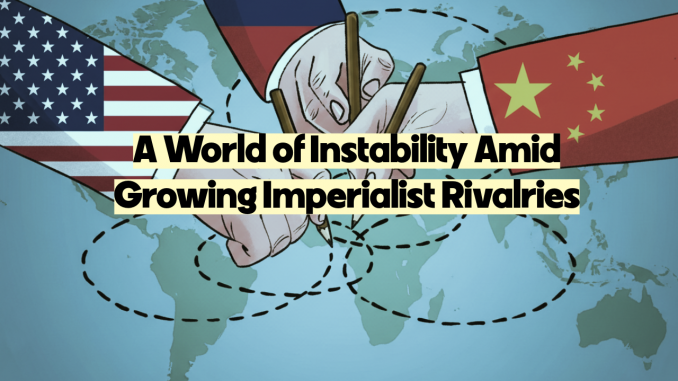
Increasing international instability continues to define the current period. Globally, we see growing militarization and conflicts in the Middle East, Ukraine, the South China Sea, South America, parts of Africa in Sudan, Eritrea, and the Democratic Republic of the Congo, between India and Pakistan, and beyond. In response to pressure from the U.S., European countries are increasing their military budgets along with their financial responsibility for NATO, as the U.S. attempts to reshuffle the priorities of U.S. imperialism, trying to pull back from its responsibility to defend Ukraine against Russia, and focus on its growing competition with China. Despite increasing international opposition, Israel’s genocide against Palestinians continues, with renewed efforts to normalize the ethnic cleansing of both the Gaza Strip and the West Bank. As climate destruction accelerates, increasing imperialist rivalries heighten global energy demand, especially for AI computing, only magnifying the impacts of environmental destruction and global heating. In this period, the pretense of the old liberal older is being increasingly abandoned for more explicit authoritarian regimes, which don’t hesitate to lay bare the dictates of capital, justified only through increasing xenophobia and ethno-nationalism. Across the globe, the world’s poorest countries, often ping-ponged between competing imperialist rivalries, face rising debts, increasing poverty, economic stagnation, climate instability, and are frequently ruled over by corrupt regimes, which are being increasingly challenged by a growing, young working class facing dwindling prospects, labeled by the media as Gen Z protestors. Much of this instability flows from intensifying imperialist tensions as the world is increasingly re-divided into competing spheres of influence, amidst ongoing barriers to significant capital growth.
At the center of this is the growing economic rivalry between the U.S. and China, intensifying existing instability and engendering new conflicts.
The U.S.-China: An Economic Rivalry
The foundation of the build up of tensions between the U.S. and China is a growing economic competition for dominance in several essential industries and global markets. Over the past few decades, the U.S. went from being a clear economic and military hegemon to one that now faces an economic competitor. As the post WWII global hegemon, the U.S. now faces sharpening tensions and economic problems due to the presence of an economic competitor, which is able to offer alternative economic relations to regimes both opposed and aligned with the U.S., challenging its total dominance of its traditional spheres of influence. China’s developing, global economic relations may have started out harmonious with U.S. interests, but they have grown to become legitimate obstacles, putting new restraints on previously unbridled U.S. domination — what many analysts refer to as a “multi-polar, great power competition.” It is not a competition between two equally matched global powers, but rather a competition of China, a rising imperial power, with the U.S., the pre-eminent imperial power.
China’s Rise: From U.S. Partner to Competitor
The rapid rise of China as a legitimate competitor took place over the last 25 years. In 2001, China joined the World Trade Organization (WTO) even as the U.S. Congress was still debating whether a “developing country” like China should even be allowed to join the WTO. In 2001, China’s GDP was 10% the size of the U.S. (China: $1.2T, U.S.: $10.2T). Today, China’s economy is over 60% the GDP of the U.S. (China: $18T; U.S.: $32T). China has surpassed the U.S. economy in industrial output, global economic trade, and international lending.
In having China join the WTO, the U.S. anticipated enormous opportunities for U.S. investment and capital accumulation through increased access to China’s massive workforce, minimal environmental and labor restrictions, access to rapidly growing industrial networks, and reduced tariffs. U.S. foreign direct investment in China went from less than $10 billion in 2000 (before China entered the WTO) to over $50 billion by 2008. China benefitted from this period as well, as it began to integrate much of the industrial technology coming from abroad into its own state-run enterprises — especially in finance, telecommunications, energy, steel, and auto — while building up large financial reserves. The relationship between U.S. and Chinese capital in the 1990s and 2000s was symbiotic.
Things began to change in response to the 2008 crisis. The 2008 crisis was a crisis of overproduction of sorts — more commonly phrased a problem of “overcapacity.” The growth of investment in China (and globally), along with the increasing industrial output did afford a period of global economic growth. But not enough. Capital cannot be endlessly reinvested back into growing production if global markets can’t absorb that level of increased output. So, during this period, capital found another sector of profitability in increased financial speculation. This speculation reached a breaking point in 2008. The global economy was hit hard and recoveries necessitated massive lending and debt accumulation to shore up losses. It was in the response to the 2008 crisis when Chinese capital began to grow in competition with the U.S.1
As the U.S. was bailing out its finance, energy, auto, and other sectors, so was China. But while the bailouts in the U.S. had little impact on China, the method of recovery in China began to squeeze U.S. investments in China. In China, the state’s financial stimulus was offered only to mostly state-owned companies as low-interest loans from state-run banks with the goal of rapidly expanding production and hiring — as China’s massive working class population could pose a major threat if unemployment spiraled too far out of control. So, these Chinese companies, leveraged with limitless state bank credit, and now equipped with the tech secrets of their former U.S. partners, began to squeeze out U.S. firms in the Chinese market and started to join them as competitors on the global scale.
By 2012, however, the Chinese stimulus had been slowing down, and China had an overcapacity crisis of its own — it couldn’t find sufficient markets to absorb the increasing investments in production. This is right when President Xi came to power and announced the Belt and Road Initiative (BRI) — a global infrastructure and economic development strategy to facilitate the export of Chinese capital by building economic trade routes to link China to other parts of the world. But the BRI was not just an attempt to create international markets for state enterprises to export their excess capacity. It was also an attempt to create new markets for Chinese finance capital. After 2012, China’s total foreign invested finance capital (including direct investment and loans) increased by about 40% per year over the next 10 years, going from $500 billion in 2012 to over $2 trillion by 2022. Not only was China squeezing out U.S. capital in China, but now it was squeezing it out of international markets too.
Since 2008, Chinese capital has been able to create an economic orbit of its own that parallels and poses a challenge to the U.S. In advanced manufacturing and technology, China has been able to acquire and develop leading technologies in robotics, electric vehicles, aerospace, 5G networks, cloud computing data centers, and fiber optic cables, bringing it into direct competition with U.S. firms. China has also secured long-term access to global oil, gas, iron ore, and lithium reserves through infrastructure deals (especially in Africa, South America, and Central Asia), again in direct competition with the U.S., and disrupting some U.S. geopolitical relations. And, through the BRI, China has built ports, railroads, power grids, and telecommunications networks globally, while leveraging new relationships through the BRICS economic bloc, putting China in direct competition with U.S. geo-political strategies, and directly competing with the U.S.-dominant IMF and World Bank.
Though China may not seek global hegemony, it has no choice but to seek economic stability through growth — basic capital accumulation — which increasingly requires the shaping of a new global order, one where the U.S. is less dominant, and where no single power dictates the rules of that global order. The problem is that U.S. imperialism has been built upon this foundation of global dominance, and sees any significant retreat from that dominance as a threat.
In Imperialism, Lenin poses the question about the transition from a relatively peaceful redivision of the world to a non-peaceful one as follows:
The question is: what means other than war could there be under capitalism to overcome the disparity between the development of productive forces and the accumulation of capital on the one side, and the division of colonies and spheres of influence for finance capital on the other?
So far, the history of capitalism has yet to show another means.
The Impacts of this Intensifying Rivalry:
1) An Acceleration of Ecological Crises
All of this intensifying competition has meant increased climate destruction, and a total abandonment of even the pretense of addressing a climate emergency. Global energy demand increases are continuing to accelerate year over year, especially as markets in India, South East Asia, the Middle East, South America, Africa and beyond continue to be major targets of foreign investment. Increasing electric vehicles, rapidly accelerating AI technology, along with growth in mineral extraction and more, all require unprecedented increases in energy demand. For similar reasons, raw material extraction is accelerating, with a 60% increase since 2010. Fossil fuel output continues to grow year over year.
Growth in renewables is only happening to help meet the increasing energy demands, as it is a better investment in areas deficient in fossil fuel sources (as in China, for example). Energy demand increases are so great that they cannot be met by accelerating fossil fuel output and renewables alone, and hence nuclear energy output and production is at an all-time high in 2025. Renewables and even nuclear energy are still touted as being motivated by carbon reduction goals, but in fact, they are simply needed to account for increased global energy demand, all of which cannot be met by fossil fuels. Energy independence and dominance can afford great leverage and defense within this contemporary imperialist rivalry, and are therefore unflinchingly pursued by the U.S., China, Russia, and every other regime with energy development possibilities. There is indeed a race for what’s left.
As a result, the worst impacts of the climate crisis are only accelerating, with absolutely no end in sight. As of October 2025, 22 out of 34 tracked planetary vital signs are at record levels, including carbon dioxide, methane, and nitrous oxide levels, sea level change, ocean heat content, ice mass reduction, Earth’s energy imbalance (absorbing more solar energy than it is reflecting), global tree cover loss, coal, oil, and gas consumption.2
Since 2023, the Earth’s energy imbalance and atmospheric greenhouse gasses have led to worsening feedback loops and a greater acceleration of climate disruption much more quickly than predicted by leading climate models. Climate change is altering cycles of energy and carbon regulation rapidly, disrupting the climate’s ability to regulate itself, and spiraling to temperature levels well past previous predictions.
Every tenth of a degree of planetary warming leads to a disproportionately greater rise in extreme weather disasters and people facing intolerable heat stress. Deadly floods, wildfires, and record-breaking heatwaves are more frequent and intense each year. Over the past 50 years, the average size of studied wildlife populations has decreased by 73%. More than 3,500 assessed wild animal species are threatened by climate change and climate-related species population collapse. The Atlantic Meridional Overturning Circulation (AMOC)3 — a major system of ocean currents that regulates global climate — is showing signs of significant weakening from rapid ice melt much faster than previously predicted. Freshwater is highly vulnerable to climatic changes connected to evaporation, flood/drought intensity, loss of ice, and snow cover. Now added to that precariousness is the massive use of freshwater needed for data centers and energy plants (particularly nuclear) needed to power them.
This long (and abbreviated) list of scientific global climate outcomes impact every living being on this planet. Hundreds of thousands of deaths, millions of displacements, and increasing threats of resource scarcity and resource conflicts related to global climate change have become the annual norm, and all of these trends are accelerating more rapidly than most of the models have predicted.
Despite these often being the most resource rich lands, many of the worst outcomes are disproportionately located in areas of the so-called “developing” world, impeded by imperialist needs, which impose life-threatening misery on the billions of people who live and work there.
The direness of the situation exposes the total sham of the many meaningless climate agreements, as economic necessity continues to trump even meager efforts at environmental preservation. Practically a complete theatrical spectacle, COP30 took place in November 2025 on the edges of the rapidly shrinking Amazon rainforest. Protestors, mainly from indigenous communities, attempted to force their way into the COP venue calling for land protection. It was later touted as a success that COP30 resulted in the formal recognition of land held and used by indigenous peoples and pledges to protect indigenous territories, but with no binding policy and few countries even taking the performative pledges.
Policy language has shifted towards “adaptation” to climate change, rather than “mitigation” with many countries’ representatives acknowledging that surpassing the 1.5ºC global warming limit is already set in stone. Rather than the robust climate denialism, which still exists, there’s a growing attitude of climate irrelevance. The pretense of ecological mitigation has been abandoned and instead, the COP meetings have turned into gatherings for industries and greater fossil fuel extraction. Trump’s refusal to participate signifies the growing irrelevance of these gatherings, and also that the U.S. is more interested in one-to-one meetings with heads of state to negotiate specific economic deals that strengthen U.S. imperialism. Climate irrelevance has replaced even the fake climate concerns of the earlier period because energy demands are too great to even allow any meaningful climate mitigation anymore. This is precisely why Trump has been so aggressive at completely shredding what little climate legislation remains in the U.S., and has been met with negligible opposition.
The existential climate crisis is also simultaneously increasing the volatility of the already unstable global economic system, exacerbating the destabilization of whole territories, creating famines, mass displacement, extreme weather, disrupting capital flows and economic activity and more. In fact, it isn’t just a race for what’s left — the race is also made increasingly difficult by the race itself.
Ultimately, to those in power, climate destruction is simply the name of the game and the price of doing business. To some of the most egregious tech ideologues, this has even driven part of their “doomerist,” post-humanist tech aspirations. Their goal is to invest and build such a robust virtual world that humans are no longer necessary (except of course, the few who can afford to survive it). Capitalism has produced two gravediggers: the working class as the gravediggers of capitalism; but now the capitalists as the gravediggers of humanity.
2) AI: An Intensification of Rivalries
The AI race is undeniable, and it is primarily taking place between the U.S. and China. AI is currently a market that can absorb a lot of investment, even if it is not yet profitable, due to its transformative impact on many industries. AI isn’t simply about potential labor-saving advantages. AI is a race for strategic economic and military advantage, which significantly augments the competition for raw materials and energy, while further exacerbating the ecological crisis.
AI is being pursued as a winner-take-all kind of competitive advantage — that is, achieving AI-dominance first will afford significant economic and imperialist advantages. On the military front, this includes things like autonomous military vessels and weapons systems that can be deployed in advance with faster response times and pre-emptive strike capability. This has the potential to upend current military advantages, opening up new possibilities for weapons systems, intelligence operations, drone swarms, and much more. The advantage of nuclear weapons was the threat of their use, prompting a nuclear weapons arms race. The advantages of AI for the military creates an even more intense and urgent race. Needless to say, the integration of AI in this way only increases the threat and destructive level of future conflicts.
And what AI can provide by way of military dominance, can also be said for economic dominance: labor savings, cost savings, speed of transactions, espionage, sabotage, misinformation, and much more. Most industries are already fast-tracking AI integration, creating a huge demand for AI-skilled programmers, as well as workers skilled in interacting with AI systems to apply them to various industry demands, just as the new computer industry decades ago demanded both computer technicians as well as an entire new workforce skilled in integrating computing technology into various industries. In China, for example, AI education is already compulsory in Beijing public schools starting at the age of six, with the explicit aim of preparing a new generation of workers, and it will soon expand to other provinces.
The AI race between the U.S. and China is complicated by a web of interdependence alongside intense competition for technological dominance, which includes efforts to decouple their supply chains. For the meantime, both countries are still vital to each other’s tech industries, even though they are both working to undermine the progress of the other. The relationship is a strategic standoff, where control over different parts of the supply chain grants each country different leverage.
Right now the U.S. has technological dominance in advanced chip design, through the U.S. company Nvidia, which produces the advanced computing systems for AI training. But the fabrication of the essential advanced chips primarily happens in Taiwan (which also depends on machines produced by the Dutch company ASML) through Taiwan Semiconductor Manufacturing Company (TSMC), producing over 90% of the world’s most advanced logic chips, whose necessity extends far beyond just the AI competition.
But, at the same time, China has near total dominance in the extraction and processing of rare earth raw materials, which are essential in the production of these advanced chips and many other vital high tech components used in many industries (including computing, electric vehicles, renewable energy, military weapons, and more).
This interdependence has complicated the competition and trade relations between the U.S. and China. Both China and the U.S. are working to develop independence from the other in this AI supply chain web. For China’s part, it seeks to achieve its own competitive chip design and manufacturing, while the U.S. seeks to both onshore chip production and develop other suppliers outside of Taiwan, while developing new partnerships to procure rare earth materials. But, none of this is expected to be fully decoupled any time soon.
The vital importance of Taiwan in this process is certainly part of the U.S.-China military posture in the South China Sea. One third of international shipping travels through this corridor and contains much of these vital supply chains. So, U.S. military presence in the area has everything to do with restricting China’s military dominance of that vital region. Taiwan has been a major recipient of U.S. weaponry, including an air defense missile system, F-16 fighter jets, and much more. There have been reports that Taiwan’s largest TSMC plant is equipped with explosives to quickly detonate in the event of an invasion by China, to short-circuit their ability to seize the chip fabrication technology.
As a consequence, the AI competition is skyrocketing the demand for energy and critical rare earth raw materials and related minerals, for high-powered AI computing, which require faster semiconductors, powerful magnets for cooling/robotics, and powerful data processing centers. These massive data centers come with enormous energy and water demands, diverting energy and resources away from cities, and further depleting dwindling reserves. Energy demand from AI data centers alone is expected to increase by over 30% per year for the foreseeable future.
Today, China accounts for about 70% of rare-earth mining and nearly 90% of processing capacity, giving them a huge supply chain dominance and leverage. The extraction and processing of the materials is very toxic and environmentally destructive, which is why it mainly takes place in countries that have limited environmental protections, like China.
The demand for rare earth materials extends far beyond AI, and into most industries that rely on computing or magnets in any way. The U.S. can’t shake this reliance quickly, but it is working as fast as it can to secure other sources around the world, like a multi-billion dollar deal with Australia, a deal with Argentina, some minimal projects in the U.S (which necessitated the elimination of various environmental protections which the Trump administration quickly rushed through after inauguration), and others. Just recently, for example, the U.S. signed the Pax Silica Declaration, uniting Australia, Israel, Japan, Singapore and South Korea in a collaboration explicitly intended to address deficient critical mineral access by edging out China’s near total monopoly in this sector. Still, overtaking China’s dominance of this industry is estimated to take over ten years.
In short, the AI race is an extension and an intensification of the U.S.-China rivalry. It is not just a competition for the technology itself, with many dangerous military, policing, and labor implications, but it is a competition for materials, energy, trade routes, and new economic relations with countries to procure these materials — that is, the AI race is also a race for both new and renewed international economic alliances.
3) Russia, Ukraine, Europe, NATO — Relationships Reevaluated
Russia’s invasion of Ukraine is certainly not a direct consequence of the U.S.-China rivalry. But it can be partially understood as a consequence of the decline of unrivaled U.S. hegemony. Just as China seeks a global order outside of U.S domination, so does Russia. The U.S. along with Western Europe sought to dominate Ukraine economically, posing a direct threat to Russia’s economy. Eventually Putin calculated that an invasion of Ukraine was necessary to pry Ukraine away from western domination, and allow Russia to seize Ukrainian territory, repeatedly claiming that Ukraine is part of its sphere of influence, and not that of the U.S. or Western Europe. A weakened U.S. was a likely part of that calculation. And Russia’s increasing alliance with China has helped Russia prolong this war despite international economic sanctions, as China heavily imports Russian oil and gas, and supplies key financial access to Russia, along with essential materials, like microchips and other tools for drone production.
Under Trump, the U.S. strategy towards Ukraine and Russia is complicated. First, the Trump administration has been much more explicit about its recognition that slowing China’s rising dominance is a greater concern for the U.S. than expending a seemingly unlimited stream of resources in an increasingly stalled out conflict, which European NATO members have yet to put forth significant resources to defend. This calculus has led Trump to pressure NATO members to more than double their military budgets by 2035, when they are supposed to reach 5% of their respective GDPs. If this happens, this would bring the military spending of NATO members to an estimated total of $2.7 trillion by 2035. These increases include both domestic military weapons production, and increased weapons purchases from the U.S. Most NATO members have agreed. At the same time, in this calculus, the role of NATO, though still essential to U.S. imperialism, could decrease as the priority shifts away from Russia and increasingly towards China, as NATO has primarily been an instrument of U.S. dominance in Eastern Europe against Russia.
At the same time, the Trump administration is trying to pressure Europe to renegotiate its trade relations to prioritize the U.S over China (as it is doing all over the world). This is a re-evaluation of old allied relationships, as the Trump administration thinks the terms of these relations can be renegotiated to better favor U.S. interests. In this reshuffling of economic ties, the Trump administration is supporting more far-right parties in Europe, with whom they anticipate stronger ideological alignment, and a better chance to negotiate new terms — perhaps even some that are more favorable to Russia. Rather than an abandonment of Europe, this is an attempt at a renewed relationship with an increasingly far-right Europe, which better prioritizes U.S. interests in this period of increasing imperialist rivalry. While this may be the goal of U.S. imperialism under Trump, there is no guarantee that attaching themselves more firmly to U.S. imperialism and U.S. interests at the expense of losing or disrupting essential economic ties to China is the best economic strategy for Europe. All of this is playing out rather overtly on the world stage.
There are some in the Trump administration who think they can go so far as to achieve what they call a “Reverse Nixon” strategy (including Monica Crowley, former U.S. Assistant Secretary of State for Public Affairs; Michael Waltz, current ambassador to the U.N., and former National Security Advisor, but removed due to the so-called Signalgate scandal; and Elbridge Colby, currently serving as Under Secretary of Defense for Policy, awaiting confirmation which is being disputed). Trump himself and Secretary of State, Marco Rubio have each expressed sympathy with this strategy. While Nixon forged an alliance with China to counter the Soviet Union, some Trump advisors think they can break Russia away from China and possibly forge better relations with Russia. This partly seems to align with the Trump administration’s support for some far-right parties in Europe, which the Trump administration thinks could support this sort of softening of relations with Russia. Regardless of the possibility of such a strategy ever succeeding, in the meantime, China and Russia’s relations have only gotten stronger since Russia’s invasion, and current U.S. relations with much of Europe seem very strained.
Trump’s latest attempt at a so-called peace settlement between Russia and Ukraine reflects his administration’s complicated goals in the region. Despite widespread opposition from most NATO members, Trump proposed major concessions from Ukraine, including: territorial concessions (Ukraine must recognize Crimea, Luhansk, and Donetsk as Russian territory, and cede more land to Russia); military limits (capping the Ukrainian armed forces at 600,000 personnel, a reduction to about 1/3 its current size); a permanent promise to never join NATO; total amnesty for Russian aggression; and lifting of all sanctions on Russia. But in the end, neither Russia nor Ukraine agreed. Russia wanted even greater concessions, and seems to expect that it will be in an even better negotiating position by extending the war and intensifying its attacks on Ukraine.
A re-evaluation of NATO and relations with European allies and Russia’s assertion of dominance in the region are all symptoms of this period of intensifying rivalries brought on by a decline in U.S. hegemony, and a redivision of the world into redefined spheres of influence.
4) Palestine: The Normalization of Genocide to Prop Up U.S. Imperial Dominance in the Region
Settler colonialism, in all its instances, has generally implied a logic of elimination towards the indigenous population. And this logic has only grown more intense and explicit as Israel has continued to expand its settlements. Thus, over the last period, much before October 7, a further right-wing, Zionist representation of this policy of erasure has come to the surface. And what we have seen since October 7 is the full expression of this ideology of total genocidal erasure.
Officially, over 70,000 Palestinians have been reported to be killed. The unreported number is estimated to be much higher, with some estimates at over 300,000 dead. The entire population of Gaza is facing severe food insecurity, with over 25% facing the worst phase of acute hunger. Over 90% of buildings have been destroyed, including schools, universities, hospitals, water treatment facilities, and power stations. The devastation in Gaza has been catastrophic.
Prior to the attack on Oct. 7, 2023 by Hamas, the U.S. was facilitating the normalization of relations between Israel and other Arab states, particularly a special agreement between the U.S., Israel, and Saudi Arabia, and a similar agreement with United Arab Emirates. The Saudi deal would have established an official defense pact, obligating the U.S. to defend Saudi Arabia in an attack, along with further military and economic ties, including U.S. support for the construction of a nuclear energy program in Saudi Arabia, and a promise from Saudi Arabia to stop its military cooperation with China. These deals were postponed by Hamas’s attack.
Some 48,000 protests in opposition to Israel have been held across the globe since Israel’s invasion of Gaza. The protests against Israel’s ongoing atrocities are awakening a new generation to the realities of Israel’s occupation and its backing by U.S. imperialism. Israel intercepted a major aid flotilla of 40 boats in October 2025, detaining over 450 activists, who were arrested and held in harsh conditions and deprived of food, water, and medicine, including Greta Thunberg and Nelson Mandela’s grandson, Mandla Mandela. In response, last October there were renewed protests against Israel, including over 400,000 people in the streets of Spain, and hundreds of thousands in a one-day general strike for Gaza in Italy.
Despite a global opposition to Israel’s genocidal war, the U.S. has been unflinching in its support of Israel, offering military support at every turn, negotiating so-called ceasefires as Israel undermines them. In effect, the Trump-negotiated ceasefire has served as diplomatic cover for what is an accelerating Israeli policy of ethnic cleansing. U.S. imperialism has been willing to normalize genocide in order to shore up its dominance of the Middle East through force, relying on and supporting its trusted military partner, Israel, which has attacked Iran, and Iranian-backed forces — Hezbollah in Lebanon, the Houthis in Yemen, as well as Iran-aligned militias in Syria — without yet sparking a regional war. Iran and its military alliances — including its dominance inside Iraq through its ties with several Shiite Iraqi militias — have posed a challenge to the U.S. hegemony in the region. But the U.S. and Israel’s attacks on these forces have been aimed at signaling a renewed U.S. dominance in the region.
China’s increasing involvement in the Middle East, stemming heavily from its energy needs and other economic interests, has connected China to all of the key regional powers, including Saudi Arabia, Iran, Israel, and Egypt. China has prioritized economic ties and infrastructure investments, particularly in ports and energy facilities (under the BRI), often taking advantage of geopolitical rifts between the U.S. and its regional partners, while presenting China as a reliable economic partner that, unlike the U.S., refrains from interfering in the domestic/political affairs of its partners. China’s approach in the Middle East mimics its approach globally: a gradual attempt to increase its economic footprint and leverage in the region, while simultaneously taking advantage of and furthering the erosion of U.S. dominance.
The Trump administration has been busy trying to revive the earlier agreements that were on the table before the Oct. 7 attack with Saudi Arabia and UAE, which was the primary reason behind his trip to the region last May, besides any personal bribes he might have received. Since Trump’s return, Israel’s relations with UAE and Saudi Arabia have improved, with increasing trade, and more Israeli companies operating in UAE. Trump has promised military contracts and advanced technology deals to both Saudi Arabia and UAE, along with tacit agreements so far to prioritize relations with the U.S. over China.
U.S. imperialism is certainly not ready to move out of the way and relinquish any of its claim to regional dominance in the Middle East. But reasserting this dominance as it removes large numbers of troops stationed in the region, and recovers from costly and long wars there, has necessitated a doubling down on its support for Israel as the representative of U.S. military power in the region, which has required ironclad U.S. support of Israel’s policy of genocide. Israel continues to dominate U.S. politics through AIPAC (American Israel Public Affairs Committee) and its various Super Pacs, spending tens of millions of dollars on campaign financing in order to ensure candidates are openly supportive of Israel. And since Trump’s latest so-called ceasefire deal, Israel has intensified its effort to back the seizure of Palestinian land by settlers in the West Bank, continued its attacks in the Gaza Strip, and promised to open the Rafah border crossing with Egypt only for Palestinians to leave, with no guarantee they will be able to return. The recent agreement has effectively split the Gaza Strip in half with a line running from north to south (the so-called “yellow line”), giving Israel control of nearly 60% of Gaza, which an Israeli military general referred to as the new official border of Israel with Gaza.
5) Central and South America: Reasserting a U.S Sphere of Influence
The Trump administration is increasing its military posture in the Caribbean, and threatening an immanent attack on Venezuela to overthrow the Maduro regime, recently seizing two Venezuelan oil tankers, amassing a large naval fleet in the region, with reports of covert operations on the ground as well. How all of this unfolds, time will tell, but it is clear that the U.S. is aggressively intensifying its claim to the hemisphere as its sphere of influence, in what the Trump administration has called the “Trump Corollary” to the Monroe Doctrine. This is nothing more than a pronouncement that the U.S. will make a major push to reclaim its economic and military dominance of this hemisphere.
Needless to say, this has nothing to do with reducing the level of cocaine or fentanyl in the U.S. Rather, Central and South America have been traditional strong holds of U.S. imperialism, whose regional dominance has seriously weakened over the past two decades.
It is certainly not a one-to-one correlation that wherever U.S. dominance wanes, China’s influence gains. But the two are related. Since the 2008 economic crisis, China has been able to offer an alternative source of funding and economic alliance outside of U.S. imperialism. Whether with Brazil, Venezuela, Mexico, Ecuador, Panama, or Argentina, China’s economic ties to the region have increased about 40-fold since 2000, with 2024 being the highest trade volume on record at $518 billion. In that period, the U.S. total trade volume with the region has declined about 8%. Needless to say, a small political and economic tug of war between the U.S. and China has developed with some countries in the region.
With respect to Venezuela, the U.S. is interested in weakening China’s economic ties and revamping its own. China’s relationship to Venezuela began to solidify in the early 2000s, under the regime of Hugo Chávez, who established the China-Venezuela Joint Fund in 2007, which included billions of dollars in Chinese loans in exchange for Venezuelan oil and other mining sectors. The economic sanctions imposed on Venezuela by the U.S. has led to hyperinflation, scarcity, increased poverty, and deteriorating social conditions triggering a massive humanitarian crisis, which has forced over 7 million people to flee since 2014, with Colombia absorbing the largest share (around 2.8 million). In addition to Colombia, increased exodus of Venezuelans to several other countries in the region has fueled rising xenophobia against Venezuelan immigrants, especially in Peru, Ecuador, and Chile. Venezuela’s relations with China have not made an impact on the general economic deterioration as their trade deals have to do with finance and trade, and have limited impact on access to day-to-day goods heavily impacted by sanctions. This has all continued under the Maduro regime. The open hostility of the U.S. to Venezuela has certainly increased under Trump, but it is an acceleration of a bi-partisan strategy to re-establish economic dominance over Venezuela and the region in general — and to do this they think Maduro has to go. Venezuela has the world’s largest oil reserves and enormous mineral deposits and is seen by the U.S. as a major market of potential investment if a friendly regime were to come to power there.
This is the general strategy in the region, with shifting political and economic alliances, notably including Brazil, Argentina, the Panama Canal, and more. The Trump administration is maneuvering with loans, political support, and military threats to reposition itself as the dominant economic player in the region, weaken the position of China, and politically weaken or remove those regimes that do not comply through tariff blackmail, election interference, or the threat of brute military force. As with all things Trump, there is a big gap between a pronounced strategy and actually executing it.
In Honduras, the Trump administration has tried to intervene in the recent election of thin margins, backing the slightly more conservative candidate Nasry “Tito” Asfura of the National Party against Salvador Nasralla of the Liberal Party. Trump gave a full pardon to former Honduran President Juan Orlando Hernández, who was convicted of drug trafficking in New York last year and was serving a 45-year sentence in the U.S. Hernández is a member of Asfura’s party. On the surface, the Trump administration claims its primary interest in Honduras is about cooperation related to migration and counternarcotics. But at the same time, China has also made inroads in Honduras both economically and politically, especially after Honduras established official diplomatic relations with China in 2023, breaking off decades of alliance with Taiwan. Even though Honduras has remained a steady hub of the U.S. military’s Southern Command, it is still another country the U.S. would like to bring more firmly under its domain and isolate from China.
The situation is similar in Colombia, which, too, has expanded its trade relations with China to the annoyance of the U.S. Trump has repeatedly said of Colombian president, Gustavo Petro, that “he will be next” after Maduro. Of course, the threat is ostensibly about drug trafficking, but in fact it is about pressuring Colombia into a position that is more favorable for U.S. imperialism.
Trump has also courted El Salvador’s right-wing dictator, President Nayib Bukele. Though elected to El Salvador’s presidency, Bukele has governed as an open dictator, indefinitely suspending civil liberties, blatantly violating the Salvadoran constitution’s presidential term limits, sending the military into the legislature to force a vote the way he wanted. He has also led a military crackdown on gangs, amassing brutal prisons, and carrying out extra-judicial killings and flaunting them publicly. This crackdown on gangs has won him some popular support because the gangs terrorize many communities. In addition to sending immigrants from the U.S. to Bukele’s prisons, Trump sees in Bukele an ally, and perhaps even a style of governing he would like to emulate.
Argentina is also in the middle of the tug of war of shifting rivalries in South America. China is Argentina’s second-largest trading partner after Brazil and the top purchaser of its agricultural exports. China has a major foothold in Argentina’s telecommunications and internet market. The Chinese technology company Huawei operates a 5G network in Argentina, and Argentina’s largest telecom company, Telecom Argentina, recently received a $74 million loan from the Bank of China. China is also financing the construction of a nuclear power plant in Argentina, has significant investments in mining projects across the country, and is trying to expand its uranium sources amid growing electricity demand.
Argentina has faced a long-term economic crisis, with mounting debts, skyrocketing inflation, and massive austerity with no real end in sight. This growing economic crisis, and the new authoritarian regime of Milei has given the Trump administration an opportunity to renegotiate terms and conditions of economic ties. The Trump administration offered a $40 billion lifeline, which Milei was able to point to in order to help his party win in the midterm elections in October 2025. In return, the U.S. is asking for greater cooperation in restricting China’s access to Argentina, both as part of their current strategy of reasserting U.S. dominance in the hemisphere, but also to give the U.S. more leverage in its ongoing negotiations with China. In addition, the U.S. is interested in expanding its own access to the country’s uranium supply. In the words of Trump’s Treasury Secretary, Scott Bessent, speaking about recent talks with Milei’s government: “Milei is committed to getting China out of Argentina, [as] we do not want another…China-led state in Latin America.”
In Mexico, the situation is a bit more complex, as the country shares a border with the U.S. China is the second largest exporter to Mexico after the U.S., exporting $130 billion in goods to Mexico last year, while the U.S exported about $334 billion. A major issue in the trade talks between Trump and Mexican President Claudia Sheinbaum has been about Mexico’s trade with China, and China’s ability to get around U.S. tariffs by trading with Mexico directly. Recently Sheinbaum’s administration announced major tariffs — as high as 50% — on imports of a variety of products from China. Officially, Sheinbaum denies that this was done in order to appease the Trump administration, and claims it was done to boost the Mexican economy. That may be true, but it is also exactly one of the main requests of the Trump administration in their trade talks.
In short, under the Trump administration, we see a rejuvenated effort to reduce China’s footprint in the hemisphere, precisely as the U.S. tries to reclaim military and economic dominance over the region. At the same time, the Trump administration is trying to exploit a rightward shift in many governments in the region, resulting from the failed attempts of the social democratic experiments of the 2000s — the so-called “Pink Tide” in Central and South America — which were unable to slow the ongoing economic instability and stagnation.
6) A New Scramble for Africa?
Africa stands out as the main continent where China’s strategy of weakening U.S. dominance has gained the most ground. China has nearly matched U.S. foreign investment levels in Africa, through its own lending mechanisms and its BRI, especially in South Africa, Mozambique, Niger, Algeria, Democratic Republic of Congo (DRC), Ethiopia, Sudan and more. In Sudan, the U.S. and China have competed for oil contracts, with China outpacing the U.S. In the DRC, there is a competition for mineral extraction and trade contracts. This competition has only led to greater instability in the region, as evidenced by the civil wars in Sudan, Ethiopia, and other regional conflicts, as well as an increase in popular movements of the poor and the youth, pushing back against economic decline, climate crises, and political corruption. Russia is also vying for a bigger military presence on the continent, negotiating security partnerships and political alliances in countries experiencing internal conflict or heightened instability. Despite their different approaches, China and Russia are now the two largest arms suppliers to sub-Saharan Africa, with Russia providing about 21% of arms to the region, and China about 18%. Meanwhile, the U.S. under Trump, has pulled back millions of dollars in aid, ending its decades long run of being the single largest donor, previously providing up to 26% of all aid going to Africa. Instead, the Trump administration is interested in making country by country deals based on economic partnerships that favor the U.S. and further isolate China and Russia. To some extent there is a new “scramble for Africa” underway (the first “scramble for Africa” took place between 1881 and 1914 as the continent was carved up between the rising imperialist powers of the time).
In the midst of this redivision of Africa among rival powers, many countries face mounting debts, political corruption, and worsening social conditions that have given rise to both civil unrest from below and civil war between different factions vying for power.
In Sudan, we have seen a decades long crisis founded on long-term stagnation, poverty, political corruption, and competition for resources, including oil and gold, continuously throw the country into episodes of internal armed conflicts, with different armed groups competing for power. The current civil war — between the government’s Sudanese Armed Forces (SAF) and the Rapid Support Forces (RSF), which is heavily backed by United Arab Emirates — has spread from the capital to other regions of the country, including Darfur in the west. According to the UN, since 2023, more than 8 million people have been displaced during the war, and more than 13,000 people have been killed. Almost half the population, 25 million people, are in need of humanitarian assistance.
The story is similar in the Democratic Republic of Congo (DRC). In addition to the common post-colonial story of economic decline, widespread poverty, and ongoing political corruption, the DRC is rich in natural resources, including coltan, gold, diamonds, and cobalt. The competition and exploitation of these minerals adds to the ongoing conflicts between rival groups. Some armed groups are financed by their control over of these resources. Currently, there are over one hundred active armed groups in the DRC, most of which are local militias tied to various communities and regions.
The current conflict in the DRC dates back to the civil war period following the Rwandan Genocide, in 1994, when 800,000 people were slaughtered. Some of the conflict of today dates back to this period, when many armed groups arose, each with constantly evolving alliances and rivalries, which have led to mass killings, disappearances, sexual violence, and torture. More than 6 million people have died as a result of conflict in the DRC since 1998, many of them killed by hunger and disease, with rampant sexual violence targeting over 1.5 million women in the country.
The U.S. and China continue to inflame this conflict as they try to navigate competing mineral extraction projects. China tends to offer infrastructure development projects in exchange for mineral extraction deals, while promising a policy of non-interference in domestic affairs, essentially trying to navigate around the internal conflict to achieve its resource extraction goals, while providing its own security personnel to protect its economic activities. In 2024 Chinese companies invested about $7 billion to build significant infrastructure projects — roads, railways, power plants — and in return, Chinese firms gained long-term mining rights to vast copper and cobalt deposits, with Chinese companies owning or co-owning over 80% of the DRC’s copper mines and processing about 80% of the country’s cobalt exports.
The U.S., on the other hand, offers security assistance tied to resource extraction guarantees. As recently as December 2025, the Trump administration has signed a so-called peace deal aimed at ending the conflict in Eastern Congo. The U.S. will provide training and military equipment to counter the militia groups, and has even helped broker a deal with Erik Prince, the founder of the private military contractor Blackwater (now part of Constellis Holdings), for logistics and security in mineral-rich areas. This is not all that new, as Prince’s private mercenaries have also provided security for some Chinese firms in the region. In exchange for the security guarantees, the U.S. is supposed to get proprietary access to a variety of essential minerals, and intends to push the DRC to circumvent their prior dealings with China. The precise outcome of all of this remains to be seen.
Overall, much of the continent is caught between this tug of war of imperialist rivalries, with no exit strategy from the longterm stagnation, poverty, political corruption, and unrest. It seems the whole continent is a ticking time bomb.
7) Gen Z Protests: Outcries Against Decay
Spanning countries in Africa, Asia, South America and Europe, both in recent months and years, so-called “Gen Z” protests have sprung up in Madagascar, Nepal, Peru, Bulgaria, Sri Lanka, Indonesia, Tanzania, and several other countries. There is a confluence of factors motivating these primarily youth-led protests, including outrage at government corruption, shortages of water and energy, and limited access to education and healthcare amidst increasing climate insecurity, rising poverty, dwindling economic prospects, and a growing lack of confidence in governments to address any of these problems. Some of the protests are reminiscent of the early period of the Arab Spring, but in different contexts. In most cases, these protests have been met with massive repression, even bringing a new military regime to power in Madagascar. Many of these protests have led to legislative changes, political crises, or occasionally new regimes, but not lasting changes.
Whether these uprisings are just flashes in the pan or perhaps signs of a bigger resistance to come is still unclear. But, while these protests do express the dashed hopes and frustrations of a generation of working-class youth, facing a future with limited prospects, the general working class has largely been absent from many of these struggles. And most of the leadership of these struggles still remains politically reformist in their aspirations, calling for changes that cannot address the systemic instability at the root of these problems. But, as the world continues down a path of increased instability, exacerbated by imperialist rivalries, the downward pressure in these countries will only grow more intense. It is easy to imagine that the factors pushing youth into the streets today could bring the working class with them tomorrow, when the dead-end of national and reformist solutions could be even clearer.
8) Trumpism: A Strategy for Reclaiming U.S. Imperial Dominance
The Trump administration is anything but unified and monolithic, yet the one area there is firm agreement around is in the strengthening of U.S. imperial dominance around the world, especially with respect to China.
It is not that previous administrations haven’t taken on the same challenge. It’s just that since Obama, and the 2008 crisis, China’s rise has continued to grow, as U.S. dominance has declined. In that sense, there is an opening for a new aggressive strategy. The fact that there has been minimal opposition from the biggest economic players in the U.S. to much of Trump’s policies shows that they are at least willing to see where it could lead.
There are several pieces to this strategy. They aim to prioritize economic dominance in all spheres. They use tariffs to coerce countries into taking a firmer stance with the U.S. over China, punish those that don’t comply, and charge a fee to do business with the U.S. They are expanding the military and repressive forces, and are using the state to seize extra capital through tax cuts and cuts to social spending. The concentration of power in the executive branch is also tied to removing legislative obstacles to economic and military policies. They are cutting environmental protections, which are obstacles in the way of energy dominance, AI ascendency, and mineral extraction. The increase in repression is rampant, and seems anticipatory of the kind of unpopular economic, political, and military positions the U.S. will take going forward in this effort to reclaim dominance, which requires higher rates of exploitation at home and abroad and likely more military conflicts. Far-right nationalism and authoritarianism is the ideology which they think is the most effective to carry all of this through. And this is also why it is showing up in other parts of the world, where the Trump administration is seeking renewed allies.
Conclusion
There is no part of the world that is not touched by this growing instability, augmented by increasing imperialist rivalries. But more importantly, there is no improved imperial arrangement that can come out of this. Growing imperialist rivalries don’t usher in greater peace and prosperity anywhere. We already see the future of what this competition promises in the tens of thousands of dead in Palestine and Ukraine, or in the collapse of other regions to climate destruction, rival gangs and militias, or civil war, along with the rise in authoritarian regimes all over.
Everywhere social democratic forces have offered an alternative, they have ended up betraying their utopian promises, unable to break out of the stagnation that comes with this period, trapped in growing debts and runaway austerity. This imperialist world affords very little wiggle room for perspectives that stay trapped within national borders and only offer national solutions to the problems of the international capitalist system.
What we have seen is that the dangers of this entire international system are being increasingly exposed. The pressure inside every country is increasing, the squeeze on the working class intensifying. In practically every corner of the globe, the objective conditions are certainly ripe for massive upheaval, but the class consciousness and militancy of the international working class is still at a low level, and organizationally it is still too weak and often isolated to immediately meet the tasks that the period calls for. But the importance of an internationalist revolutionary perspective, against far-right and social democratic nationalism, is as great as it ever has been. Resistance will emerge to this miserable order — as it already has. And where revolutionary organizations are built up in the working class, where international revolutionary ties have been developed, the possibilities will emerge for intervening and offering a real strategy of revolutionary transformation.
- For a full exposition of this shift from harmony to competition, see: Hung H. Clash of Empires: From “Chimerica” to the “New Cold War.” Cambridge University Press; 2022. ↩︎
- Ripple, WJ and C Wolf et. al. The 2025 State of the Climate Report: A Planet on the Brink. BioScience, Volume 75, Issue 12, Pages 1016-1027. Published 29 October 2025. ↩︎
- The AMOC is a vast system of ocean currents in the Atlantic Ocean that transports warm, salty water northward near the surface from the tip of southern Africa to the northern North Atlantic and returns colder, denser water southward. This circulation plays a key role in regulating Earth’s climate by moving heat between the tropics and the poles. When the AMOC slows, it can significantly alter weather patterns, influence sea level rise, change heat and carbon uptake in the ocean, and potentially contribute to deoxygenation and disruptions in ocean ecosystems. ↩︎