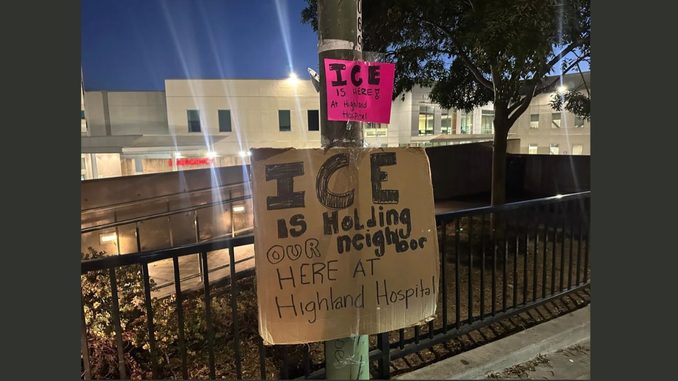
On October 16th, ICE agents violently assaulted a community member in Emeryville, CA, breaking six of his ribs and resulting in his nearly week-long hospitalization at Highland Hospital in Oakland. Despite the lack of a warrant, ICE agents were allowed to stay at the patient’s bedside in the hospital for six days. The patient was ultimately discharged from the hospital directly into ICE custody, where he currently remains.
Alameda Health System (AHS) leadership and county authorities directly violated their own policies as well as state mandates throughout this person’s hospitalization. They failed to verify the legal validity of the agents’ presence in the hospital, as required by their own internal protocols. At the direction of county sheriffs, Alameda Health System broke policy by anonymizing the patient in the hospital census, leading to inexcusable delays in the patient’s ability to connect to legal aid.
This detention was also a test of Alameda County’s policy to ensure county properties are ICE-Free Zones. Unfortunately, the county also failed to adhere to its own policy. Alameda County sheriffs enabled ICE agents to use county hospital property as a staging area, in direct violation of the ICE-Free policy. Sheriffs protected and escorted the agents, blatantly disregarding official signage that prohibits such use of county property.
Despite the failure of hospital and county leadership to protect this person, he was not facing ICE alone. From the moment the news broke that someone who had been assaulted by ICE was being held in our Oakland safety net hospital, community members and hospital workers stepped up on his behalf. Members of the public came to Highland to provide 24/7 presence around the hospital throughout the entirety of this person’s hospitalization. They came from all ages and backgrounds, but were united in a sense of responsibility to observe and document the actions of ICE and the response of hospital leadership. With no organizational hierarchy or assigned leaders, people were eager to fill in wherever they were needed. Many people delivered a steady supply of hot coffee, donuts, pizza, hand warmers, and immigration rights resources. These community donations were enthusiastically shared with hospital workers and with people coming to Highland for care. Concerned members of the public gathered on the sidewalk surrounding the hospital, and supportive neighbors opened their bathrooms to those on watch.
Hospital workers also showed up to advocate for this patient, and to demand that AHS leadership meet their obligation to keep their patients safe. Workers jointly composed a letter to upper management outlining the numerous failures of AHS to comply with policy and with state and local mandates. They demanded that their concerns be addressed, and that the patient’s rights be protected. The response from AHS CEO James Jackson included only that “staff should not interfere with law enforcement activities” and that they should “carry out their job responsibilities as usual.” None of the healthcare workers’ demands were addressed.
On October 23rd, the community was shocked to find out that the patient had been handed off directly from Highland into ICE custody. With the news full of stories of detention center deaths and overseas disappearances, people found it unacceptable that our county and hospital leadership failed on so many levels to keep our neighbor safe. Healthcare workers and community members held a rally in front of the hospital that night, speaking up against ICE, as passersby honked their horns in support.
The following week, on October 27th, the Alameda County Board of Supervisors and Alameda Health System leadership held a joint meeting and included an agenda item to discuss the ICE response. Again, the community showed up in force, filling the room provided as well as an overflow room, with almost 100 additional people showing up on Zoom. The AHS CEO clumsily opened the discussion with a letter supposedly from an anonymous healthcare worker who was frightened by the “protestors” outside the hospital. He neglected to acknowledge the letter provided by clinicians demanding that AHS do better, or to address the ongoing outrage of the public. The AHS legal team then gave a presentation about the ICE training that they claim to have provided to hospital workers, to the confusion of Highland workers in the audience who confirmed they have received no such training.
The patient’s attorney, Nikolas De Bremaeker, revealed that no warrant had been supplied for the patient, to the shock of Alameda County Supervisor Nikki Fortunato Bas, who had been assured otherwise by hospital administration. When pressed on the issue of the warrant, the AHS legal team stumbled over their words, admitting, “We did request a copy and we weren’t provided with anything.” Supervisor Fortunato Bas expressed frustration at the breakdown of policies intended to keep people safe on county property, stating, “We could have kept that person somehow from getting into ICE’s hands. And that’s completely unacceptable to me.”
During public comment, multiple AHS workers reiterated how the system failed this patient and the community at large. Healthcare workers spoke about encountering patients frightened by the prospect of ICE in their hospital, who cancelled their appointments, including for necessary prenatal care. Community members spoke of their disgust at seeing AHS leadership and Alameda County sheriffs collude with ICE to protect them and facilitate their abusive practices.
The meeting concluded with the county board of supervisors calling for AHS leadership to submit a report on the “facts” of this incident for their review. But the public and AHS workers have seen the lies that the hospital administration passes off for truth and are not willing to let them write the narrative of these events. We are also not satisfied with simply adjusting policies that have already been flagrantly ignored, or for waiting for elected leaders to solve these critical issues.
Workers and community members are standing up and building our collective power, organizing both in the streets and in the workplace to protect our neighbors and demand their safety. We saw how the resistance in Minnesota pushed ICE out of their communities, and we can do the same here. The organized power of working people is capable not only of stopping these attacks, but of building the momentum to fight for a better world for all of us.