Twenty-five years ago, millions of people in the United States and around the world watched horrifying images of the World Trade Center in lower Manhattan burn and collapse. Footage of commercial jets flying into the buildings and the Pentagon were both terrifying and disorienting to watch. The death, destruction and horror brought the U.S. nearly to a standstill for days, and left a painful memory seared into the minds of all those who lived through it. 2,977 people (not including the 19 hijackers) died in the attacks, most of whom had no direct responsibility for what brought them on.
While the U.S. public was reeling from the unfamiliar trauma of being collateral damage from warfare, the people in power wasted no time seizing the moment to take advantage of the vulnerable state of the population. A childlike narrative was crafted – “they hate us for our freedoms” – in order to simplify and deflect attention away from a brutal reality that is often hidden from the vast majority. But despite the thoughtless and propagandistic comments by politicians, news reporters and commentators in the days and months following, the attacks did not come out of nowhere, nor were they completely unexpected. Thousands died that day because of U.S. imperialist activity around the world.
And for the past 25 years, the attacks have been used by the U.S. ruling class and their politicians as a blank check to carry out a long list of policies that they could have only dreamt about on September 10. In the wake of the attacks, they used them as an opportunity to engage in what became essentially a permanent state of war on the people of the Middle East. They also built up a new and more expansive security apparatus that would not only be used against so-called international terrorists but was and currently is being used to clamp down on opposition here in the United States. The long effects of this one day played a large role in the repression we are facing today.
U.S. Intervention in Afghanistan
To understand the roots of September 11, it is essential to understand the United States’ support for jihadist groups, particularly in Afghanistan. U.S. intervention in Afghanistan began in 1979, when the U.S. began funding opposition groups that would challenge Afghanistan’s Soviet-backed government, pushing the Soviet Union to invade. Afghanistan was part of the Soviet Union’s sphere of influence, and the U.S. ruling class and policymakers were determined to undermine its rival superpower wherever possible.
Thus began U.S. policy of supporting the mujahideen, a grouping of Islamic fundamentalist forces who opposed the Soviet-backed government and were fighting to overthrow it. The United States’ Central Intelligence Agency (CIA) sent military and strategic aid to these mujahideen, who were mostly led by warlords supported by their regional ethnic groups and fighting in the name of Islam. Although there was popular support for getting rid of Soviet influence, most of the mujahideen’s material support came from the U.S., which helped arm and train the militias. They fought a guerilla-style war against occupying Soviet troops, suffering huge losses in order to slowly chip away at their enemy. Particularly important in helping the mujahideen to gain the upper hand were thousands of Stinger missiles, which were made in the U.S. and given to mujahideen forces, enabling them to successfully attack Soviet air power.
After ten years, the Russian troops were withdrawn, defeated by a much less powerful opponent. More than a million had died in the conflict, the vast majority being Afghan fighters and civilians. Although the suffering for Afghans was tremendous, U.S. leaders viewed their actions as a success. In the words of Jimmy Carter’s National Security Advisor Zbigniew Brzezinski, “We now have the opportunity of giving to the USSR its Vietnam war.“
The chance to inflict a loss of sorts on the Soviet Union was the primary concern for U.S. policymakers, and once that opportunity ended, so did the aid for Afghanistan. An already poor region, now even worse off after a decade of occupation and war, was left to rot by the United States. It was in this impoverished environment that Islamic fundamentalist and openly anti-U.S. sentiments and forces grew.
The Blowback
The blowback began within Afghanistan in the years that followed. Rival warlords fought regional wars using the weapons and militias that the CIA and U.S. financing had helped build. They brought down the government but continued fighting among themselves for territory and power. They engaged in large-scale drug production and smuggling and exploited, while terrorizing their local populations. Islamic fundamentalism grew, as Pakistani intelligence and religious schools educated young people in reactionary Muslim extremism.
In order to stabilize the conflict-ridden nation and South Asian region, Saudi Arabia and Pakistan – two regional Islamic powers that were firmly supported by the United States – worked together to create and bring to power the Taliban. The Taliban was a mixture of former mujahideen and young, impoverished men who had been made refugees during the war against the Russian Soviet occupation. It practiced a violent and repressive form of Islamic fundamentalism. Although the Taliban was able to take power in 1996, it was never able to fully control the nation, leaving a fractured state in which warlords still had their own fiefdoms, with a reactionary form of Islam spreading rapidly.
This blowback that developed within the nation began to spread and influence outside forces as well. One of these was the jihadist group Al Qaeda, headed and financed by Osama bin Laden, a part-owner through his family of Saudi Arabia’s largest construction company. He had joined the mujahideen in Afghanistan in the 1970s to fight the Soviet occupation. While bin Laden might have initially viewed the alliance with the U.S. with pragmatic acceptance during the Afghan war against the Soviet Union, his attitude soon shifted dramatically, as did the target of his hostilities. This shift took place particularly following the first Gulf War in 1990-91 as well as in the open embrace of the United States military forces by the Saudi Royal Kingdom. Bin Laden saw both developments as a massive desecration of Islamic holy lands. He remained tied into Pakistani and Afghan Islamist networks and eventually moved his training camps into Afghanistan under Taliban rule. It was here that his Al Qaeda would prepare young Muslim fundamentalist men to prepare for attacks on the United States and other targets. In the 1990s, there were attacks on the U.S. in downtown Manhattan, Saudi Arabia, and Kenya, all funded and organized by bin Laden’s jihadist Al Qaeda networks.
Even as this threat was maturing and becoming more obvious to U.S. intelligence analysts, U.S. policymakers and capitalists continued to practice imperialist business as usual. Just as during the conflict with the Soviet Union, U.S. disregard for the needs of the Afghan people remained the norm, and most continued to live lives stifled by low levels of infrastructure and economic development. The Clinton administration exerted plenty of diplomatic energy in the 1990s not to help ordinary Afghans, but instead to encourage the Taliban to allow U.S. business interests to operate in the nation. The Clinton State Department worked closely with Texas-based oil company Unocal to get the Taliban to allow them to build a pipeline through Afghanistan. This occurred even as U.S. intelligence agencies gained a clearer picture of Osama bin Laden’s goal of attacking the United States, and how Al Qaeda was using Pakistan and Afghanistan to help further those plans. Imperialist goals of promoting business interests far outweighed the potential dangers of violent blowback.
These reactionary forces that formed in response to foreign imperial conflict and intervention would soon turn to attack the U.S. itself. They were effects of the imperialist policies blowing back onto the imperialist powers themselves. This is the historical background to the deadly attacks on that Tuesday morning, September 11, 2001.
On that morning, planes struck the two massive buildings that were both real and symbolic representations of U.S. capitalist power. The World Trade Center twin towers in lower Manhattan were seen worldwide as symbols of capitalism, Wall Street, banking and U.S. exploitation of the rest of the globe. Concretely, the towers did actually house the headquarters of some of the world’s most prominent financial services companies, like Cantor Fitzgerald. These companies did and do spread the tentacles of capitalist exploitation around the world, making them obvious targets for anyone wanting to attack U.S. economic power.
The other buildings targeted for attack – the White House, the Capitol, and the Pentagon – symbolically and concretely represented U.S. political and military power around the globe and are often seen by those outside the U.S. as sources of their oppression. Despite the religious reasons often cited for the attacks, the locations chosen for attack strongly implied that U.S. imperialism was the real problem, and therefore the real target of the terrorist attacks.
In fact, Osama bin Laden published a “Letter to America” in late 2002, where he clearly articulated a range of grievances against U.S. foreign policy. These included: U.S. support for Israel’s occupation of Palestinian territory; U.S. attacks on Muslims in Somalia; U.S. support for Russia as it repressed its Chechen Muslims for domination of the region’s massive oil wealth; U.S. occupations throughout the Middle East; and the devastating sanctions against Iraq that starved the population of basic medical supplies and food. While this diatribe against U.S. imperialism was largely framed in religious anti-U.S. and anti-Semitic language, the substance of the grievances was based on political-economic concerns.
The War on Terror Abroad
The U.S. ruling class used the 9/11 attacks as justification for an expansion of U.S. military activity worldwide, with an emphasis on the Middle East, South Asia and North Africa. This included more military presence, increased military funding, increased use of drone technology and illegal assassinations. Most significantly, it included the invasion and occupation of two majority Muslim nations: Afghanistan and Iraq.
Less than one month after the attacks, on October 7, 2001, the United States invaded Afghanistan. The immediate aim was of course to destroy the Al-Qaeda camps that had been training grounds for some of the 9/11 attackers and many other jihadist fighters. Another was to remove the Taliban government that had allowed bin Laden to operate the camps. After these objectives were accomplished, U.S. and other NATO forces remained, conducting counterinsurgency against anti-U.S. elements, and propping up U.S.-backed rulers and coalitions. This meant that U.S. troops were for nearly 20 years involved in a simmering counterinsurgency war in support of increasingly unpopular regimes. Almost unbelievably, nearly 20 years to the month after invading Afghanistan to oust the Taliban, as U.S. troops left on the final flights from the Kabul airport, Taliban forces were literally reentering the capital city and reclaiming their control over the nation once again.
Also, about 18 months after the 9/11 attacks, the United States invaded Iraq. Although Iraq had nothing whatsoever to do with the 9/11 attacks, it figured prominently in the minds of Bush administration officials who were both tightly connected to U.S. capitalist interests and also ideologically committed to opening the Middle East to U.S. influence. To justify intervention, they maintained that Iraq under Saddam Hussein had supported terrorism generally, had to at least some extent supported Al Qaeda and bin Laden, had weapons of mass destruction, and was directly threatening the United States and world. Although all of these selling points were more or less false, high-ranking members of the administration directly and consistently lied about them throughout 2002 and 2003. They were assisted not only by right-wing media like Fox News and the New York Post, but even by prominent journalists at the New York Times, who repeatedly exaggerated the goals and capabilities of the Iraqi regime. In March of 2003, U.S. troops invaded and quickly occupied Iraq, giving lie to the idea that Iraq had ever been a threat to the United States.
The Bush administration appointed Paul Bremer, an insurance company executive, as the chief civilian administrator of Iraq. In that position, he privatized significant chunks of the Iraqi economy, giving oil concessions to major U.S. oil companies, lowering taxes on corporations, giving no-bid contracts to U.S. operators, and generally allowing U.S. business interests to flood into the nation. This occupation lasted until the end of 2011 and saw phases of insurgency against U.S. forces as well as internal civil war among competing factions. Largescale fighting often spiraled out of control, especially between 2006 and 2008 when Sunni-Shia conflict was often described as open civil war.
The total costs of both occupations were enormous, both in terms of money and in terms of life and suffering. The Costs of War project at Brown University tallied the numbers. The two U.S. invasions combined caused at least 900,000 deaths, the vast majority of whom were Iraqi and Afghani people. This of course doesn’t count the collateral suffering, the millions wounded and the pain caused by economic destruction. In terms of money, the United States spent $8 trillion to finance the two wars, including the costs of caring for veterans returning from them.
While the so-called “war on terror,” given a green light by September 11, unleashed horrendous destruction in Iraq and Afghanistan, it also worsened bloodshed elsewhere. It led to the development and massive expansion of drone strikes, particularly during the Obama and Trump administrations all around the world. From Pakistan to Yemen to Somalia, these strikes often led to the deaths of countless civilians, especially in instances where they indiscriminately bombed weddings and other family gatherings. These drone strikes were even used in extrajudicial killings of U.S. citizens, as in the case of Anwar al-Awlaki and his family.
The destruction of Iraq had destabilizing impacts on the entire region, particularly with the growth of ISIS. When the Sunni-dominated regime of Saddam Hussein was overthrown, it created a power vacuum as well as sectarian violence among the population. In these conditions ISIS emerged and used brutal violence against their perceived religious enemies in Syria as well as Iraq. In Syria, following the popular uprisings of the Arab spring against the regime of Bashar Al Asad, the U.S. supported various factions and militia groups in a horrific civil war that killed hundreds of thousands of people and displaced millions more.
9/11-Era Repression Still Used Against Us Today
Within the United States, another form of reaction took place. The attacks momentarily terrified most living here. But this immediate emotional response, which affected many layers of society, including many working-class people, was quickly tapped by the political elite and turned into an orgy of nationalist emotion and virulent Islamophobia.
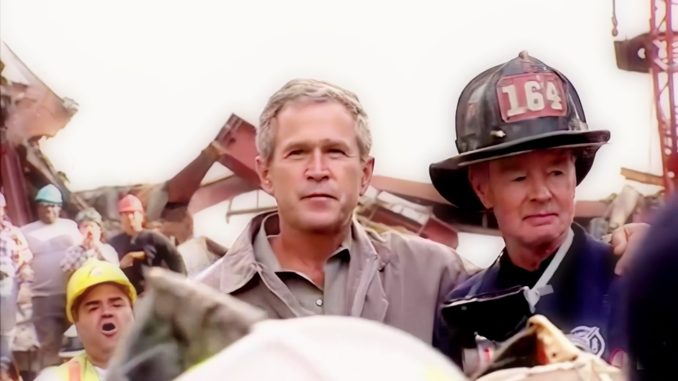
In the news media and among political leaders, the patriotic drumbeat was continuous. “America Under Attack,” and “Another Pearl Harbor” were common headlines and comments. “Why do they hate us?!” was a question asked in patriotic outrage by television reporters. President George W. Bush went to the World Trade Center site and told firefighters and other workers in the crowd, “I can hear you. The rest of the world hears you. And the people who knocked down these buildings will hear all of us soon.” This was his promise that vengeance was coming. A few days later, he used for the first time the phrases “war on terrorism” and “war on terror.”
It was clear that he and his advisors, led by Vice President Dick Cheney, were going to use the attacks to advance goals that they had in mind for years – removing uncooperative regional leaders like Saddam Hussein; breaking Iraqi state-run enterprises; opening the door for U.S. business interests; keeping oil- producing states in line with U.S. objectives; and giving U.S. corporations (like Cheney’s Halliburton) billion-dollar no-bid contracts to rebuild what U.S. bombs destroyed.
They not only used the attacks to justify the invasion, occupation and privatization of Iraq, but they also turned their attention towards a supposed “enemy within.” More than 700 people, nearly all Muslim, were arrested without cause in the days after September 11.
In late October 2001, Congress passed and Bush signed the USA Patriot Act, which expanded law enforcement authority to conduct investigations, expanded the allowable scope of those investigations, and removed privacy protections previously enshrined in federal laws. Although the law officially expired in 2020, law enforcement agencies still retain most of the new powers it authorized.
The Bush administration also instructed the National Security Agency to initiate eavesdropping on people’s phone and email communications between the United States and other nations.
In January of 2002, Bush issued a military order establishing a detention center at Guantanamo Bay, Cuba, creating an extralegal no-man’s land that the government used to defy existing U.S. laws. They held at Guantanamo Bay people captured in the newly developing war on terror, who would be detained without habeas corpus or without trial of any sort. More than 700 prisoners have been held there and tortured since 2002.
In November of 2002, Congress passed and Bush signed the Homeland Security Act. This act created the Department of Homeland Security (DHS), a new cabinet- level department. Within the DHS umbrella, the U.S. Border Patrol was reorganized as U.S. Customs and Border Protection (CBP) and a totally new agency known as Immigration and Customs Enforcement (ICE) was created. The law also created new standards and methods for increased information-sharing among government agencies.
This so-called war on terror was used to justify the building and expansion of a repressive security apparatus that would be used against internal enemies. The federal government even allowed local police forces for the first time to buy old U.S. military equipment and encouraged the militarization of local police forces to a scale never seen before.
Following 9/11, these so-called enemies were usually thought to be Muslim, as politicians and much of the mass media promoted Islamophobia to garner support for the invasions and occupations first of Afghanistan and then Iraq. This widespread demonization campaign against Arabs and Muslims strengthened these toxic attitudes among many people in the U.S. Especially in the days and months following September 11, but also for many years after, people perceived to be Arab or Muslim faced increased levels of violence, including murders as well as other hate crimes.
But as we see clearly today, these repressive laws can easily be turned on any supposed enemy within. These agencies, laws and practices are now being turned towards immigrants and the left, both of which are regularly labeled “terrorists” by Trump, Stephen Miller, and other propagandists of hate both inside and outside of the government.
Immigrants are bearing the brunt of the repression. CBP and ICE are detaining, kidnapping and murdering migrants and any who dare to stand up for them nationwide. Department of Homeland Security and its agencies are now being supercharged by billions of dollars in new spending to act not only against immigrants, but against anyone or anything reactionaries consider to be “the left.” A new Red Scare is currently being manufactured to prepare the ground for more repression. The word terrorist is used as a general term for anything or anyone that the administration doesn’t like. Activists in Minneapolis, Minnesota, at the Prairieland Detention Center in Texas, and around the nation are now being surveilled and arrested, and are facing decades-long incarceration for nothing more than attending meetings or protests, or for carrying political literature. The apparatus created in the months after 9/11 handed them the tools that they now use against us today.
Imperialist States Are the Real Terrorists
Despite acknowledging the horrific nature of the 9/11 attacks and the fact that most of the people killed that morning likely didn’t think much about the larger imperialist forces driving Muslim fundamentalists to attack the U.S., we also must recognize the larger fact that… the U.S. and other imperialist states are the real terrorists!
Which nations are the only nation-states to have actually used the biggest weapons of mass destruction, including nuclear bombs? Which ones have consistently rained down bombs and missiles on poor peoples around the world? Which have overthrown multiple governments elected by their populations? Which have occupied nations for no justifiable reason? Which ones today kidnap foreign leaders and use drones to assassinate opponents and innocent bystanders? Which murder sailors and fishermen without trials or convictions for crimes? And which nation-states condemn whole regions of the world to economic stagnation and millions of people to poverty and starvation?
The U.S. and other imperialist powers have committed all of these crimes for decades. They are the real terrorist regimes. And the fundamental reason for the 9/11 attacks goes back directly to Cold War imperialist policies of the United States.
Do Religious Zealotry and Nationalism Offer Solutions?
While it is understandable why oppressed people and the people of occupied regions react against and want to rid themselves of an outside exploiter, we must also recognize that nationalism and religious zealotry – like that practiced by the Taliban, Al Qaeda, Hamas, and others – is not the answer. While groups that use nationalism and religion to rally adherents to an anti-U.S. or other anti-foreign cause, their use of these sentiments obscures the true causes of their oppression.
Nationalism and religious chauvinism actually stand in the way of oppressed workers developing greater class consciousness. Groups like Al Qaeda and others themselves exploit the very real class differences that exist within the Islamic world and its individual nations. There, the ruling class capitalists (the bin Laden family and the Saudi royal family, for example) have built wealth and power on the backs of working people, most or all of whom are also Muslim. Instead of leading working people towards challenging the rule of their exploiters of their own nation or religion, national and religious chauvinism turn this anger outward, towards foreign enemies. They also keep workers from seeing class as an international phenomenon, which might lead them to see their common cause in uniting with workers of other nations and of other religions.
If the goal of Osama bin Laden and his co-thinkers had been to weaken U.S. imperialism with the September 11 attacks, then they failed. If we look at the evidence from the past 25 years of intensified war and destruction throughout the Middle East, it seems that the opposite was the case – the September 11 attacks were more than anything an excuse for U.S. imperialism to reign terror on Muslims.
What Can Stop Imperialism?
On the 25th anniversary of the attacks, we can be sure that there will be many patriotic ceremonies to remember those who lost their lives. But these ceremonies will also be obvious attempts to unite people in the U.S. around a shared sense of nationhood in the face of terrorism, or any other sort of threat, whether from within the nation or from without. The major capitalist media and their politicians will all sing the same tune, and work to make us think that we in the U.S. are all in this together.
But imperialist drives for profits and related Cold War policies aimed at weakening the Soviet Union were the key forces that led to U.S. intervention in Afghanistan in 1979 and ultimately to the attacks on September 11, 2001. The best way to remember the victims of the 9/11 attacks, as well as all of the other victims of terrorism, from the killings by U.S. troops in al-Falluja, Iraq to the deadly U.S. air strikes in Kunduz, Afghanistan and beyond, is to dedicate ourselves to ending the imperialist policies that caused them.
That means breaking with the capitalists who run our society and the politicians who work for them. We may live in the same nation, but they exploit and oppress us. It means breaking away from the flag-waving nationalism that they push on us. It means resisting their attempts to divide us by labeling so many of us “communists” or “leftists” or “terrorists,” as they have recently with the Minnesota and Prairieland, Texas anti-ICE protesters.
And it means not buying into the anti-Muslim hatred that they are still working so hard to spread, just as they did 25 years ago.
The working class is the majority of the population in our world today. If we are united, then we can begin to focus on the real problem: the system and those who benefit from it. Only a revolution led by the working class can get rid of it.
If we want to make real change, we can’t let ourselves be divided by these same distractions again.