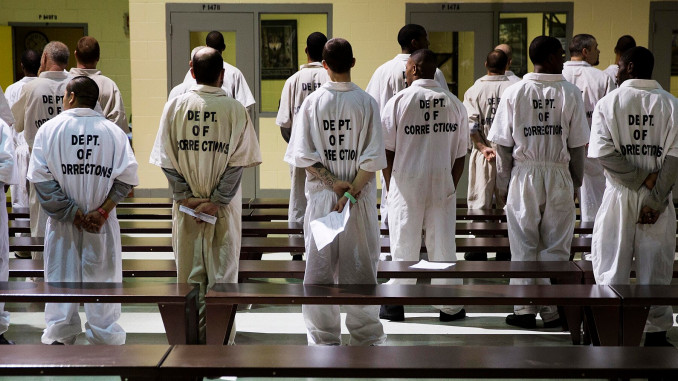
15 years ago today, on December 9, 2010, prisoners in Georgia began a prison work strike that lasted at least six days. Although it’s not known exactly how many prisoners took part, there were at least hundreds of strikers spread over at least seven prisons throughout the state. In these prisons, prisoner-workers refused to do the daily work routines that make the prisons run, and many refused to even leave their cells. It is possibly the largest work stoppage of prisoners in U.S. history.
The strike was organized by prisoner-workers who were super-exploited while in prison. While many prisoners in U.S. prisons labored to produce commodities for profit making companies, most are paid at least a tiny sum. In Georgia prisoner-workers were not paid at all, meaning that in effect they were essentially slaves. Along with their recognition that they were being unjustly exploited for the profit of others, they also wanted to take a stand against the miserable treatment that is a common part of prison life. Their demands give some sense of these conditions:
- A LIVING WAGE FOR WORK: In violation of the 13th Amendment to the Constitution prohibiting slavery and involuntary servitude, the DOC demands prisoners work for free.
- EDUCATIONAL OPPORTUNITIES: For the great majority of prisoners, the DOC denies all opportunities for education beyond the GED, despite the benefit to both prisoners and society.
- DECENT HEALTH CARE: In violation of the 8th Amendment prohibition against cruel and unusual punishments, the DOC denies adequate medical care to prisoners, charges excessive fees for the most minimal care and is responsible for extraordinary pain and suffering.
- AN END TO CRUEL AND UNUSUAL PUNISHMENTS: In further violation of the 8th Amendment, the DOC is responsible for cruel prisoner punishments for minor infractions of rules.
- DECENT LIVING CONDITIONS: Georgia prisoners are confined in over-crowded, substandard conditions, with little heat in winter and oppressive heat in summer.
- NUTRITIONAL MEALS: Vegetables and fruit are in short supply in DOC facilities while starches and fatty foods are plentiful.
- VOCATIONAL AND SELF-IMPROVEMENT OPPORTUNITIES: The DOC has stripped its facilities of all opportunities for skills training, self-improvement and proper exercise.
- ACCESS TO FAMILIES: The DOC has disconnected thousands of prisoners from their families by imposing excessive cell phone charges and innumerable barriers to visitation.
- JUST PAROLE DECISIONS: The Parole Board capriciously and regularly denies parole to the majority of prisoners despite evidence of eligibility.
To write this list of demands and then to organize the strike, the prisoners did two things that deserve mention.
First, and maybe for the first time, the prisoners were able to collaborate and communicate across prison walls. They did so by using cell phones. Phones were not allowed for inmates, but in a great example of irony, prisoners were able to get phones which had been smuggled in by guards trying to make an extra buck. They put these illicit phones to good use in their organizing efforts.
Second, the prisoners managed to organize along class lines, recognizing themselves first and foremost as workers. Often, in prisons as in life, working class people are divided or allow themselves to be divided by race, ethnicity, nationality, gang affiliation or religion. These divisions then keep them from organizing together to improve their collective situation. In this case they managed to overcome at least some of these divisions, and Black, white and Latino prisoner-workers were able to unite around their common interests as workers. Once they realized that their unity and collective action was the only possible avenue to improving their collective conditions, at least hundreds were then able to stand together and fight together against their oppressive and exploitative conditions.
The strike lasted for six days, ending on December 15. It was of course an uphill battle from the start. When prison officials learned that it might take place, a few of the prisons went on lockdown on the evening of December 8th, the night before the strike was to begin. As the days went on, some prisoners were beaten and isolated, some transferred, and in some prisons had water and heat cut off. After six days the strike, which was initially planned for only one day, was called off.
While the strike was not successful in winning concrete gains, and even a fact-finding mission to investigate prison conditions in the state was undermined and came to nothing, this strike is nonetheless an inspirational example of what oppressed and working-class people can accomplish. Even with limited or no resources, and even under conditions of near total domination, prisoners in the hundreds were able to talk to each other across racial and ethnic lines. They were then able to come to agreement and organize themselves, not just in one prison but in several facilities. And they were able to pinpoint their common exploitation as workers as the key factor binding them all together. It was around that common factor that they were able to take action.
15 years later, we can still learn lessons from these prisoner-workers that can be put to use today. If they could organize and carry out a strike under conditions of near total physical domination, imagine what we could all do together.