The news in recent weeks has been full of headlines about U.S. foreign policy under Donald Trump’s increasingly aggressive regime. Although his government has carried out attacks on Iran, Yemen, Somalia and Nigeria since beginning his second term, it was the recent attack on Venezuela and the kidnapping of its president, plus Trump’s threatening rhetoric towards Greenland and Europe that have gotten the most attention. In both of these cases, the media and political elites tend to focus on Trump’s personality and the supposedly unique nature of his recent actions.
While there is some justification for this, when looked at more closely it can also be seen that Trump is in fact just one more president who for more than a century has carried out a similar list of imperialist policies. In the longer historical context, Trump’s policies are not a substantive departure from previous U.S. foreign policy. He is simply adding his own particularly crude and vicious style to what has been a long history of U.S. imperialist expansion and domination.
This Is Not New
The United States was expansionist from its earliest days as a British colony. Settler colonists swept westward, taking land violently from indigenous inhabitants and making coerced or lopsided agreements to steal the land out from under them. As the U.S. state matured in the 19th century, it purchased huge parcels of land from nations like France, Spain, and Great Britain, and later purchased Alaska from Russia. It fought wars of aggression like the Mexican–American War to take huge chunks of land from Mexico.
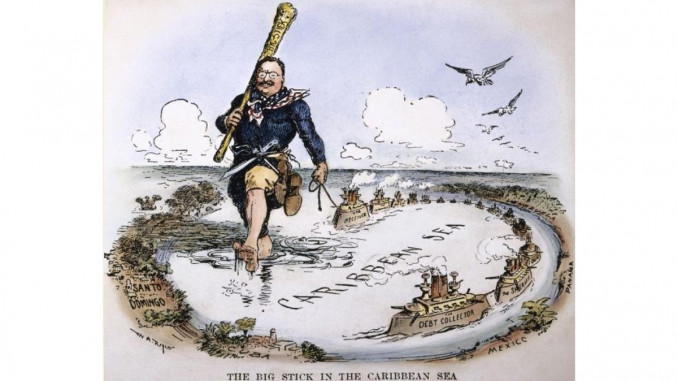
It was in the 1890s that the United States became a truly imperialist power, with its expansion driven by the dynamic growth of capitalist corporations in the late 19th century which needed new regions in which to invest their profits and new markets to sell their commodities. With this economic force driving the outward expansion, the U.S. government began a campaign of militaristic expansion outside its continental boundaries. It supported a coup that took Hawaii in 1892. As it imposed the “Monroe Doctrine” (which essentially said that the U.S. regarded all of the Americas as its territory to manage, and that Europeans should stay out), the U.S. pressured the British to stay out of Venezuela in 1895, and took Cuba, Puerto Rico, Guam, and the Philippines in the 1898 Spanish–American War. A few years later, the U.S. helped engineer a fake rebellion in Colombia to break away the Darien Region, later to be called Panama and become the site of the Panama Canal.
After establishing itself as “The New Empire” (the title of a classic book on the topic by historian Walter LaFeber) around the turn of the century, the U.S. continued to be openly imperialist. It used economic and often military force to ensure that U.S. business interests were allowed access to trade routes, open markets, natural resources and cheap labor. U.S. capitalists did business with dictators in the Caribbean, Mexico, Central America and parts of South America, becoming the most influential force in the region. If bribery and mutually beneficial business relations with local leaders didn’t assure compliance, the Marines could be sent in or a coup arranged. Even Franklin Roosevelt’s so-called Good Neighbor Policy of the 1930s, which deemphasized the use of military force and promoted the idea that the U.S. would help its southern neighbors through economic aid rather than coercion, didn’t fundamentally change the existing power relationships or the extractive and exploitative goals pursued by the U.S.
During World War II, the U.S. military presence expanded to many other regions of the world, including Greenland, where it established a military base that still exists today. The end of the war and the Cold War that followed saw the U.S. build and maintain a massive complex of military installations around the world. It also saw the use of numerous covert operations, often run by the infamous Central Intelligence Agency, to ensure that U.S. business interests got what they wanted. Whether directly or indirectly, the U.S. participated in nearly a dozen coups and overthrows in the Cold War era. Iran in 1953, Guatemala in 1954, Congo in 1960, Indonesia in 1965, and Chile in 1973 are just a handful of the places where U.S. imperialism helped destroy democracy and protect the interests of U.S. capitalists.
Usually, these coups were conducted quietly, without fanfare or U.S. military forces doing the dirty work. But sometimes U.S. troops were directly involved. In the 1960s, for example, the U.S. sent about half a million troops to Vietnam to fight against peasant revolutionaries fighting for independence from colonial rule. In 1989 the U.S. invaded Panama and took former ally and dictator Manuel Noriega into U.S. custody, solidifying its influence in the Panama Canal zone. And in 1991 the U.S. invaded Kuwait and Iraq to support loyal regimes whose oil production was threatened by Saddam Hussein’s Iraqi army. And, of course, beginning in 2001, the U.S. invaded Afghanistan and then Iraq and occupied both for a decade or more. There is a long history of U.S. military aggression being used to carry out economic imperatives.
The Battle to Control the World Today
And today, while not all capitalists agree on the need for aggressive military actions, a group of incredibly wealthy capitalists who cohered in support of Trump do support this type of expansion. Many of these are from the tech and military-industrial sector and need access to rare earth and other industrial minerals in order to produce the commodities that have made them rich. Their technologies are used by the U.S. military in direct competition with the growing military power of China. Some of these capitalists – Peter Thiel, Elon Musk, Erik Prince and others like them – hold openly racist and imperialist views that they believe justify their economic, political, and military dominance over supposedly non-white or non-western people and regions. They also agree that expansion and control over various regions are necessary to both limit the ability of China to expand into these regions, and also to give them access to the natural resources and strategic areas they need to remain competitive against ever expanding Chinese imperialist interests. This economic war is leading us directly towards the increasing likelihood of military conflict.
Nations like Venezuela and Greenland are part of this intensifying imperialist competition. China has deepened relations with Venezuela in the past decades, buying oil, giving loans, and investing as part of its push to expand into Latin America. Venezuela also has huge mineral resources that could be further exploited with enough investment. It also has one of the three major rivers in Latin America that help connect commerce from the Caribbean to the Amazonian interior. And in addition, because Secretary of State Marco Rubio is obsessed with destroying the remaining remnants of the Cuban Revolution, and since Venezuela has helped keep Cuba’s power sector running with cheap oil supply, Rubio felt a strong desire to crush that connection in an attempt to more quickly bring about the fall of the supposedly communist Cuban regime.
China has also increasingly turned its attention to Greenland and the Arctic, where the prospects of new sea lanes opening up and the thawing of natural resource-rich regions offer possibilities for Chinese intervention and gain. From a military perspective, Greenland is without question a strategically significant place, particularly as global warming thaws millennia-old glaciers. Trump isn’t just making this up. Not only does the United States and its resource-hungry capitalist class want more access to oil, or to the rare earth minerals that can be found in Greenland, they also cannot afford to let China gain control over these resources. Hence the push for new aggression and new conquest in Greenland, Venezuela and other places that Trump is now overseeing.
The major differences between U.S. imperialism historically and Trump’s version today are differences of style rather than substance. Unlike U.S. political leaders and businessmen since World War II, the Trump administration is willing to be completely up front and announce its intentions, behaving openly like a mafia boss or gangster threatening and shaking down less powerful nations and regions. He’s willing to simply use force, and then admit that he’s going to take their oil, their ships, or their rare earths. This has not been the case since the 1890s and early 1900s, when openly racist imperialist politicians like President Theodore Roosevelt and Senator Albert Beveridge promoted U.S. expansion through open conquest. And even they often tried to disguise their aggression and racism with supposedly noble intentions.
So let’s not fool ourselves into thinking that Trump alone is the problem. His style is far more vulgar and his ignorance is more profound. But those things aside, the Trump administration is continuing the same basic imperialist policies that U.S. administrations have maintained for more than a century, Democrat and Republican alike. If we want to stop U.S. aggression and militarism, we won’t be able to do so by just getting rid of Trump, or just by voting Democrat.
To stop the type of foreign interventions that the United States has been known for since the 1890s, we’ll have to go after imperialism itself and the capitalist economic system that drives it.