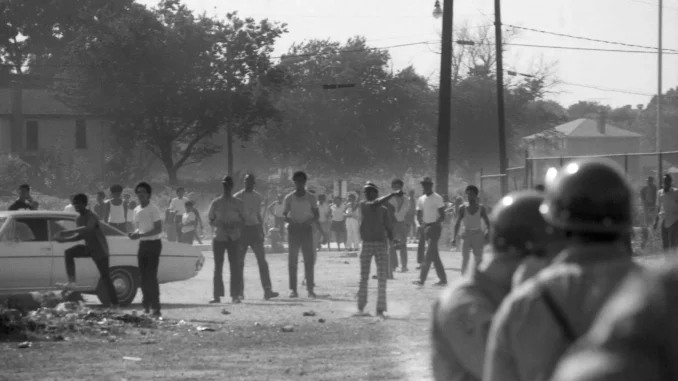
During Black History Month, our attention often focuses on the stories and achievements of great leaders. But those leaders are famous only because of the activism of masses of people for their own liberation. Freedom for Black people in the United States and across the Americas was not won by politicians’ speeches, laws, or reform. They organized, resisted, and fought back. Again and again, freedom was taken, not given. This long tradition holds lessons for all of us today, perhaps especially immigrants held in ICE detention centers or living under threat of detention.
The most recent widespread Black liberation movement in the U.S. has been Black Lives Matter. The massive, impactful Civil Rights Movement of the 1950s and 1960s is well known, as is the Black Power Movement of the 1960s and 1970s. But the struggle for Black liberation has always been a part of U.S. history.
Under slavery, resistance was constant. Between the seventeenth century and the Civil War, there were hundreds of documented uprisings by enslaved people in what became the United States. These are probably only a small fraction of what actually occurred, as many revolts were buried in the historical record to avoid inspiring others. And in Haiti, their revolution showed that enslaved people could defeat colonial powers and abolish slavery themselves.
Rebellion did not always mean armed revolt. Enslaved people used tactics like slowing down work, faking sickness, and sabotaging production. Many learned to read and write in secret, despite the risk of severe punishment. In swamps and forests, people formed semi-independent communities that survived for generations. Parents fled with children to prevent families from being broken apart by sale. These acts directly challenged the economic foundation of slavery.
Many slaveholders convinced themselves that the people they enslaved were loyal and even grateful. During the Civil War, the Confederacy relied heavily on enslaved Black labor while assuming those workers would remain obedient. This delusion proved costly. As the war went on, enslaved people fled plantations in massive numbers, leading some historians to describe this process as the largest slave revolt in world history.
Black soldiers formed regiments to fight for the abolition of the slave system, even while facing racist treatment, lower pay, and deadly assignments. The famous Fifty-Fourth Massachusetts Regiment refused to accept the notion that low pay was better than none. They insisted on their full humanity through a labor action, serving a year without pay rather than accepting unfair wages. Ultimately, the War Department relented and equalized Black and white pay in the army.
As Black people have been treated as a source of free or cheap labor throughout U.S. history, it makes sense that participation in labor activity has always been a part of their self-liberation. Despite discrimination and sometimes even outright refusal to admit them, Black workers have always been a significant force in unions and labor actions. Whether forming their own unions like the Colored National Labor Union in the 19th century or the Brotherhood of Sleeping Car Porters in the 20th century, or whether participating in strikes like the wildcat strikes during World War II, or the 1968 Memphis Sanitation Strike, or more recent strikes by education workers and other public workers, Black workers have been on the front lines of workers’ struggles.
Prisons in the United States still rely on forced labor. Incarcerated people (disproportionately Black) cook, clean, do laundry, and maintain facilities, often for pennies or nothing at all. Their labor makes their own incarceration possible. When this work stops, the system fails. That is why prison strikes have always been met with harsh retaliation. One of the demands of the incarcerated men who rose up at Attica Prison in 1971 was higher wages. Black prisoners were systematically relegated to the lowest-paying jobs. The uprising was met with brutality with 33 prisoners killed.
More recently, incarcerated people in Alabama have organized against the same kinds of brutal conditions, where over 1,300 people have been killed since 2019. The Alabama prison system is a humanitarian catastrophe while the state holds no one accountable. The documentary The Alabama Solution, filmed on smuggled cell phones, shows how incarcerated people have refused to tolerate these conditions. Prisoners are forced to labor, often without pay, under threat of solitary confinement. Since 2013 a group of men have educated themselves on their rights and have been organizing inside as the Free Alabama Movement. A key organizer, Melvin Ray, says, “We always understood that our labor is what this is all about.” Incarcerated people in Alabama held a state-wide work stoppage in 2022, demanding that the federal Department of Justice take over running the prisons. This followed a previous call for a national prison strike against forced labor under the 13th Amendment’s incarceration exception, a loophole that has enabled the re-enslavement of African Americans.
Today, ICE so-called detention centers tell a similar story of brutality, with signs that forced labor is becoming an element of the system. The situation is one of confinement, overcrowding, cruelty and profit for mega-corporations in the business of human caging. But the story is also one of resistance and self-liberation. In the last year, people swept up into these concentration camps have begun resisting their imprisonment. There was an escape from a New Jersey facility in 2025 and already this year there was a large protest of children imprisoned in Dilley, Texas, inspired by the militant action of the people of Minneapolis. These actions make clear that detainees, much like enslaved Black people or Black prisoners throughout U.S. history, need not be passive victims. They are organizing, speaking out, and taking risks to demand food, medical care, and the release of children.
Our rulers are also turning their brutality beyond the usual targets – Black and Brown people. Capitalism in crisis is prepared to brutalize and kill anyone who opposes it. We should study and learn from the people who have always known that liberation is not granted from above. It is forced by people who refuse to accept cages, whether they were plantations, prisons, or ICE and CBP (border patrol) detention centers.