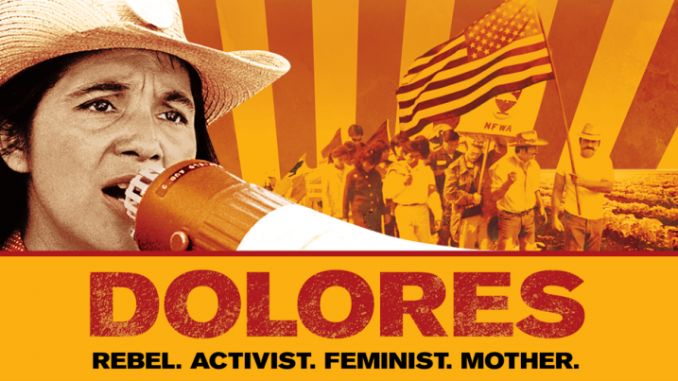
The 2017 Dolores documentary follows the life of organizer Dolores Huerta. Known for being the co-founder of the National Farm Worker’s Association (which would later become today’s United Farm Workers labor union), the film offers a sincere look at the great efforts she made to organize her communities and the unique struggles she faced as a Latina woman throughout her life. It tells a complete story of how someone begins to dedicate their life to being an activist and the importance of uniting across struggles to fight for a dignified life for all people.
The film focuses on her work organizing California farm-workers. Dolores grew up in Stockton, CA where she felt she was “being forced into a mold” and wanted to be more than a married woman and mother. She met community organizer Fred Ross who later introduced her to Cesar Chavez. At the time, Chavez wanted to form a farm-worker’s union and seeing Huerta’s success engaging and organizing the people around her, Ross suggested she was the person he needed to work with.
The documentary uses archival footage and more recent interviews with Dolores, her family, and other activists such as Angela Davis, to tell the story. It doesn’t shy away from highlighting the racism and sexism she faced even within the movement. From the beginning of her time working with Chavez, through the famed Delano grape strike, and even into her old age, Huerta constantly had to put up with accusations that she was a bad mother and efforts to discredit her contributions to the farm-worker’s movement. As Davis put it, people inaccurately saw “[Chavez] was the leader and she was the housekeeper of the movement.”
Throughout the film, there are clips of a television interview with her and Chavez. The interviewer largely focuses on Chavez, and asks him questions about having a woman as a lead organizer. He comments that “Dolores being out there made it alright for women to be out in the picket line so it made it alright for their husbands to permit their wives to be [there].” When the interviewer finally turns to Huerta, she asks her: “Don’t you have every woman’s dream of going to the spa?”
Huerta would always return to the message that this work, the sacrifices she made with her 11 children, and more, were for a struggle that was larger than she was. She encouraged farm workers to tell their stories, and be the ones to go out door knocking to gather signatures and support for their strikes and boycotts. She reflects on needing to wrestle against her own beliefs growing up Catholic in the midst of a growing feminist and Civil Rights movement. Her focus was on being a grassroots organizer. When it became clear the UFW was more interested in maintaining the legacy of Chavez, she left to continue her efforts to have workers and everyday people see themselves as leaders in their communities. “I always thought it was wrong to take credit for the work I did,” she shares. “All a person has is their story. If we take away their story, we take away their power.”
Dolores paints a very human picture of Huerta and her life’s work. With her recently coming forward about the abuse she experienced under Chavez, it’s an important film to watch and discuss the pitfalls of having anyone be the focal point of a people’s movement. “If we become that which we are trying to end, we become the oppressor,” Dolores reminds us. In another speech, she reflects how “The history of the world has always been made by mass movements of people.” Her story is inspiring, demonstrating how even against great odds and having to fight machismo and injustice on all fronts, people can successfully fight for a better life. Her work with farm workers drew links to the environmental movement fighting off pesticides, the feminist movement, the Civil Rights movement, and more. It helps us see how, as Davis put it, “one movement would not be successful without others.”
You can stream the documentary on PBS or with a public library card on Kanopy.