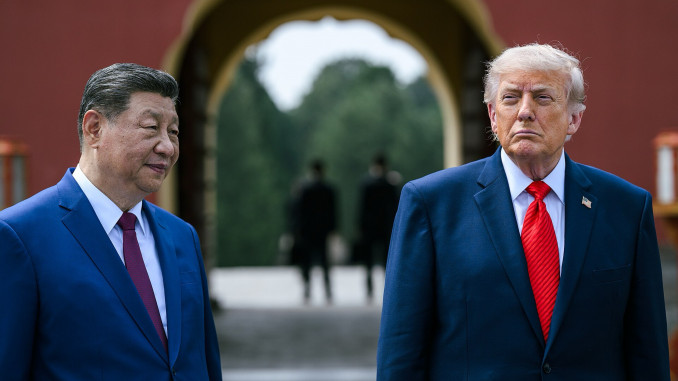
The recent meeting in China between Trump and China’s president, Xi Jinping, filled the world’s media. Where they met, what they ate, and who traveled with them were covered in detail. It was presented as the meeting of the world’s two superpowers, aimed at maintaining a peaceful relationship while they compete for the world’s markets and natural resources.
A closer look at the reality behind the show exposed the situation of the world capitalist system and the crises that lie ahead. Can they continue to avoid a direct clash that could lead to a major confrontation (World War III)?
The stakes are high. The domination of the U.S. on the world scale has been on the downturn, and China’s influence has increased. This situation has been accelerated under the chaotic Trump regime, which has further dismantled the post-World War II order, which secured the relations between the U.S. and Europe. NATO was established as their military alliance, supposedly to defend Europe from the Soviet Union. Economic relations that were put in place continued during the formation of the European Union. Trump has undermined much of that.
The U.S. maintained its dominance throughout much of the world with its massive military presence. It has between 750 and 800 bases outside the U.S. The other world powers—Britain, France, Russia, and China combined—have fewer than 50 overseas military bases. As a consequence, the U.S. has been in a position to dictate much of the world economic and political order.
Recently, the U.S. has seen its economic dominance undermined by China’s rapid economic development. During the past decade, under Xi’s rule, China’s Belt and Road initiative has extended China’s investment and trade relations with countries around the world. In 2001, 30 countries had more trade with China than the U.S. In 2025, 145 countries had more trade with China than the U.S. The U.S. still dominates military production, exporting 42% of global armaments, with $331 billion in sales.
These two superpowers are in competition for the resources that are essential for them to expand their positions in the fast-changing global economy. This means having control over access to energy sources like oil and coal. Beyond that, it means the ability to develop and produce essentials for the emerging technologies.
China has the largest known concentration of rare earth ores. It leads in the complex processing process of the ores. This provides the essential elements needed in the production of high-tech components including electric vehicle batteries, wind turbines, smartphones, magnets, and semiconductors. China also leads in the development and production of AI robots and electric vehicles.
The U.S. leads the world in AI investment and production of AI models, but China is catching up. The U.S. also has an edge in semiconductors, with developments by Nvidia providing an advantage over Chinese alternatives. The relationship to Taiwan plays a key role in this area as it produces almost 90 percent of the advanced chips needed for AI development.
The statistics tell one story. But the reality is that these two men head powerful states that exist within a system that is beyond their control—a system that demands constant expansion. They are both navigating the collision course the two countries are on. Among the unresolved questions are: Taiwan’s independence, the U.S. war on Iran, and the possible confrontations developing from the U.S. and China’s competition in the world economy.
These challenges can quickly escape their control and escalate into an open war. Both nations have massive weaponry, including nuclear weapons. A clash like this seemed unthinkable a decade ago, but is now a possibility.
What also may seem unthinkable is our possibility to challenge and stop this insanity. Many people around the world are aware of the situation we face. They, like increasing numbers in the U.S., are seeing the support the politicians provide to maintain this system.
In the U.S., we face ICE attacks on people in our communities, the dismantling of social services, and the deprivation of our right to vote. Confronting these attacks can be our starting point for broad social movements.
It may seem impossible, but real change comes from facing the impossible. We have seen this, from the fight against segregation which expanded to civil rights for all, to the fight for women’s—and everyone’s—right to vote, and the movement to end the war on Viet Nam. Each can be a step toward a broader movement. We can’t be certain what the outcome will be. But we do know that our future and that of future generations is up to us.