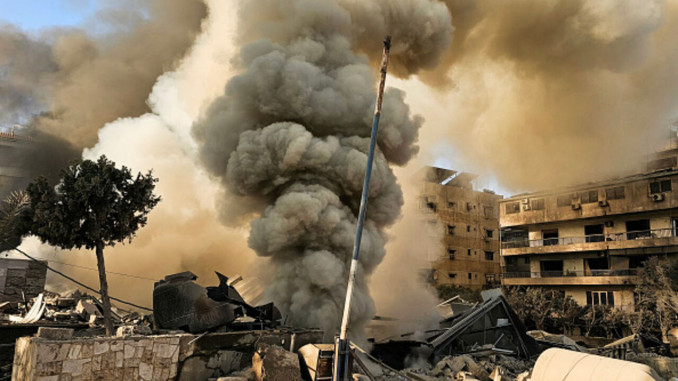
On Tuesday, April 7th, after over a month of U.S./Israeli war on Iran and Lebanon, a cease-fire was declared. The world breathed a sigh of relief. For 48 hours before that, Trump had made threats that have no precedent in the history of U.S. politics. From the war on Vietnam to the invasion of Iraq and Afghanistan, presidents have always pretended to protect innocent life and obey international law. Trump, however, threatened to “annihilate” Iran. On Tuesday, he declared that “a whole civilization will die tonight.”
He threatened large-scale destruction of Iran’s power plants and bridges, and a massive attack on Iran’s 93 million people. These threats, if carried out, would be in violation of international law and U.S. law, but Trump doesn’t care. In January, when asked about international law, Trump said, “I don’t need international law.” and the only limit is “my own morality, my own mind.” We can see that he has no morals and has the mind of a mass murderer!
The Death Toll
According to official estimates, this war on Iran has already killed 3,600 people, including more than 1,700 civilians, 340 of whom were children. At the same time, Israel launched an invasion of Lebanon, where Hezbollah, the armed political party linked to Iran, is based. Israeli missile strikes killed 1,460 people. And the Israeli military has invaded and seized control over huge areas of land across the south and east of the country, bordering Israel. More than 100 people have been killed in Iraq, where Iranian-linked militias have clashed with government and U.S. forces. Thirteen U.S. soldiers have also died, and 33 people in Israel. Despite the so-called cease-fire, the attacks continue, and the death toll continues to rise and threatens to increase exponentially if the war continues.
Destruction and Displacement
The bombs and missiles raining down on Lebanon and Iran have driven millions of people from their homes. More than 3.2 million Iranians have been displaced, over ten percent of the population. In Lebanon, more than one million people, one-fifth of the population, have been forced from their homes. The occupying Israeli army is demolishing those houses and setting up an occupation of southern Lebanon to the Litani River, which it intends to continue long into the future. It is also extending its military occupation to the north.
Oil Prices and Economic Disruption
When Israel and the United States launched their attack on Iran on February 28, the immediate response of the Iranian regime was to close the Strait of Hormuz. It is a narrow waterway in the Persian Gulf through which roughly 20 percent of global oil flows. This left roughly 400 tankers waiting to pass through the Strait.
Iran has also responded to the attacks by launching its own strikes at the oil-producing infrastructure of the U.S.-allied Gulf States. The Gulf States and the U.S. have also struck Iranian refineries and petrochemical facilities. Even if the war ends tomorrow, between 30 and 40 percent of the region’s oil refining capacity will have been destroyed. Economists predict between 2.4 and 3 percent inflation this year due to higher oil prices caused by the war so far.
Starvation
Oil and gas are not the only essential products that pass through the Strait of Hormuz. More than one-third of the world’s traded nitrogen fertilizer, a petroleum-based product, is shipped through the Strait to most of the world’s agricultural centers. According to the U.S. Department of Agriculture, 25 percent of farmers have not yet purchased the fertilizer they need for the growing season. The spike in fertilizer prices will make the cost of growing crops higher than the current sale price of products for many farmers, and they will cut their production. This pattern will be repeated, not only in the U.S. but throughout the world. The U.N. World Food Program estimates that 45 million more people could experience acute hunger due to the fertilizer crisis.
Thirst
Across the Middle East, 60 million people rely on water desalination plants for drinking water. Already, desalination plants in Kuwait, Bahrain, the United Arab Emirates, and Iran have been struck as countries trade missile and drone strikes. So far, less than 5 percent of the desalination capacity of the Middle East has been destroyed, but more will be destroyed if the war continues and expands. If the source of clean water in the Middle East is destroyed, it will create a crisis of thirst that will depopulate the region and send millions into exile.
Trump’s Dilemma
Every word that comes out of Trump’s mouth seems to be a lie. He has declared victory in this war multiple times, while the war continues. He declares Iran’s military destroyed, and then responds to Iranian drone strikes with more strikes and threats. The reality is that this war, poorly calculated and conducted with unparalleled arrogance, has been a loss for the Trump administration. Currently, only 30 percent of Americans express support for the war. Gas prices, food prices, and the seemingly unstoppable recession on the horizon have taken a toll on Trump’s prospects, and he knows it. Trump needs the war to be over, but the forces his administration has set in motion may be out of their control.
Iran has been threatened by the U.S. for decades and is prepared for this war. The survival of the regime in spite of the death of its leading figures and response to the U.S. and Israeli attacks shows that.
The Ceasefire
Details of what is called a ceasefire are still emerging with massive contradictory assertions by all involved. The ceasefire emerged from discussions between Pakistani officials and Iranian representatives. Pakistan stepped in to broker a deal. Like most other regional powers, the Pakistani government wants to facilitate a swift end to the war and its devastating economic and political consequences. The Iranian government released its set of demands, which included repayment (reparations) for the destruction caused by the war, control by Iran over the Strait of Hormuz, and the right to collect tolls, and an end to U.S. and Israeli attacks on Iran and Lebanon.
Lies and Distortions
Trump, as usual, lied and contradicted himself almost immediately. He said that Iran’s demands were a good basis for an agreement, then demanded Iran release control of the Strait of Hormuz. Israel’s government, apparently surprised by Trump’s acceptance of a ceasefire, immediately launched the most devastating attack of its war on Lebanon, killing at least 250 people. Trump and those in the administration have responded to this violation of Iran’s demands, defending Israel and denying that the ceasefire agreement covered Lebanon.
The Problem of Israel
Israel did not set the stage for the war as some claim. The United States has been in conflict with Iran since 1979 when the Iranian Revolution overthrew the Shah of Iran. The Shah had been put in power as a result of a U.S./British coup in 1953, which overthrew a democratically elected government that challenged foreign domination of Iran’s resources. The Islamic Republic of Iran was established and took back control over the oilfields that the U.S. and multinational oil corporations had profited from for decades.
Israel is only a cog in the wheel of U.S. domination. Every U.S. administration, Democrat and Republican, has tried to exert control over the Middle East control its vast oil deposits. Israel was established by conquest and ethnic cleansing of the Palestinian Arab population. It became an outpost of British and then U.S. control in the area. Its existence poses a constant threat to the Palestinian population as well as the neighboring countries. This has made it a perfect ally and enforcer in the U.S.’s imperial strategy in the region. It receives billions of dollars of military and economic aid a year from the U.S. Today, Prime Minister Benjamin Netanyahu rules Israel with the support of blood-thirsty far-right parties, and the Israeli population overwhelmingly supports the continued genocide of the Palestinian people and a war on Lebanon and Iran in the name of security.
A Separate Ceasefire under U.S. Pressure
Now, after carrying out the bloodiest attack on Lebanon since the war began, Netanyahu has agreed to negotiate a ceasefire with Lebanon under Trump’s pressure. But Netanyahu refuses to cease the attacks while negotiations continue, a condition the Lebanese government cannot accept. Tomorrow, he may drag the U.S. and the world back into war for his own purposes by continuing to violate the ceasefire. It would not be the first time that Netanyahu has done this while the U.S. is attempting to broker a ceasefire with Iran or the Palestinians. Meanwhile, the Israeli government has passed a law imposing the death penalty, without appeal, on Palestinians (not Israelis) who allegedly commit murder and has passed laws to annex and extend settlements in the West Bank. The genocide in Gaza, in spite of the so-called ceasefire there, continues. Perhaps this is the type of ceasefire Netanyahu imagines in Lebanon – one where the Israeli army occupies half the country and inflicts constant violence on the population, extending Israeli territory and control.
Trump’s War, U.S. Imperialism’s Policy
Trump launched this war, and it seems to have backfired dramatically with the U.S. using its powerful high-tech weaponry to carry out massive destruction, but depleting its arsenal significantly. Meanwhile, Iran is using its highly dispersed and replaceable drone fleet to exact damage across the region, increasing the pressure on the U.S. from its allies to bring the war to an end. At the same time, Trump has called for a dramatic increase in military spending, increasing the Pentagon budget to 1.5 trillion dollars. This will result in cutting the funding of Social Security, Medicare, and education by ten percent. This enormous military budget, which is a massive handout to what is called “the military-industrial complex” and the banks and financial institutions, may provide the support for the current policy from the corporate and financial sectors.
These wars may provide the pretext to manipulate or disrupt the midterm elections that Trump’s supporters in Congress seem very likely to lose. This could serve to further transform the U.S. into a militarized and authoritarian society, a project Trump has already begun with his immigration policies, attacks on freedom of speech, on Federal workers’ unions, and on many institutions in the U.S.
This attempt to exert its power internationally and to control the U.S. population is a response to major challenges the U.S. ruling class faces to its dominant position in the world. It is losing out to China in the global market. China dominates production in many significant arenas of advanced technological production, including metals, auto, batteries, solar power, biotech, pharmaceuticals, and more. The Trump administration has undermined scientific advancement and development in the U.S. with its attack on government agencies, research funding, and attacks on universities.
Trump’s approach has been to use U.S. military dominance to impose its direct control, as is seen with this war on Iran. The policies of previous administrations were more measured, waging an economic war, imposing a wide range of economic sanctions, and limiting its ability to develop nuclear energy. These policies were less catastrophic but had the same goal as this war – to break the independence of Iran and its role in the region and control its resources. Controlling Iran’s oil would have a significant impact on China. Iran has been instrumental in supplying oil to China during the last decades of China’s industrial development. Some of the U.S. ruling elite may see increased military power and war as a solution to declining U.S. economic power, and see a war with Iran as a necessity.
We Cannot Accept This
These wars defend the interests of the rich and powerful and no one else. They can point to the violence of the Iranian regime against its own people, and that is true. But the violence of the U.S. is magnitudes greater. A U.S. victory over Iran and further domination of the Middle East would be a huge defeat for the people of the region, who would face the domination of a new regime backed by the military might of the U.S.
The threat of escalation hangs over the world. The blustering, ego-centric Trump, supported by those who will profit from this destruction, and goaded on by Netanyahu in Israel, could decide that he can’t back down and could drag the world into an even deeper crisis. The racist, genocidal politics of Israel in its conquest of Palestine over decades may have created a monster that goes beyond the limits of the need for U.S. imperialism in the region.
The two men who are responsible for this catastrophe, Trump and Netanyahu, are in control of governments with nuclear capabilities. What if one of them decides that the use of nuclear war is their only solution? The consequences for humanity would be terrifying.
The situation we are in is clear, and we must not wait to see what they will do. We have seen more than enough. The wars in the Middle East are not just the actions of two deranged men. They are the outgrowth of the imperialist system that dominates the planet today, a system that the U.S. stands at the head of today. We need to keep this in mind as we organize ourselves and do everything we can to oppose these wars.
There is growing discontent in the U.S. military. The number of active-duty military personnel registering as conscientious objectors is increasing. We have seen a purging of the ranks of some of the top military and the refusal to promote some who are in line for promotions. We can’t wait on them; but our actions can provide support for those who could impede the war from the inside.
We need to protest, talk to everyone we know, and do everything we can to stop this war. We cannot accept this war and the inhuman, genocidal, bloodthirsty actions of those who started it. The war has already taken thousands of people’s lives and wounded and traumatized many tens of thousands more. Millions of people have been displaced, their homes and lands bombed. And the economies are in tatters, leaving tens of millions of people in desperate situations.