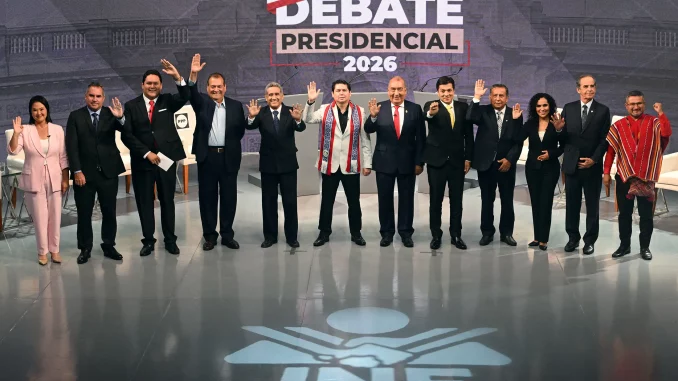
The first round of Peru’s presidential election will take place on April 12th. With 38 candidates and the front runner in the polls barely exceeding 10 percent, the outcome is impossible to predict. Many Peruvians have no trust in this political spectacle: about 25 percent of voters plan to cast a blank or null ballot — in Peru, those who do not vote pay a fine. This electoral process (whose second round will take place in June, opposing the two leading candidates from the first round) will not put an end to the political crisis that has been lasting for years: over the last ten years, Peru has had 8 different presidents.
Five years of growing insecurity, turmoil and struggle
Five years ago, the left-wing candidate Pedro Castillo defeated Keiko Fujimori, daughter of the dictator who ruled in the eighties. In fact, Castillo only received 18% of the vote in the first round, but this was enough to advance to the second round in a field of candidates almost as crowded as this year’s. Mass demonstrations against Fujimori erupted under the slogan “Fujimori, never again.” Castillo became president with some popular support but mostly due to the widespread rejection of Fujimori.
The political elite in Peru did everything in its power to prevent him from governing, but Castillo did little to help. In no way did Castillo enact the radical program of his party, Peru Libre or Free Peru. Castillo did not touch the rights of multinationals to exploit Peru’s natural resources, especially its mineral wealth. Nor did he call for a constituent assembly and a new constitution to break the power of Peru’s political elite. It can be said that he could not have done those things without support – he was president by virtue of people’s rejection of Fujimori, not by virtue of his program. But Castillo also engaged in the corruption and nepotism common to Peruvian politicians, undercutting much of the hope people had invested in his presidency.
For Peru’s oligarchy, Castillo’s impotence and capitulation were not enough. Castillo still symbolically represented the poor, indigenous Andes people. He was not a member of Lima’s wealthier, whiter political class. This in itself raised unrealistic hopes for the majority of the population that someone like them could govern in the existing situation. On December 7, 2022, the Congress moved to impeach Castillo for corruption, ironic as they themselves are even more corrupt. In response, Castillo ordered the dissolution of Congress and called for the constituent assembly and new constitution he had put off for years. If Castillo lacked the support to do those things at the beginning of his administration, he had even less support by the end. Congress responded by impeaching and imprisoning Castillo, an act that has come to be known as the “congressional coup.” His former vice president Dina Boluarte betrayed him and took over the country, backed by the far-right coalition led by Fuerza Popular, the Fujimorist bloc.
Dina was the perfect puppet behind whom the Fujimorists could pursue their agenda. In recent years, illegal mining and deforestation expanded at an extraordinary rate and extortion by criminal gangs has menaced the population. Today, almost six people are murdered every day in Peru — crimes directly linked to the growth of the illegal economy.
Bus drivers are a prime target of this criminality. In September 2024, a protest movement began among bus drivers who were seeing their colleagues killed for refusing to pay protection money. This movement culminated on October 6, 2025 when, galvanized by the Gen Z movement that had started in Nepal and enraged by yet another murder, Lima’s transport workers launched a major strike. In a metropolis of 13 million inhabitants, served by a network of 44,000 bus units, there was little the army and police could do once drivers stopped working and blocked the city’s main arteries. The officers who tried to dislodge the workers were driven back, bloodied. “I would rather die on the barricade than like a dog,” said one driver.
Frightened by this rising discontent and the prospect of a mass demonstration on the 15th, the Fujimorists chose to sacrifice their puppet — Dina, who with a two percent approval rating, was the most despised head of state in Latin America. In the absence of a working-class organization capable of sustaining the struggle, the transport workers’ movement eventually subsided.
Jose Jeri, who succeeded Dina, unsuccessfully tried to emulate President Bukele of El Salvador, whose tough stance on crime and skilled communication strategy has made him a popular model across Latin America. But Peru is not El Salvador: its illegal economy is far larger and far more intertwined with the state and the ruling class.
Two factions of the far right at war
A power struggle is underway within the far right. Aliaga, former mayor of Lima and a very wealthy real estate developer, is challenging the Fujimorists for leadership of the right. He has positioned himself as Washington’s man of choice and went so far as to speak of a Reconquista (reconquering or coup) at a meeting in Spain — about Peru. This is hardly surprising from a man who organized a memorial event for Charlie Kirk — someone he admitted he had only heard of after his death. Aliaga pushed for Jeri’s dismissal over his ties with China, especially after Jeri was caught having a secret meeting with Chinese businessmen. On February 17, Jeri was censured in a vote of no confidence and set to be replaced, much to the pleasure of the U.S. and the Trump administration.
Aliaga openly expresses contempt for non-white people in a country where 60 percent of the population is of Andean origin. This, combined with the sheer absurdity of a man who is not ashamed of being called, and calling himself, “Porky” (because he resembles the famous cartoon character), makes him the ideal foil for the Fujimorists in the second round. Yet despite his polling position, he is unlikely to even reach that round as he is expected to perform poorly and embarrass himself in the coming presidential debates.
Alfonso López-Chau — The left offers nothing but a dead end.
Alfonso López-Chau, a former rector of the prestigious UNI university, is in third place in the polls. He presents himself as the anti-corruption candidate. Having called members of parliament “rats,” he declared: “A president who finds himself hamstrung by Parliament has no option but to resort to civil disobedience and turn to the people, who are the very foundation of all modern democracy.”
Lopez-Chau will be the candidate of Castillo’s Peru Libre. Lima-centric polls place him behind the other candidates, but he is very likely to draw strong support from the Andes. Yet he has neither the charisma nor the base of Castillo, who was a leader of a popular teachers’ strike before becoming a candidate. The left as a whole appears badly weakened by the failure of the Castillo experiment and by the population’s persistent anxiety over crime and insecurity.
Keiko Fujimori builds her main argument by attacking the left for its failures and its past. She claims expertise in eradicating crime, pointing to her father’s record of crushing “terrorism” — the Maoist-inspired insurgency waged by Shining Path guerrilla group. The irony is that she remains the closest political ally of the criminal networks she has been shielding for years.
Meanwhile, the working class is being squeezed hard by rising international oil and gas prices, a pressure made worse by the rupture of a pipeline supplying Lima. Everything costs more, from energy to food. Peruvians are working two or three jobs just to survive — paying the price exacted by the gangs, the small ones who demand protection money and the big ones who count on the hunger of the poor. Can this situation last much longer? Hardly. But in the absence of a genuine revolutionary working-class organization capable of channeling the growing discontent, there is every reason to fear that future movements will fall short of stopping the forces that impoverish people, plunder resources, and reduce working people to mere pawns in the rivalry between the U.S. and China.