The Trump Administration’s strategy for its war on Iran is hard to determine. Certainly, it doesn’t help that the administration’s stated aims seem to change from day to day. In the past, they claimed that Iran’s nuclear program had been “obliterated.” Then they claimed the current war is necessary to destroy that same nuclear program. Then they claimed the war was to change the regime itself. Nothing is consistent, and facts seem not to matter. So what is really going on?
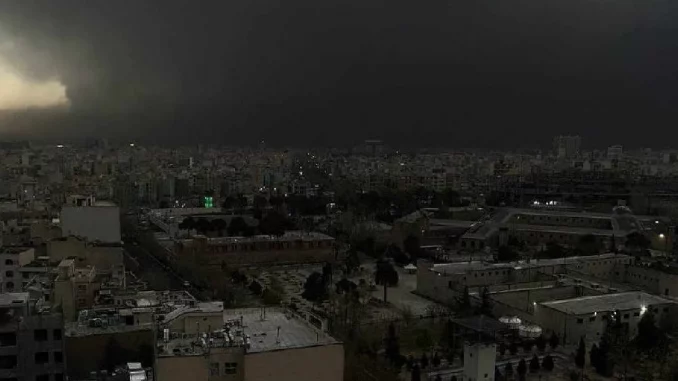
The war began with Trump’s unilateral order to the military to begin strikes against Iran in tandem with Israeli military strikes. Trump denied that this aggression constituted an act of war, while at the same time, the U.S. and Israeli militaries killed Iran’s Supreme Leader, Ali Khamenei, and other Iranian leaders. How could these actions be anything but a declaration of war? Trump openly called for regime change in Iran, calling on the same people he was bombing to rise up against the government. Later, however, Trump’s spokespeople walked back that declaration, saying instead that the administration is seeking “regime modification.”
Trump has promised that this war will be short, though U.S. soldiers and certainly Iranians will die. But Trump has also refused to rule out sending ground troops and has signaled his willingness to plunge into a serious escalation of the war if he doesn’t get what he wants. As the war continues, Trump’s promises of a limited, temporary attack are being exposed as imperialist fantasies. The reality in front of people in the U.S. and especially the population of Iran is a bloody regional war on a scale we have not seen in recent times.
At first, it seemed that the Trump administration was attempting to do to Iran what it had done to Venezuela earlier this year. There was a huge military buildup in the Caribbean and bombardment of Venezuelan fishing boats and some inland sites for months before the president of Venezuela, Nicolás Maduro, was kidnapped by U.S. troops. All of this was a means of intimidation to ensure the success of what they are calling “regime modification” in Venezuela. U.S. intelligence operatives had cultivated a relationship with members of Maduro’s government, especially the Vice President, Delcy Rodríguez, to participate in this “modification.”
The regime in Venezuela was not overthrown. Its president, Maduro, was kidnapped and taken to a U.S. prison in New York. Vice President Rodríguez was prepared to take Maduro’s place and she rapidly initiated policies and reforms demanded by Washington. These included cutting ties with China, starving Cuba of petroleum imports, and opening Venezuela’s lucrative oil industry to investment by U.S. corporations.
In many ways, Iran seems like a similar case to Venezuela. The Iranian regime, like the Venezuelan government before the kidnap of Maduro, is an obstacle to U.S. dominance in the region and an ally and business partner of China. The country is a major oil producer and uses its wealth to influence politics in the Middle East, as Venezuela had done in Latin America. However, there are major differences.
The Iranian regime is much older, and its leading members are much more unified, making backroom deals like the U.S. did in Venezuela highly unlikely. The violence launched against Iran is also more extreme, with the leadership of the Iranian regime killed in missile strikes rather than kidnapped. Those in the Iranian regime who were killed have included some others the U.S. had hoped it might make a deal with. The Iranian regime has also anticipated an attempted overthrow since the U.S. invasion of Iraq in 2003. The chain of command in Iran is prepared, and authority has passed from those killed to those loyal to the regime. They are backed up by the unified, well-organized, and experienced Iranian military, especially the elite Revolutionary Guard Corps. While pounding Iran with missiles, Trump continues to offer the Revolutionary Guard “total immunity” if it stands down and allows the U.S. and Israel to overthrow the Iranian government. So far, the Iranian regime and its military have refused to cooperate with the U.S. The prospect of a quick victory for Trump is receding further and further from the realm of possibility, while the Iranian regime remains unwilling to submit.
While Trump’s aim of a quick military modification of the Iranian regime is being exposed as an imperialist fantasy, what is the alternative? At this time, no force on Earth can match the U.S. war machine. But Iran has a powerful military and many links with religious political militias and parties throughout the Middle East. These include the ruling parties of Iraq and Yemen, the paramilitary force and political organization Hezbollah in Lebanon, and many smaller organizations in other states. Military analysts in the U.S. estimate that a ground invasion of Iran would require half a million soldiers, a war on the scale of the Vietnam or Korean War.
Iran has seen major social unrest in recent years, most recently January’s movement against the regime. However, attacks on Iran that have slaughtered civilians have not encouraged the population to rise up and support the invasion. If history is any lesson, when a nation is attacked, it unites against the invading power. This was the case in Iran in the 1980s when Saddam Hussein’s Iraq launched an 8-year war to crush the Islamic Republic with the help of the U.S. The Iranian population seems unlikely to rise up in support of Trump.
The U.S. has explored the possibility of arming militias and political parties from Iran’s oppressed Kurdish minority. The Kurdish parties, however, are wary of an alliance with the U.S. and Trump, who betrayed them in Syria and Iraq after their heroic fight against ISIS. The Arab States of the Middle East are likewise wary of fully supporting the U.S. because they don’t want to be seen by their populations as going to war for the U.S. in alliance with Israel, which continues to carry out a genocide against the Palestinians. If the U.S. continues its war against Iran, the military force, in addition to whatever Israel will commit, will primarily come from United States troops, in numbers which may require a military draft.
In fact, the most terrifying prospect is that this war is like so many of Trump’s other actions – to cause chaos without a plan and use the chaos to push through the policies he wants and distract the public. The Trump administration is already claiming that Iranian intelligence manipulated the 2020 and 2024 elections. The war may be Trump’s excuse to cancel or manipulate the November congressional election and extend his power domestically. The war is already costing nearly a billion dollars per day, and Trump has proposed a $1.5 trillion military budget for 2027. A huge amount of this will go to the war profiteers, arms companies, and A.I. companies working with the military, and certainly many millions of dollars will disappear in the grift and corruption which is a hallmark of this administration. The bloody reality of a U.S. invasion of Iran will be a costly disaster, in many ways, for the people of the U.S., and a horrific tragedy for Iranians. And it can be a political manipulation and profiteering bonanza for Trump and his cronies. But that is not the only outcome.
This war does not have widespread popular support among the majority of people in the U.S., especially those who could face a draft. The mobilizations against ICE, the opposition to the genocide in Palestine, the “No Kings” demonstrations and the generally growing discontent point to the possibility of a real movement against this war on Iran.
We saw the U.S. war on Vietnam brought to an end, first by the fight of the Vietnamese people, and the massive anti-war movement that gave active to support to the active resistance among U.S. troops that made that war unwinnable for the U.S. military. Now is the time to call on people to stand up against this war, and that includes the families of those who are in the military as well as those in the military who need strong popular support for their opposition to what they know is a criminal action.