The U.S. attack on Iran in 2026 is only the latest in decades of U.S. aggression against that country. U.S. imperialism, whether directed by the Democratic Party or the Republican Party, has worked tirelessly to dominate Iran and control its resources. This current war has nothing to do with protecting the U.S. or defending any other country from Iran and its supposed terrorist ideology or nuclear capacity. The history of imperialist aggression against Iran shows what the real issue is – Iran’s vast oil resources and its independence.
1953: Coup Against Mohammad Mossadegh
August 19, 1953: The United States with the help of British intelligence organized a coup to overthrow the democratically elected parliamentary government of Mohammad Mossadegh. Mossadegh’s government had moved to take control of Iran’s oil which had been exploited for decades by international oil conglomerates. The coup was a blatant power-play to maintain control of Iran’s oil and stop the people of Iran from using it to develop their own country rather than enrich the major oil companies based in the West.
1953 – 1979: The Rule of the Shah of Iran
The U.S. and Britain replaced Mossadegh’s parliamentary regime by restoring the monarchy ruled by the king or “shah.” With the help of the U.S. and Israel, the Shah instituted a brutal police state which suppressed any opposition. The secret police, SAVAK, jailed or killed any opponents of the regime from liberals to communists and trade unionists to Islamists. Meanwhile the Shah’s government benefited from booming oil prices. Inequality in Iran skyrocketed and resentment against the Shah and his cronies festered.
1978: Mass Uprisings
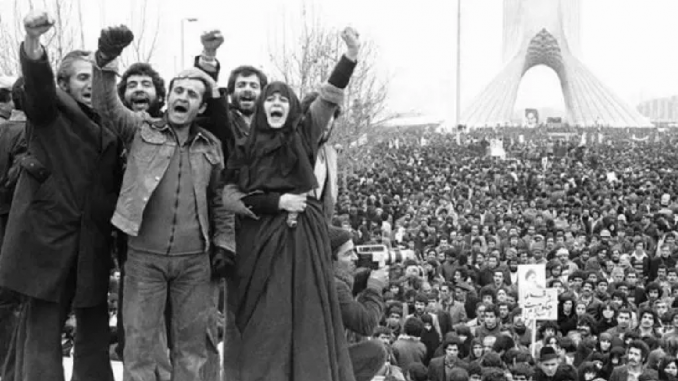
In 1978 the anger simmering under the surface of Iranian society burst into the open. Widespread protests erupted against the Shah. The protests involved a broad range of forces including workers, students, and the unemployed. The demonstrators were motivated by different perspectives, some left-wing, others religious, and many without any perspective other than hatred for the regime.
September 8, 1978: “Black Friday”
The Shah’s security forces killed hundreds of demonstrators in Tehran, beginning a long period of bloody repression. Wave after wave of demonstrators marched into the guns of the military without stopping until the soldiers themselves broke down, unwilling to kill their brothers and sisters to protect the regime. A revolution had begun.
1979: Iranian Revolution
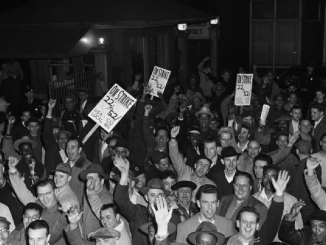
The army began to fraternize with the demonstrators. The Shah had lost control. Perhaps most important of all, the oil workers came out on strike, shaking the foundations of the regime’s economic power. Workers formed councils and some even proposed that the working class take over society. However, the Islamic revolutionaries, linked to small and medium-sized business owners, maneuvered their forces. They posed themselves as a moderate alternative to the Shah on the one hand, and they recruited poor and unemployed youth with a utopian religious message on the other. They used armed militias to suppress their opponents and put themselves at the head of the revolution. By April of 1979, the Islamic revolutionaries were able to proclaim the Islamic Republic of Iran under their leader, Ayatollah Ruhollah Khomeini.
1979 – 1981: Revolutionary Consolidation
From 1979-1981 the Islamic revolutionaries consolidated power. A brief period of democracy was gradually constrained as the Islamists created unelected Islamic institutions that put limits on the democratic input of the population. The Islamic Republic became more and more repressive, instituting strict morality laws including segregation of sexes, dress codes especially for women, and limits to freedom of speech and assembly. The liberal, socialist, communist, and feminist opponents of the regime were outlawed, imprisoned, and driven into exile. However, at the same time, the regime won support by taking control of the oil and using Iran’s wealth to develop the economy and provide some benefits to the population, especially the impoverished rural population which is the base of support for the regime to this day.
1980 – 1988: Iran-Iraq War
The regime of Saddam Hussein, next door in Iraq, feared the spread of revolution to its population, the majority of which follow the Shi’a branch of Islam. Shi’ism is the majority religious faith in Iran as well and is the ideological foundation of the Islamic Republic. From 1980 to 1988, Saddam Hussein received the support of the United States to invade and attempt to crush the Islamic Republic. This was a catastrophe which wreaked havoc on both countries. Half a million people were killed, and the populations of both Iraq and Iran were economically devastated.
1988: Mass Executions of Political Prisoners
In the wake of the Iran-Iraq war, the regime in Iran feared a resurgence of opposition. Thousands of left-wing activists in Iran’s jails were tried and executed in one of the bloodiest crackdowns on opposition in Iran until today.
1989 – 1997: Moderation, Privatization, and the new “Islamic Bourgeoisie”
During the 1990s, Iran recovered from the devastation of the Iran-Iraq war. The recovery led to a growth of inequality and the enrichment of a new layer of managers and owners linked to the regime. This new “Islamic bourgeoisie” privatized major industries, cut subsidies to the poor, and flaunted their wealth in front of the population.
1997 – 2009: Hope for Reform, Frustrated
In 1997, the regime began to loosen some of its restrictions, allowing more freedom to the middle class, loosening morality laws, and giving the population some breathing room, and even the hope of democratic reform. This period of openness came to a close in 2009. The presidential election that year posed the hard-line Islamist past against the democratic reformism of the present. Mass demonstrations of students threatened the regime and some workers began mobilizing through underground trade unions. The unelected Islamic leadership of the regime manipulated the election, ensured the victory of the hard-liners and smashed the opposition. Morality laws and repression were re-imposed and the regime tightened its control. This experience showed to many young Iranians that reform within the system via its limited democratic mechanisms would always run up against the limits set by the unelected Islamic institutions of the regime.
2009 – 2016: The Nuclear Question
During the second decade of the 21st century, the regime was heavily concerned with its economic isolation and the military challenge posed by the U.S. and its ally in the Middle East, Israel. The Islamic Republic had begun enriching uranium in the mid-2000s, building on the foundations of the nuclear program begun with U.S. and British assistance in 1957 under the Shah. Officially, the purpose of the nuclear program was to create power plants, but the same technology can be used to create nuclear weapons. This possibility became the source of conflict with the U.S. and other Western powers. Economic sanctions on Iran, begun in 1979 after the revolution, escalated under the pretext of discouraging Iran’s nuclear program. The U.S. regime of Barack Obama, elected in 2008, used sanctions as a bargaining chip to limit Iran’s nuclear program, eventually leading to the Joint Comprehensive Plan of Action in 2015, also known as the Iran nuclear deal. The deal promised to loosen sanctions in return for proof that Iran was reducing its nuclear program and limiting it to energy production.
2016 – 2019: The Trump Factor and Economic Instability
The Trump administration, for reasons of domestic political posturing more than any rational strategy, abandoned the international agreement with Iran. The Trump administration imposed tighter sanctions on the country at the same time that oil prices fell on the world market. From 2017 to 2019 Iran was shaken by economic protests as inflation made it nearly impossible for poor Iranians to survive. The protests began a cycle of revolt against the regime that continues to threaten it with resistance from below.
2022: “Woman, Life, Fraeedom” Movement
Protests erupted after the death of Mahsa Amini, a young Kurdish woman killed by the Islamic Republic’s morality police. This movement was a turning point as thousands of Iranians came out into the streets, not just demanding concessions from the regime but openly opposing it and calling for its downfall. Since 2022 the Iranian regime has had to contend, not only with challenges from imperialism, but also from a growing sentiment among the population that life under the Islamic Republic is intolerable and the only way forward is to overthrow it.
2023 – Present: Ongoing Crisis
In early 2026, economic protests once more erupted, alongside demands for the end of the Islamic republic. The demonstrations in Iran involved an estimated six percent of the population, the biggest social mobilization in Iran since the 1979 revolution. For good reason, the Islamic Republic’s rulers were terrified, and they met the movement with extreme violence. Somewhere between 15 and 30 thousand people were killed or disappeared. The movement failed to overturn the regime and was drowned in blood.
2026: Trump’s War
In March 2026, after a long period of military buildup, and supposed negotiations to re-institute an agreement around nuclear weapons, the Trump regime launched airstrikes on Iran in concert with Israel. Trump has openly declared war and called for regime change, posing his regime’s war-mongering aggression as aid to the Iranian population. The Supreme Leader Ali Khamenei, Iran’s unelected Islamic authority, was killed along with numerous other Iranian officials in the first day of the assault. While the Trump administration has made signals that it seeks to negotiate with a new Iranian leadership emerging from the old regime, this seems unlikely given the indiscriminate violence that has been unleashed. Some of the Iranian rulers the U.S. supposedly hoped to negotiate with have been killed in the bombardment. Whatever the strategy, or lack of strategy, on the part of the Trump administration, the logic of the situation is drawing the U.S. into a protracted war against the Iranian people, to impose a puppet regime, and once more place Iran under U.S. imperial domination. In the early days of this war, it has engaged about a dozen countries throughout the Middle East. However, the people of Iran, the U.S., and other countries whose lives and resources are being wasted may have the final say in what happens if we can stand up to the warmongers and death merchants in Washington and Israel.