Los Angeles Unified School District (LAUSD) teachers and staff will strike on April 14, unless the two unions representing 68,000 LAUSD employees reach an agreement with the school district. United Teachers Los Angeles, representing roughly 38,000 teachers, and SEIU Local 99, which represents more than 30,000 workers, such as cafeteria workers, bus drivers, and special education assistants, authorized a strike by 94% and 97%, respectively. Teachers and school staff will stand together in solidarity to win a better contract. When unionized workers unite in a contract fight, they often win higher compensation and better benefits.
LAUSD teachers and staff are asking for a 17% wage increase over the next couple of years, no layoffs, more student supports, smaller class sizes, more mental health workers, and protections from subcontracting. Does LAUSD’s contract fight sound familiar? If you are a Californian, you probably heard similar demands from your local teachers’ union this past year. That is because this 2025-2026 school year teachers’ unions across the state have been in contract negotiations, and many unions have been on strike. Let’s name a few: Placer County Association of Credentialed Teachers, South West Teachers Association of the South Bay, Mt. Diablo Education Association, Glendale Teacher Association, Miller Education Association, and Porterville Educators Association. All of these California local teacher unions went on strike this school year. None of these unions came together as California teachers unions to strike together.
The California Teachers Association, CTA, which is the state union for all these local unions, had originally proposed the We Can’t Wait Campaign with the idea that California local teacher unions would strike at the same time. Teachers and staff across California were invigorated by this campaign. Many veteran teachers who had participated in previous strikes for minimal wage increases that did not keep up with soaring inflation rates, were hesitant to strike again. However, the prospect of a handful of school districts across the state striking together promised to make more of an impact. Many school districts on strike at the same time could have shut down thousands of schools, affected hundreds of thousands of families, and impacted workforces as families juggled for childcare. A massive strike across the state may even have drawn the attention of the state government, as so many constituencies would have felt the toll of trying to work in a system that relies on schools as the only form of childcare.
Maybe then California’s state government would have seen and felt the importance of California educators and reconsidered the funding discrepancies of California’s public school systems. While California is the world’s 4th largest economy, California is only 16th in per student spending among states. Here are some quick numbers to put it in perspective: New York provides a public school with $33,437 a year per pupil, while California provides a mere $18,020. How can this be when California has some of the richest people in the world, and an economy that could function as its own nation? $18,020 is a mere 3.38% of a taxpayer’s income. The poor funding of California schools make the school districts appear as the bad guys, yet they are the mere henchmen of a bad state government that provides insufficient funding to its school districts. School districts have little control over how much state money they get, and are wary of committing to higher wages and benefits without knowing how they will pay for it.
A united educators strike across the state is not what happened. Instead thousands of California K-12 teachers walked off their jobs or voted to strike at different times of the school year. David Goldberg, president of the California Teachers Association, claims these strikes throughout the school year are part of a strategic, statewide effort by the union to boost salaries and benefits — and get the public’s attention.
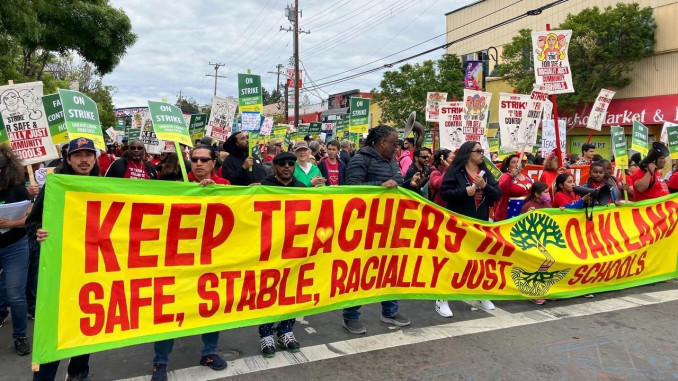
In some cases this has been true. Oakland Unified School District was able to narrowly avoid striking in February of this year. 90% of the district’s unionized workers had voted in the strike authorization, 98% of those members voted in favor of a strike. This strike mandate was a powerful weapon that the union bureaucrats were able to wield during heated last minute bargaining sessions between the union and the school district. Oakland Education Association, the teachers’ union, had been on strike twice in the last six years, which proved to the district and the wider community that the union was not bluffing, and that the workers would strike if the district did not come to the bargaining table with a legitimate contract offer. The union and district were able to come to an agreement and avoid a strike. Oakland unionized workers voted and approved the tentative agreement that provides more resources for workers and students, and includes an 11% salary increase over two years for all educators.
Neighboring school districts were not as victorious. Many school districts in California went on strike this 2025-2026 school year for multiple days to only “win” a salary increase of a few percentage points that does not keep up with soaring inflation rates. San Francisco Unified School District exemplifies this conundrum. San Francisco unionized teachers had not been on strike in decades, which put them at a disadvantage — it was uncertain for both workers and the bosses how far the strike was willing to go. In addition, San Francisco was one of the earliest school districts to go on strike in this California teacher strike wave of the last school year. The school districts who threatened to strike earlier in the school year had to strike and set a precedent for the districts that would threaten to strike later in the year.
The California teacher strike wave had great potential, but unfortunately the results were minimal and inequitable. School districts with striking and negotiating experience, such as Oakland Unified School District, were able to win more of their demands. School districts with little experience in striking were able to experience the power of a unified workers’ action, but the contract results were minimal. United teachers unions and school workers that strike together win much more — not just salary increases and a few extra resources — but massive numbers of unionized workers coming together can even make policy change, or overthrow a system. We cannot remain in our work silos, whether that’s a school, hospital, or office space. We the workers must unite in a larger fight to overthrow this capitalist system that oppresses us all each and every day.