January 3, 2026 article from the New Anticapitalist Party-Revolutionaries (NPA-R) in France, translated from French.
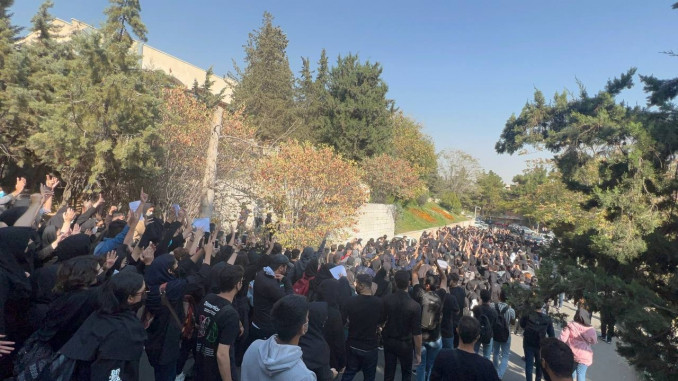
In recent days, massive protests have erupted in major Iranian cities. Tehran merchants were quickly joined by students and larger segments of the population in these protests, which were initially caused by the rising cost of living (a 250% increase in the price of bread!). Anger has gone beyond economic demands, with calls to overthrow the Islamic republic—despite repression that has already left more than seven people dead.
Rampant corruption, international sanctions, military defeat: the Islamic Republic is eroding from the bottom up
This crisis comes at a time when the mullahs’ regime is weakened. Three years after the “women, life, freedom” movement and a few months after the Israeli-American bombings, the morality police have notably loosened their grip on individual freedoms: women who refuse to wear the veil in public spaces are, for example, no longer harassed. But at the same time, the government has stepped up and accelerated political repression, targeting activists (in associations or trade unions) in particular in the name of the fight against “Israeli spies.”
Even today, the regime, struck by the force of the mobilization, seeks to divide it between the “legitimate” demands of shopkeepers (who constituted a significant part of its social base when the Islamic republic was established) and the rest of the protesters, who are denounced as “foreign agents.” Thus, in the early days of the protests, the government even tried to weaken the demonstrations by dismissing certain police officials and promising to work on measures to improve the “purchasing power” of the population. Unfortunately, the inertia of a corrupt regime led to some unfortunate setbacks: on December 31 (three days after the protests began), the government increased tolls by 30% on fifteen of the country’s highways!
The protests continued and spread throughout the country, with some storming places of power such as prefectures. The government imposed “holidays” for the entire population, closed schools and universities, and stepped up targeted repression by arresting trade unionists and students—sometimes preventing them from leaving their university dormitories. The regime sent its supporters or militiamen to attack the gatherings, and its police opened fire on the demonstrators, who sometimes responded by throwing stones.
Will the imperialists intervene?
The ongoing uprising could transform the Middle East, and the mullahs’ regime—like its opponents—is well aware of this. Israel and the United States are threatening further military intervention, under the pretext of “saving” the people of Iran by installing the son of the former Shah of Iran (Reza Pahlavi) in power. In reality, Trump and Netanyahu seem to be weighing the pros and cons. They dream of getting rid of the Iranian regime, weakened by the virtual disappearance of its “axis of resistance ” (Lebanese Hezbollah, Bashar al-Assad’s Syria, Yemeni Houthis), especially since military intervention would have the merit of burying any emancipatory popular uprising (and its associated risks) under piles of dead bodies and debris. But on the other hand, they do not want a confrontation with the mullahs (and their potential collapse) to spread chaos throughout the Middle East, which they have been violently reshaping for nearly three years.1
The need for an independent working-class and revolutionary policy
The struggling masses therefore face not only the risk of imperialist military interference, but also a political strengthening of monarchist and ultra-nationalist (including “fascist”) tendencies, which are playing a greater role in the current movement than in previous years—notably thanks to the political support of the imperialists, who some see as a lesser evil compared to dictatorship.
Will the growing intervention of the labor movement, which has demonstrated its fighting spirit in certain sectors (particularly refineries), be sufficient to bring about emancipatory political prospects for all workers and peoples of Iran?
Solidarity with the struggling masses of Iran! No to the intervention of the imperialist powers! No to the return of the Shah’s monarchy! Down with the Islamic Republic!
1 Ali Larijani, secretary of the Supreme National Security Council, has threatened Trump that “American intervention in this internal affair would be tantamount to spreading chaos throughout the region and destroying American interests.”